Sivananda Yoga
Peace Educator Training
300 Hour Yoga for Peace Program
Stories of Peace Pilgrimage – bearing witness with Swami Sitaramananda
The Sivananda Peace Education Training seeks to nurture peace educators and compassionate leaders who embody the timeless wisdom of Yoga and Vedanta while integrating the best insights of modern psychology, communication, and peace studies.
Through self-transformation, service, and spiritual awakening, participants are encouraged to become instruments of peace and contributors to the healing and well-being of humanity.
Promote holistic peace/conflict transformative practices and methods as an accessible way to wellbeing and peaceful development of individuals and society. Apply classical Yoga and Vedanta philosophy to address specific disharmonious conditions in a person, a family or a community.
Why Sivananda Peace Education Training?
Prompted by the confusion, anxiety, violence, and divisions of the world today, we revisited the wisdom of the great spiritual traditions and found timeless teachings that inspired the creation of the Sivananda Peace Education Training program.
Blessed are the peacemakers, for they shall be called children of God. — Matthew 5:9
Do not do to your fellow men what is painful to yourself. This is the whole Torah; the
rest is commentary. — Torah
The most covetable possession on earth, the greatest treasure in the entire universe,
is peace. Peace, to be lasting and constructive, must be achieved through God. — Swami Sivananda
If a kingdom be divided against itself, that kingdom cannot stand; and if a house be divided against itself, that house cannot stand. — Jesus the Christ
Peace is the happy, natural state of man. It is his birthright. War is his disgrace. — Swami Sivananda
Better indeed is knowledge than practice; better than knowledge is meditation; better than meditation is renunciation of the fruits of action. Peace immediately follows renunciation. — Bhagavad Gita XII.12

Gain tools and knowledge in areas such as:
• Causes of stress and their relationship to conflict.
• Learning the power of the subconscious mind.
• Application of Yoga and Ayurveda practices to promote a happy and peaceful lifestyle.
• The root causes of addiction, abuse, and harmful behaviors.
• Application of Vedic Counseling techniques for integral health and peace.
• Yogic perspectives on life’s purpose.
• Yoga of relationships.
• Theory of karma and dharma.
• Connection of body-mind and consciousness, Self
• Emotional management
• How to teach groups the methods of peaceful collective living, resource sharing, collective endeavor, and conflict resolution.
1-YEAR PROGRAM FORMAT
(300 hrs)
Three onsite immersive residential trainings of 7 days each
Distance learning, 2 hours weekly for 12 weeks
Practicum with individual cases
Practicum with groups
Module Dates
MODULE 1 • January 6–14, 2027
Yoga and the Mind, Methods and Steps to Inner Peace
MODULE 2 • May 5–13, 2027
Relational Peace and the Ethics of Oneness
MODULE 3 • July 3–11, 2027
Peace Applications: for a social and Universal Peace
MODULE 4 • July–September 2027
DISTANCE LEARNING ONLINE, 12 weeks
PEACE TECHNIQUES PRACTICUM
Applied knowledge and techniques to educate individuals and groups under the guidance of a mentor.
GRADUATION • December 2027
Module Schedule (7 days each)
- 6:00 – 8:00 – Peace Education Talk
- 8:00 – 10:00 – Asana Practice
- 10:00 – 12:00 – Brunch Break
- 12:00 – 1:30 – Peace Education Talk
- 1:30 – 3:00 – Break Time
- 3:00 – 5:00 – Group Discussion Practice
- 5:00 – 7:00 – Peace Education Talk
- 7:00 – 8:00 – Dinner Break
- 8:00 – 9:00 – Peace Education Talk
Faculty
Director of Program
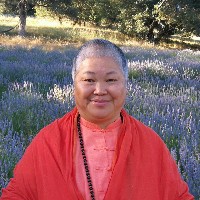 Swami Sitaramananda is a senior acharya of the International Sivananda Yoga Vedanta Centers (ISYVC) and is director of the Sivananda Ashram Yoga Farm in Grass Valley, California and the Sivananda Yoga Resort and Training Center in Dalat, Vietnam as well as more city centers in Ho Chi Minh, Dalat, Hanoi, and Tokyo, Japan. Swamiji is the acharya for Asia as well as the organizer and teacher of the Sivananda Yoga Health Educator Training (SYHET) program, an 800-hour program on yoga therapy, accredited by the International Association of Yoga Therapists (IAYT).
Advisory Board

Dr. Youssef Mahmoud
Peacebuilding
Youssef Mahmoud is a Tunisian diplomat, academic, and international peacebuilding expert with over three decades of experience in United Nations peace operations and policy reform. He is known for advancing a people-centered and preventive approach to peacebuilding, emphasizing sustainable peace through inclusion, local ownership, and institutional resilience.
During his UN career, Mahmoud served as United Nations Resident Coordinator and Humanitarian Coordinator in Cambodia and Guyana, and held senior leadership roles in peace operations, including Special Representative of the Secretary-General and Head of MINURCAT in Chad and the Central African Republic, as well as Executive Representative of the Secretary-General and Head of BINUB in Burundi. At UN Headquarters, he served as Director in the Department of Political Affairs and Head of the Office of the Under-Secretary-General for Political Affairs, contributing to global political strategy and conflict response.
He played a key role in major UN reform processes, including the High-Level Independent Panel on Peace Operations (HIPPO) and the global study on UN Security Council Resolution 1325 on Women, Peace and Security. In 2019, he led an independent strategic review of the UN peacekeeping mission in the Democratic Republic of the Congo (MONUSCO), focusing on improving effectiveness and alignment with local realities.
He currently serves as Senior Adviser Emeritus at the International Peace Institute in New York and Visiting Professor at the African Leadership Centre, King’s College London, where he supports research, mentoring, and leadership development in peacebuilding and governance.

Michael Nagler
Nonviolence
Michael N. Nagler is an American scholar, peace activist, meditation practitioner, and one of the leading contemporary teachers of nonviolence. He is Professor Emeritus of Classics and Comparative Literature at UC, Berkeley, where he co-founded the Peace and Conflict Studies Program in which he taught the immensely popular nonviolence course that was webcast in its entirety as well as PACS 90, “Meditation” and a sophomore seminar called “Why Are We Here? Great Writing on the Meaning of Life” for fifteen years.
For more than five decades, Nagler has dedicated his life to studying and teaching the philosophy and practice of nonviolence inspired by Mahatma Gandhi and Martin Luther King Jr. He is the founder and president of the Metta Center for Nonviolence, which promotes nonviolent education and social transformation.
He is the author of numerous influential books, including “The Search for a Nonviolent Future” (2001), which received a 2002 American Book Award and has been translated into Korean, Arabic, Italian, and other languages, “Our Spiritual Crisis: Recovering Human Wisdom in a Time of Violence” (2005) and “The Nonviolence Handbook” (2014); “The Third Harmony: Nonviolence and the New Story of Human Nature” (2020). “The Upanishads” (with Sri Eknath Easwaran, 1987), and other books as well as many articles on peace and spirituality. He is also the recipient of the 2007 Jamnalal Bajaj International Award for promoting Gandhian values outside India.

Gay Rosenblum-Kumar
Peacebuilding and conflict transformation
Gay Rosenblum-Kumar is a peacebuilding practitioner with thirty years’ experience designing and managing peacebuilding support projects with the UN and international NGOs. In the 1980s, she managed an anti-apartheid educational project for refugees and exiles from southern Africa; with the United Nations in the 1990s she co-founded and managed the UN’s DPPA/UNDP Joint Programme on Building National Capacities for Conflict Prevention establishing the UN’s first cadre of peace and development advisors (PDAs). Subsequently, Gay represented two peacebuilding INGOs at UNHQ in New York: Nonviolent Peaceforce which deploys unarmed civilian protection teams in conflict-affected countries and Peace Direct which strengthens and advocates for local peacebuilding partners working to mitigate violence and conflict.
Her passion and her work is to advocate for the principles and practices of nonviolent, locally-led peacebuilding and to strengthen the visibility and work of local peacebuilders working to mitigate violence and conflict in Palestine.

Dr. Debashish Banerji
Peace & Scriptures
Dr. Debashish Banerji is a scholar of Integral Yoga, Indian philosophy, psychology, and art history. He currently serves as the Haridas Chaudhuri Professor of Indian Philosophies and Culture and Doshi Professor of Asian Art at the California Institute of Integral Studies (CIIS), San Francisco, where he is also associated with the East-West Psychology Department.
Through his extensive writings and lectures, he bridges ancient wisdom and modern thought, revealing how the teachings of the Bhagavad Gita, the Upanishads, and other spiritual traditions offer profound insights into human unity and spiritual evolution. His work has contributed significantly to the dialogue between Eastern wisdom and contemporary approaches to education, culture, and global transformation.

Dr. Fred Luskin
Forgiveness & Peace
Dr. Fred Luskin is a psychologist, author, and educator specializing in forgiveness research, positive psychology, and stress reduction. He is a Senior Consultant in Health Promotion at Stanford University and the Director of the Stanford Forgiveness Projects, where he has developed evidence-based programs on forgiveness, emotional healing, and resilience. His work integrates psychological science with practical tools that help individuals reduce suffering, release resentment, and cultivate inner peace.
He is the author of “Forgive for Good” and “Forgive for Love Has No Limits”, in which he presents forgiveness as a learnable skill that supports emotional wellbeing, healthier relationships, and reduced stress. Through workshops, lectures, and training programs delivered internationally, Dr. Luskin teaches practical methods for transforming emotional patterns and developing compassion, gratitude, and psychological flexibility. His approach bridges clinical psychology with contemplative and mindfulness-based practices, making his work widely used in wellness, education, and peacebuilding contexts. He is also on the faculty of SYHET – Sivananda Yoga Health Educator Training.

Dr RamKumar
Ayurveda for peace
Dr. Ramkumar is an experienced Ayurvedic physician and one of the founding visionaries and Medical Directors of Vaidyagrama Ayurveda Healing Village in Coimbatore, India. He is part of a group of traditional Vaidyas dedicated to reviving authentic Ayurveda through a living, eco-conscious, and spiritually rooted healing model.
Vaidyagrama is widely recognized as a “living Ayurveda village,” designed to integrate classical Ayurvedic medicine, sustainable living, ecological responsibility, and spiritual practice into a unified healing environment. Within this system, Dr. Ramkumar contributes to both clinical leadership and philosophical direction, emphasizing Ayurveda not only as a medical system but as a way of life aligned with nature, dharma, and holistic well-being.
His teaching emphasizes the eternal Ayurvedic vision that true healing arises when the individual is restored to equilibrium on all levels—physical, mental, environmental, and spiritual. Through his lectures, training programs, and international workshops, he shares this wisdom with students and practitioners across the Americas, Africa, Europe, Australia, and Asia, inspiring a deeper understanding of health as happiness, contentment, and inner harmony, and life itself as a sacred journey toward wholeness.

Silvia Nakkach, MA, MMT (Saraswati Devi)
Psychologist & Nada Yoga Teacher
Silvia Nakkach, MA, MMT (Saraswati Devi), is a Grammy-nominated musician and a renowned vocal artist. She is a former clinical psychologist, an author, a world-wide sound and music educator, and a Nada Yoga scholar and yogini. She is a pioneer in the field of sound and music therapies, and an academic consultant and the creator of many certificate programs on Sound, Voice, and Music in the Healing Arts across the world. A leading voice in the field of music in consciousness and shamanic practices. She has released 16 CD-Albums. She is the director and founder of the international Vox Mundi School of the Voice, and among other books, Silvithe author of Free Your Voice. voxmundiproject.com
Peacebuilding
Gay Rosenblum-Kumar
Peacebuilding and conflict transformation
Gay Rosenblum-Kumar is a peacebuilding practitioner with thirty years’ experience designing and managing peacebuilding support projects with the UN and international NGOs. In the 1980s, she managed an anti-apartheid educational project for refugees and exiles from southern Africa; with the United Nations in the 1990s she co-founded and managed the UN’s DPPA/UNDP Joint Programme on Building National Capacities for Conflict Prevention establishing the UN’s first cadre of peace and development advisors (PDAs). Subsequently, Gay represented two peacebuilding INGOs at UNHQ in New York: Nonviolent Peaceforce which deploys unarmed civilian protection teams in conflict-affected countries and Peace Direct which strengthens and advocates for local peacebuilding partners working to mitigate violence and conflict.
Her passion and her work is to advocate for the principles and practices of nonviolent, locally-led peacebuilding and to strengthen the visibility and work of local peacebuilders working to mitigate violence and conflict in Palestine.
Vedanta Philosophy

Swami Sitaramananda
Peace Psychology; Unity in Diversity
Acharya of the West Coast (USA) and of Vietnam, Japan, China, and Taiwan
Swami Sitaramananda is a senior teacher in the International Sivananda Yoga Vedanta Centres and a direct disciple of Swami Vishnudevananda. Originally from Vietnam, she studied and worked in Canada before joining the Sivananda organization in the early 1980s. She received sannyasa initiation in 1985 in the Saraswati order and was later appointed as an acharya. She is currently Acharya for the USA West Coast and East and Southeast Asia.
She has taught yoga, meditation, and Vedanta philosophy for more than 40 years. Her teaching work has included Yoga Teacher Training Courses, meditation retreats, and study programs in North America, Europe, India, and Asia. Swami Sitaramananda has served for many years as director of the Sivananda Ashram Yoga Farm in California and has led the development of Sivananda Yoga Ashram & Centers in Vietnam and other parts of Asia. Since 2015, she has been a member of the Executive Board of the International Sivananda Yoga Vedanta Centres. She is based between the Yoga Farm in California and the Sivananda Yoga Resort and Training Center in Vietnam.
She is the founder and principal teacher of the Sivananda Yoga Health Educator Training (SYHET), a yoga therapy training program accredited by the International Association of Yoga Therapists.
She is the author of many books translated into many languages: “Essentials of Yoga Practice and Philosophy”, “Learning Selfless Love”, “The answer lies within”, “Guru’s Grace”, “Karma Yoga Manual”, “Positive Thinking Manual”, “Meditation Manual”, “Sadhana for Self Healing” ,”Wisdom from the Self – 71 quotes cards”.

Swami Sankarananda
Peace Pilgrim & Self-Knowledge
Swami Sankarananda is a simple pilgrim. Driven by a longing for something real and enduring, he left behind his former self-centered life and traveled to India. Following Divine guidance, he returned in 2013 and embarked on a pilgrimage of more than 7,000 miles, including a coast-to-coast crossing of the United States, which he completed in early 2016. Carrying no money and relying entirely on faith and grace, Swami Sankarananda discovered beyond a shadow of doubt that peace is here and now—not something to be found in the external world, but the very nature of our own Self.
Walking in the footsteps of Peace Pilgrim and grounded in the lineage of Swami Sivananda, Swamiji’s teachings are not about adhering to rigid dogma, but about actionable steps you can take—right now—to transform stress into equanimity and fear into faith. Swami Sankarananda founded the Divine Grace Yoga to help guide all he encounters toward real and lasting peace. Through satsangs, workshops, and “Be Still and Know” silent retreats, he shares the practical application of Yoga in daily living, offering tools to help quiet the mental chatter and touch the profound stillness that resides at the core.
Dr. Debashish Banerji
Peace & Scriptures
Dr. Debashish Banerji is a scholar of Integral Yoga, Indian philosophy, psychology, and art history. He currently serves as the Haridas Chaudhuri Professor of Indian Philosophies and Culture and Doshi Professor of Asian Art at the California Institute of Integral Studies (CIIS), San Francisco, where he is also associated with the East-West Psychology Department.
Through his extensive writings and lectures, he bridges ancient wisdom and modern thought, revealing how the teachings of the Bhagavad Gita, the Upanishads, and other spiritual traditions offer profound insights into human unity and spiritual evolution. His work has contributed significantly to the dialogue between Eastern wisdom and contemporary approaches to education, culture, and global transformation.
Psychology, Stress & Trauma
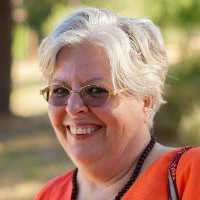
Swami Jnaneswariananda
Stress Resilience & Yoga
Swami Jnaneswariananda is the current Acharya of Sivananda Ashram Yoga Ranch in Woodbourne, New York & of Sivananda Yoga Vedanta Center New York. She is senior teacher of Sivananda Yoga Vedanta Center since 1995. She has been director of centers and ashrams in Canada and Italy. She teaches Hatha Yoga, Meditation, Anatomy and Vedanta at the Teacher Training Courses in North America, Italy and India. Swami Jnaneswariananda took the vows of Sannyas in 2001. Her understanding of the impact of stress and methods for building stress resilience is brilliant.

Swami Sivasankariananda
Pain & Grief psychology
Swami Sivasankariananda is the current director of the Los Angeles Sivananda Yoga Vedanta Center and is a member of the Board of Sivananda Yoga Vedanta Center California. She completed her TTC at the Yoga Farm in 1997 and ATTC there in 2008. Swamiji has been on yatra in north and south India and Mount Kailas. She loves to teach and is particularly fond of the Bhakti Yoga practices. She took sannyas in 2017 and is a certified yoga therapist, specializing in chronic pain care. She is on the faculty of the Sivananda Institute of Health & Yoga (SIHY) and a teacher in the Sivananda Yoga Health Educator Training program. She served as director of the San Francisco Center from 2015 to 2019.
Dr. Fred Luskin
Forgiveness & Peace
Dr. Fred Luskin is a psychologist, author, and educator specializing in forgiveness research, positive psychology, and stress reduction. He is a Senior Consultant in Health Promotion at Stanford University and the Director of the Stanford Forgiveness Projects, where he has developed evidence-based programs on forgiveness, emotional healing, and resilience. His work integrates psychological science with practical tools that help individuals reduce suffering, release resentment, and cultivate inner peace.
He is the author of “Forgive for Good” and “Forgive for Love Has No Limits”, in which he presents forgiveness as a learnable skill that supports emotional wellbeing, healthier relationships, and reduced stress. Through workshops, lectures, and training programs delivered internationally, Dr. Luskin teaches practical methods for transforming emotional patterns and developing compassion, gratitude, and psychological flexibility. His approach bridges clinical psychology with contemplative and mindfulness-based practices, making his work widely used in wellness, education, and peacebuilding contexts. He is also on the faculty of SYHET – Sivananda Yoga Health Educator Training.

Sarah Joy Marsh
Nervous System Regulation & Interpersonal Neurobiology
Sarahjoy Marsh, MA, E-RYT 500, C-IAYT is a yoga teacher, yoga therapist, and author with extensive training in yoga, counseling psychology, and interpersonal neurobiology. With over 30 years of yogic study and 25+ years of teaching experience, she integrates classical yoga with Western psychology, mental health counseling, neuroscience, kinesiology, and body-based therapeutic approaches.
She is the founder of Amrita Yoga, a therapeutic vinyasa system that combines yoga philosophy, Ayurveda, pranayama, mindfulness, physical therapy principles, and modern neuroscience. Sarahjoy has developed comprehensive training programs including 200-hour, 300-hour, and 800-hour yoga therapy certifications, and pioneered the first Yoga Alliance–certified teacher training program conducted in a U.S. prison.
She is the founder of Living Yoga and the DAYA Foundation, organizations dedicated to bringing trauma-informed yoga, mindfulness, and recovery tools into prisons and underserved communities, as well as supporting individuals affected by addiction, trauma, chronic illness, and mental health challenges. Through her Yoga for Recovery methodology (presented in her book Hunger, Hope & Healing), she supports people in restoring self-worth, stability, and the capacity to thrive.

Lila Lolling
Sacred Ecology & Neuroscience
Lila Lolling is a Certified Yoga Therapist, 800-hour certification accredited by the International Association of Yoga Therapy (IAYT). E-RYT500 – Senior Sivananda Yoga Teacher, and Continuing Education Provider YACEP. She is on the faculty of Sivananda Yoga Health Educator Training. Founder of the DeafYoga Foundation and a speaker at the United Nations International Day of Yoga on the theme of Yoga for Peace, Lila has dedicated her life to making yoga accessible and relevant to modern seekers. She is author of “Walking the Ancient Path of Yoga”, a training manual for YTT’s.
Her teachings emphasize the sacred relationship between human consciousness and the natural world, inviting students to rediscover reverence, interconnectedness, and ecological responsibility. Through the lens of yoga philosophy and emerging insights into mind-body integration, she guides individuals toward greater harmony with themselves, their communities, and the living Earth. She invites students to experience nature not as separate from human life, but as an extension of it, fostering ecological sensitivity and inner awareness. Her work integrates scientific understanding with contemplative inquiry, encouraging a more holistic perception of life.
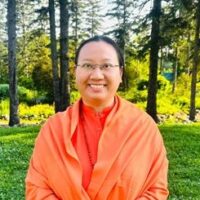
Swami Divyananda
Yoga Psychology
Swami Divyananda is a yoga teacher hailed from Vietnam and sannyasin in the Sivananda tradition. She started practicing yoga at the age of 20 and completed her TTC in 2016, SYHET in 2020, and ATTC in 2022. She has also completed five Sadhana Intensive courses, deepening her practice.
Ayurveda & Health
Dr RamKumar
Ayurveda for peace
Dr. Ramkumar is an experienced Ayurvedic physician and one of the founding visionaries and Medical Directors of Vaidyagrama Ayurveda Healing Village in Coimbatore, India. He is part of a group of traditional Vaidyas dedicated to reviving authentic Ayurveda through a living, eco-conscious, and spiritually rooted healing model.
Vaidyagrama is widely recognized as a “living Ayurveda village,” designed to integrate classical Ayurvedic medicine, sustainable living, ecological responsibility, and spiritual practice into a unified healing environment. Within this system, Dr. Ramkumar contributes to both clinical leadership and philosophical direction, emphasizing Ayurveda not only as a medical system but as a way of life aligned with nature, dharma, and holistic well-being.
His teaching emphasizes the eternal Ayurvedic vision that true healing arises when the individual is restored to equilibrium on all levels—physical, mental, environmental, and spiritual. Through his lectures, training programs, and international workshops, he shares this wisdom with students and practitioners across the Americas, Africa, Europe, Australia, and Asia, inspiring a deeper understanding of health as happiness, contentment, and inner harmony, and life itself as a sacred journey toward wholeness.

Mary Thompson (MahaVidya)
Ayurveda for peace
Mary Thompson is a world-class Ayurvedic teacher, practitioner, and mentor, recognized as one of the early pioneers of Ayurveda education in the United States. With over two decades of teaching experience, she is known for her heart-centered approach in guiding students and practitioners worldwide as they step into their professional paths in Ayurveda. She is an Ayurvedic Practitioner, Certified Clinical Ayurvedic Specialist, and Panchakarma Specialist, and serves as a senior teacher at the California College of Ayurveda, from which she graduated in 1997 as part of its first graduating class. She is also a founding board member and former Secretary of the California Association of Ayurvedic Medicine (CAAM). She is also part of the faculty of SYHET, since its inception for 10 years.
Mary further expanded her clinical and philosophical foundation through studies in India at the International Academy of Ayurveda in 1999, where she engaged in experiential learning across Ayurvedic schools, clinics, and hospitals. In recognition of her contribution to Ayurvedic education, she received the Charaka Award for Excellence in Teaching in 2008 and was honored with the title “Ayurvedacharya.” Today, she continues to teach internationally, supporting students with compassion and clarity, and transmitting Ayurveda as a practical and transformative path of balance, healing, and conscious living.
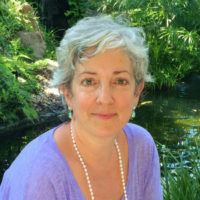
Durga Leela
Yoga of Recovery
Durga Leela is an internationally recognized yoga therapist, educator, and founder of the Yoga of Recovery approach. Durga Leela holds the RYT-500 qualification, having completed both the Sivananda Yoga Teachers Training Course and the Advanced Yoga Training. Durga is a Clinical Ayurvedic and Pancha Karma Specialist, trained both in the US (at CCA) and India and serves as the Director of the Ayurveda Programs at the Yoga Farm in California, since 2003 and she is on the faculty of Sivananda Yoga Health Educator Training – SYHET.
Durga Leela is author of the book: “Yoga of Recovery: Integrating Yoga & Ayurveda with modern recovery tools for addiction. Yoga of Recovery is a comprehensive program that integrates Ayurveda and Yoga with recovery tools for a holistic mind, body and spirit approach for all those affected by addiction and self-destructive behaviors. It is currently offered as workshops, retreats and certificate courses in the US and internationally

Om Prakash
Ayurveda for peace
Dr. OmPrakash is an Ayurvedic physician from Thanjavur, South India, who graduated from Coimbatore Ayurveda College in 2009. He further specialized in Clinical Orientation at FRLHT, Bengaluru, and studied Sanskrit at Sanskrita Bharati, Tamil Nadu. After seven years of clinical practice at Vaidyagrama Ayurveda and serving as Assistant Medical Officer at an Ayurveda Dispensary near Kanyakumari, he returned to Vaidyagrama in 2023 as a physician and faculty member. His heart beats for the healing power of herbs, as evidenced by his extensive field surveys and studies around Kanyakumari from 2016 to 2023. Beyond his professional pursuits, Dr. OmPrakash finds solace and rejuvenation in the embrace of nature. He is an avid nature walker and a passionate advocate of forest bathing, recognizing the profound impact of nature on holistic well-being. Dr. OmPrakash is a maestro when it comes to Skin and Allergy specialties, bringing a unique blend of expertise and compassion to every patient.
Communication

Swami Narayanananda
Compassionate listening & non-violence communication
Swami Narayanananda is a senior teacher in the International Sivananda Yoga Vedanta Centres. Born in London, England, he joined the Sivananda organization in 1999.
He received sannyasa initiation in 2009 in the Saraswati order. His teaching includes Hatha Yoga, pranayama, meditation, Vedanta philosophy, chanting, and classical yoga scriptures. He also teaches communication skills informed by Nonviolent Communication. He has served in several Sivananda centers and ashrams in North America, including the Sivananda Ashram Yoga Farm in California, the Sivananda Ashram Yoga Ranch in the Catskills, New York, the Sivananda Yoga Vedanta Center in New York City, and the Chicago Sivananda Yoga Center. Since its establishment in 2017, Swami Narayanananda has served as director of the Sivananda Yoga Resort and Training Center in Vietnam. He regularly teaches in Sivananda Yoga Teacher Training Courses in Vietnam and has also taught in courses in China, while also teaching programs in South Korea and Japan.

Di Strachan
Leadership Training
Di Strachan is the award-winning consultant, coach and trainer and the owner and director of Positive Futures, and one of the guides for the 2021 Women’s Leadership Circles! She strengthens businesses, organizations, communities, and individuals through effective communication, visionary planning, leadership coaching, and training. She leads collaboratively to build sustainable resources, economies, and positive futures. For the past 25 years, Di has provided county, state, and national workshops, along with marketing and development services. She has helped people to lead more effectively in their own lives and for others. Her realms of expertise include; leadership development, stewardship and resource management, marketing, meeting facilitation, management training, communications, and strategic media relations.

Jessica Mariglio
Conflict Resolution
Jess Mariglio is an educator and facilitator devoted to conflict transformation, restorative practices, and conscious communication. Before becoming a psychotherapist, she was working in environmental conflict resolution and international peacebuilding. Jessica received her Master’s degree in Clinical Psychology with an emphasis in Marriage and Family Therapy from Pepperdine University. Her unique approach integrates narrative therapy with EMDR and mindfulness with the intention of helping clients to reclaim their freedom from unwelcome effects of trauma and step into a way of being that feels alive and vibrant.
Hatha Yoga for Peace

Swami Adiparashaktiananda
Hatha Yoga for Peace
Swami Adiparashaktiananda took sannyas in 2017. He is a dedicated sadhaka, practitioner, and teacher. He graduated from Sivananda Yoga Teacher Training Course (TTC) in 2009 at the Sivananda Yoga Farm in Grass Valley, CA. He is the current assistant director of Sivananda Ashram Yoga Farm and leads daily meditation & satsang when he is at the ashram. He has been traveling yearly to Vietnam as Swami Sitaramananda’s assistant and has been teaching the Hatha Yoga classes for the TTC. He has also been traveling to China and Japan to help spread classical yoga knowledge. As a firm believer in the therapeutic benefits of yoga asana, pranayama, and meditation, Swami Adiparashakti is a calm Peace teacher & radiates joy and enthusiasm. He teaches a number of courses including Pranayama Intensive, Hatha Yoga Sadhana, Bhagavad Gita, and Sadhana Intensive. At the Yoga Farm he helps to maintain the garden, the orchard and the grounds as well as the website and marketing.

Swami Padmananda
Stress & Hatha Yoga
Assistant Director of the Sivananda Yoga Resort & Training Center, Đà Lạt, Vietnam. A devoted yogini with more than 10 years of yoga practice and teaching experience. She teaches at Sivananda Teacher Training Courses in Vietnam.
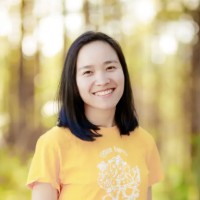
Yogini Saraswati
Therapeutic Counseling
A devoted yogini with more than 16 years of yoga practice and teaching experience. She is Director of the Sivananda Yoga Vedanta Center, Ho Chi Minh City, Vietnam and also on the Faculty of Sivananda Yoga Health Educator Training.
Justice & Mediation

Jennifer D. Rhodes
Attorney - Mediation
Jennifer D. Rhodes earned her Juris Doctorate from Stanford Law School, where she focused on Litigation, Negotiation, and Mediation. Ms. Rhodes also holds a Bachelor of Arts in Psychology and Communication from the University of California at Berkeley. Ms. Rhodes brings to her practice experience with complex matters involving business, technology, intellectual property and development. Ms. Rhodes is also a graduate of the Harvard Law School program on Mediation and Negotiation. Ms. Rhodes founded Rhodes & Co. in 2008, where she represents high-net-worth clients in complex civil and family matters. She also serves as a Mediator, Private Judge and Settlement Officer.
Vulnerable groups

Chanda Hilton
Accessible Yoga
Chanda Hinton is an advocate and educator specializing in accessible and adaptive yoga for individuals of all abilities. Her work is deeply rooted in inclusivity, compassion, and the belief that yoga is a universal practice that can be adapted to every body and every condition. Drawing from her own lived experience with disability, she has become a leading voice in creating safe, empowering, and trauma-sensitive yoga environments. She trains teachers and communities to understand movement, breath, and awareness in ways that honor individual needs. Her teaching reflects the essence of yoga as union—removing barriers between body, mind, and spirit—and opening pathways for dignity, self-acceptance, and embodied well-being.

Bidyut Bose
Youth Peace Education
Bidyut “B.K.” Bose, PhD, is founder and executive director of Niroga Institute, a nonprofit organization that brings Transformative Life Skills—yoga, breathing techniques, and meditation—to students, vulnerable youth, cancer survivors, seniors, and people battling addiction.
Bidyut “B.K.” Bose earned a doctorate degree in computer science from University of California, Berkeley, and spent many years in research and development in Silicon Valley. He has multiple patents to his credit, and has presented at international conferences and at universities around the world. As a child, he learned yoga and meditation from his father, and later studied with monks in the Himalayas. Inspired by the twin ideals of self-realization and selfless service, he founded Niroga Institute in 2005, and his research interests are now centered on the scientific application of Transformative Life Skills and developing cost-effective architectures for lasting social transformation.

Tara Durga Devi
Gentle Yoga & Respect towards seniors
Tara Durga Devi is a senior Sivananda Yoga Educator and advocate for conscious aging, dignity, and intergenerational respect. She has been teaching yoga and meditation for 40 years and was co-founder and owner of The Yoga Center, an affiliated Sivananda Yoga center in Stockton, CA. She has been trained in Yoga Therapy and is a graduate of the Sivananda Yoga Teachers Training Course (TTC) and Advanced Yoga Teachers Training Course (ATTC); and Tara Durga Devi is one of the rare yoga teachers trained by Swami Vishnudevananda, with whom she took TTC in 1976. And she is also a member of the SYHET faculty.
Her work addresses issues of age-related prejudice and highlights the importance of honoring wisdom, life experience, and the evolving stages of human development. She encourages greater awareness of how society views aging and promotes a more compassionate and respectful approach toward older adults.

Father Gregory Joseph Boyle
Accessible Yoga
Father Gregory Joseph Boyle, S.J. is an American Jesuit priest and the visionary founder of Homeboy Industries, the world’s largest and most successful gang-intervention, rehabilitation, and re-entry program. Over four decades, his radical approach to compassion and community transformation has redefined juvenile justice and social re-integration globally.
Fr. Boyle taught at Loyola High School and worked with Christian Base Communities in Cochabamba, Bolivia. In 1986 he was appointed as Pastor of Dolores Mission in the Boyle Heights neighborhood of Los Angeles, he served as pastor through 1992. During 1993, he was the Chaplain of the Islas Marias Penal Colony in Mexico and Folsom Prison, before returning to Los Angeles and Dolores Mission. The year 2009 was the 25th anniversary of Father Greg’s ordination as a priest.
Homeboy Industries traces its roots back to 1988 when in an effort to address the escalating problems and unmet needs of gang-involved youth, Fr. Greg and many community members developed positive alternatives, including establishing an elementary school, a day care program and finding legitimate employment for young people.
Executive Director of Homeboy Industries and an acknowledged expert on gangs and intervention approaches, Fr. Boyle is an internationally renowned speaker. He has given commencement addresses at numerous universities, as well as spoken at conferences for teachers, social workers, criminal justice workers and others about the importance of adult attention, guidance and unconditional love in preventing youth from joining gangs. Fr. Greg and several “homies” were featured speakers at the White House Conference on Youth in 2005 at the personal invitation of Mrs. George Bush. In 1998 he was a member of the 10-person California delegation to President Clinton’s Summit on Children in Philadelphia. Fr. Greg is also a consultant to youth service and governmental agencies, policy-makers and employers. Fr. Boyle serves as a member of the National Gang Center Advisory Board (U.S. Department of Justice, Office of Juvenile Justice and Delinquency Prevention). He is also a member of the Advisory Board for the Loyola Law School Center for Juvenile Law and Policy in Los Angeles. Previously, he held an appointment to the California Commission on Juvenile Justice, Crime and Delinquency Prevention.
Interfaith

Srinivasan (Mark Ashley)
Interfaith Minister - Yoga for peace
Srinivasan (Mark Ashley) has been a dedicated practitioner and educator in the yoga tradition since 1978. A direct disciple of Swami Vishnudevananda, he has served as a senior Sivananda Yoga Vedanta teacher and has been a lead Yoga Teacher Trainer since 1982, instructing on all aspects of the yogic path.
Srinivasan brings both practical and scholarly insight into the Hindu scriptures, with a particular focus on the Bhagavad Gita and the Yoga Sutras of Patanjali. His teaching expertise spans the full breadth of the tradition, including:
● Philosophy & Practice: Vedanta, Raja Yoga psychology, and meditation.
● Ethics in Action: The application of Karma Yoga in modern life.
● Devotional Path: The practice of Bhakti Yoga and its parallels in other traditions.
Srinivasan’s unique perspective is rooted in a life of “lived pluralism.” He is an Interfaith Minister trained under Rabbi Gelberman and is an active member of the United Methodist Church. By integrating his identity as a Christian practitioner with his profound roots in the Sivananda lineage, he offers seminary students a rare and seasoned perspective on interfaith dialogue, spiritual discipline, and the universal search for Truth.

Stephen Long Fellow Fiske
Interfaith - nonviolence
Stephen Longfellow Fiske is an American musician, author, poet, and interfaith minister with extensive experience in peace education and nonviolent activism. He is the founder of the Jerusalem Prayer Project, an international initiative that uses music, film, and interfaith dialogue to promote reconciliation, understanding, and cooperation across religious and cultural divides, particularly in contexts of conflict. Fiske is the author of The Art of Peace: A Personal Manual on Peacemaking and Creativity and The Call to Interfaith, in which he explores sacred activism, emphasizing the integration of inner transformation, creativity, and spiritual practice as the foundation for social engagement and peacebuilding. As a performer and educator, he has collaborated with numerous peace, environmental, and interfaith organizations, combining music, storytelling, and contemplative practice as educational tools. His work consistently highlights nonviolence, interfaith unity, social responsibility, and the role of inner development as the basis for sustainable peace.

Rabbi Lynn
Interfaith
Lynn Gottlieb is one of the first women to become a rabbi in Jewish history and has served in that role for over fifty years. She is a pioneer Jewish feminist, an author, visual artist, ceremonialist and master storyteller. She co-founded Congregation Nahalat Shalom in Albuquerque, NM in 1981 and serves as rabbi emeritus. Currently, Rabbi Lynn directs Shomeret Shalom Ordination program for Jewish Revolutionary Nonviolence and serves on the board of Interfaith Movement for Human Integrity and on the rabbinic council of Jewish Voice for Peace. Her activism includes a lifetime of Palestinian solidarity, as well as work on immigrant rights, abolition, repatriation of Indigenous land, prevention of gender violence, disability access and support for Muslim communities. Her latest theater piece is Storyteller on Sacred Ground, and her latest books include Shomeret Shalom: Replanting Seeds of Jewish Revolutionary Nonviolence (2024) and As We Speak These Words: Poem, Prayers and Art for a Liberated World with Rabbi Brant Rosen to be published this winter. She lives in Berkeley, CA near her beloved family.

Rev. Jere Farrell
Interfaith
In 2005, Rev. Jere Farrell stepped into leadership as our senior minister. With a background as a Catholic priest, Rev. Jere brought a deep sense of reverence, wisdom, and compassion to the community. His journey from traditional ministry to Unity’s inclusive, practical spirituality resonated with many and helped the congregation grow in both size and spiritual depth. Under his guidance, Unity in the Gold Country became known as a place where everyone—regardless of age, background, or belief—could feel seen, valued, and inspired.
Rev. Jere retired in 2024, leaving a lasting legacy of faith and unity. He now serves as Minister Emeritus, continuing to hold a special place in the heart of the community.
Today, Rev. Anand Anma leads Unity in the Gold Country into its next chapter. With a passion for inclusivity, youth and family programs, and community engagement, Rev. Anand carries forward the spirit of our founders while embracing the evolving needs of our growing congregation.
As we honor our past, we remain grounded in the timeless principles of Unity—love, oneness, and the sacred presence of the divine within and around us. We invite you to join us as we continue this beautiful journey together.

Ramana
Mantras & Kirtan, music
Ramana Erickson has taught Kirtan, Sanskrit and Yoga philosophy courses for more than thirty years in the United States, India, and Japan.
Born in the U.S., Ramana first started practicing yoga and singing kirtan at the ripe old age of 10 under the tutelage of Swami Vishnudevananda at the Sivananda Ashram Vrindavan Yoga Farm in Grass Valley, California. At 13, Ramana became the youngest hatha yoga student to graduate from the Sivananda Yoga teacher training course, taught by Swami Vishnudevananda himself. Ramana’s mother, Swami Shraddhananda, served as one of the first directors of the Yoga Farm.
In 1976, Ramana and family moved to Swami Muktananda’s ashram in Ganeshpuri India. It was here that Ramana spent his high school years, and where he practiced all aspects of kirtan music: singing, tabla, harmonium, hand cymbals, and other percussion instruments. He also immersed himself in the study of Sanskrit, Yoga Sutras, Vedic chanting, Vedanta, Kashmir Shaivism, Vedic puja, and Yoga, and was guided in his studies by Swami Tejomayananda, a Sanskrit and Vedanta scholar and early close disciple of Swami Muktananda.
In 1988, Ramana met Mata Amritanandamayi (Amma) and stayed in her ashram, in Kerala, South India. He has now been her devotee for more than 40 years.
Ramana continues to teach Kirtan, Sanskrit and Yoga philosophy at Yoga studios, Ayurvedic schools, and other spiritual institutions throughout the Bay Area.
He has played tablas for many Western Kirtan artists such as Krishna Das, Jai Uttal, Jahnavi Harrison, Mangalananda, and many others.
TUITION
– Normal Tution: $3600 plus Accommodations
– Early bird 1: register by Aug 15: $3000 plus Accommodations
– Early bird 2 – register by Oct 15: $3300 plus Accommodations
3 Modules. Each module is 8 nights.
Accommodations cost per module:
– Shared dorm – $500
– Om Single – $750
– Siva Single – $1000
– Shanti Single – $1500
Module 1: Yoga Life and Peace Educator
January 6 – 14, 2027 (initiation is at 5pm on Jan 6th) (graduation is at 8pm on Jan 13th)
Module Overview
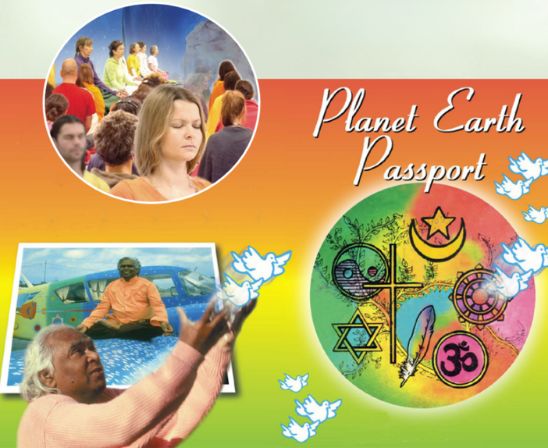
Peace begins within. This foundational module introduces the principles and lifestyle of Yoga as a holistic path to inner harmony and social transformation. Drawing on the teachings of Swami Sivananda and the classical synthesis of Yoga, students explore how peace can be cultivated through right living, self-awareness, relaxation, and the intelligent management of life-force (prana). This course also draw inspiration from the peace organization of Swami Vishnudevanandaji (TWO) and his peace flight in 1970s.
Participants will examine the role of the Peace Educator as both a leader and a healer, and reflect on the relationship between personal well-being and collective peace. Through practical tools for stress resilience, relaxation, and environmental awareness, this module provides a strong basis for developing a peaceful, balanced, and service-oriented life.
Learning Themes
- The synthesis of Yoga (4 paths: Karma Yoga, Bhakti Yoga, Raja Yoga, Jnana Yoga) as a path to peace
- The Five Points of Yoga Life for physical, mental, and spiritual well-being
- Asana – Proper Exercise,
- Pranayama – Proper breathing,
- Savasana – Proper relaxation,
- Sattvic – Vegetarian diet,
- Vedanta & Dhyana – Positive thinking & Meditation
- The mission and qualities of the Sivananda Yoga Peace Educator
- Two complementary roles of the Peace Educator: Leader and Healer
- Understanding inner peace and world peace
- The importance of physical, mental, and spiritual relaxation
- Prana and the energetic environment: how to preserve and enhance life-force
- Building resilience and responding to stress with wisdom and equanimity
- Cultivate a peaceful lifestyle that contributes to individual and collective well-being
Module Aim
To provide students with a practical and philosophical foundation for living and teaching peace through the integrated wisdom of Yoga and Ayurveda, empowering them to become instruments of healing, harmony, and compassionate leadership in their communities and in the world.
Module 2: Global Citizen: Skills & virtues to be a Spiritual Warrior
May 5–13, 2027 (initiation is at 6pm on May 5th) (graduation is at 8pm on May 12th)
Module Overview
In an increasingly interconnected world, peace requires individuals who embody both inner strength and universal compassion. This module explores the concept of the Global Citizen as a Spiritual Warrior—one who recognizes the unity of all life and acts with courage, wisdom, self-discipline, and selfless service.
Drawing from Yoga philosophy, Vedanta, and universal ethical principles, participants learn to cultivate peaceful relationships, emotional maturity, and conscious action. Through the practices of Karma Yoga and Bhakti Yoga, students discover how love, duty, humility, and devotion can transform daily life into a path of personal and collective awakening.
The module also examines the principles of human rights, universal laws, and the responsibilities of global citizenship, empowering participants to become compassionate leaders and agents of peace in their communities and in the world.
Key Themes
- Cultivating global citizenship and the understanding of the unity of all life.
- Applying universal ethics, human rights, and yogic values to foster peace and justice.
- Developing self-discipline, emotional balance, and positive habits through the Yamas, Niyamas, and Karma Yoga.
- Transforming relationships through compassion, non-violent communication, and selfless service.
- Understanding karma, dharma, and the law of cause and effect as guides for conscious living.
- Cultivating courage, emotional resilience, and alignment with a higher purpose.
- Practicing forgiveness, gratitude, humility, and devotion as pathways to inner harmony.
- Balancing emotions and sublimating them through the teachings of Bhakti Yoga.
- Integrating meditation and contemplative practices into daily life to cultivate wisdom and lasting peace.
Module Aim
To inspire participants to become conscious global citizens and spiritual warriors who embody universal values, cultivate selfless love and inner discipline, and actively contribute to peace, justice, and the well-being of humanity through compassionate action and spiritual awareness.
Module 3: Peace Application
July 3–11, 2027 (initiation is at 6pm on July 3rd) (graduation is at 8pm on July 10th)
Module Overview
Peace is not merely an ideal to be contemplated, but a living practice to be embodied and shared. This module focuses on the practical application of peace principles in personal relationships, communities, and society. Participants develop the skills and attitudes necessary to serve as facilitators, peace-builders, and compassionate leaders capable of addressing individual and collective suffering.
Drawing from Yoga psychology, Vedanta, Ayurveda, and contemporary approaches to communication and trauma awareness, students learn methods for conflict transformation, group facilitation, and therapeutic relationships. Special attention is given to supporting vulnerable populations and responding to the challenges posed by violence, inequality, social prejudice, environmental crises, and technological change.
Through service, dialogue, and community engagement, this module encourages participants to become active instruments of healing and reconciliation, contributing to a culture of peace founded on understanding, inclusion, and respect for all life.
Key Themes
- Developing leadership, communication, and group facilitation skills for peace-building and community service.
- Applying yogic approaches to assessment, counseling, meditation, conflict resolution, and personal transformation.
- Using music, pilgrimage, interfaith dialogue, prayers and contemplative practices as tools for healing and social cohesion.
- Understanding trauma and responding compassionately to the needs of vulnerable and marginalized populations.
- Addressing issues of violence, discrimination, addiction, poverty, and mental health through a culture of peace.
- Promoting inclusive and accessible approaches that honor diversity and human dignity.
- Empowering communities through education, mutual support, and compassionate action.
- Cultivating ecological awareness and recognizing the interconnectedness of humanity and the natural world.
- Fostering multicultural understanding, dialogue, and collective resilience in times of social and environmental change.
Module Aim
To equip participants with practical methods and compassionate leadership skills for applying the principles of Yoga and peace education in service to individuals, communities, and the wider world, while fostering healing, inclusion, social responsibility, and reverence for all life.
Distance Learning: Health, Continuing Education and Practicum
6:00 – 8:00 pm on Jul 25th, Aug 1st, Aug 8th, Aug 15th, Aug 22th, Aug 29th, Sep 5th, Sep 12th, Sep 19th, Sep 26th, Oct 3rd, Oct 10th
Overview
Peace and health are deeply interconnected. This concluding module explores the relationship between physical, mental, emotional, and spiritual well-being through the lens of Ayurveda and Yoga. Participants gain an understanding of the causes of suffering and disease, the impact of stress and trauma, and the importance of cultivating resilience, forgiveness, and compassionate care.
The module also emphasizes lifelong learning and professional development through networking, research, and engagement with peace organizations. Through guided practicum experiences and case studies, participants are invited to integrate the knowledge and skills acquired throughout the program into real-life situations involving individuals, groups, and communities facing suffering and conflict.
By combining self-development with practical service, this module supports the emergence of peace educators who are committed to continual growth and dedicated to the healing and well-being of humanity.
Key Themes
- Understanding the relationship between health, well-being, and peace through the principles of Ayurveda and Yoga.
- Exploring stress, trauma, anxiety, depression, and suicide prevention from a holistic perspective.
- Cultivating forgiveness, resilience, and compassionate approaches to healing emotional suffering.
- Encouraging lifelong learning through research, bibliography, and collaboration with peace organizations.
- Integrating theory and practice through case studies and supervised practicum experiences.
- Applying peace education skills to support individuals and groups experiencing conflict, trauma, loss, or social challenges.
- Developing empathy through bearing witness and learning from historical events and collective suffering.
- Strengthening the capacity for service, reflection, and compassionate leadership in diverse contexts.
Module Aim: To integrate the principles of Yoga, Ayurveda, and peace education into practical service and lifelong learning, empowering participants to respond skillfully and compassionately to individual and collective suffering while continuing their personal and professional development as peace educators.
What people are saying: