In this talk, we will try to understand, in the context of the global epidemic, how fear and anxiety create havoc and take away your well-being and mental health, and how faith is so important in dispelling fear.
We will address the question step by step in 4 points
keeping in mind the need for prevention of disease due to poor immune system
impacted by negative emotions, and the need for healing emotionally in order to
heal physically.
First we need to understand all facets of FEAR, STRESS, and
ANXIETY.
What are the causes of fear?
Some Yogic methods for dealing with fear.
Cultivating faith to dispel fear and anxiety.
What
is Fear?
Fear is a very strong primitive emotion, present in animals, as it serves a very basic purpose: It helps us to survive. It is at the base of our stress response: fight, flight or freeze.
Things that appear unfamiliar to us, or situations beyond
our immediate comprehension, cause us fear. Fear creates imagination of darkness, of
falling and distorts the mind. Fear is
therefore based in unreality.
When we are fearful, we become paralyzed and lose our
faculties. We freeze, unable to do
anything to solve our problem.
Fear
is of two kinds, normal fear and imaginary fear.
According to Swami Sivananda, the percentage of normal
fear will only be five percent whereas imaginary fear will come to ninety-five percent. Normal fear is
healthy. It paves the way for one’s
progress; it preserves life. So in the
context of the possible virus infection, we wash our hands, clean our
handrails, stay put and avoid socializing, etc.
Imaginary fear causes diseases, as it depletes all energy
and produces uneasiness, discomfort and disharmony, etc. Examples of imaginary fear: You might be
afraid that you will get infected and there is no cure, you might be afraid
that your business will collapse and you will be destitute, that you will lose
your job as the companies downsize themselves, that your kids will not be able
to study, that your husband’s staying at home will lead to change of the
relationship dynamic causing frustration and divorce, etc.
Some behaviors due to fear and panic:
hoarding,
isolation, hatred of others, blameful attitude
shame and guilt
depression
constant tension, hyper vigilance
addictions, drink our sorrow away.
“ enjoy life while you still can”
“ I do not care! “
What is Stress?
Stress is the cause of many forms of diseases, especially
chronic stress. We have a built-in stress response in our nervous system in the
form of the fight or flight mechanism in response to situations of danger to
our survival. However, our stress response might not be adequate. Remember that Stress is subjective and can be
changed once an understanding of the causes of our stress is obtained.
5 CAUSES OF STRESS:
Low prana: Refer
to our previous talk about the relationship between low prana and negative
thoughts. We can alleviate our stress by
increasing the prana through Yoga practice and positive lifestyle.
Negative emotions:
Not only fear and anxiety, but also anger, which comes from expectations
and desires unfulfilled, can create stress. Grief is another negative emotion
creating stress.
Lack of
adaptability: If we develop flexibility
in mind and behavior, it helps to tackle the cause of our stress.
Existential anxiety:
The imminent danger of the virus epidemic might trigger our fundamental
anxiety of existence which can be calmed down only by a broader picture about
life and death and our sense of meaning.
Karma: We cannot
help but ask the question why, and we have to accept our collective karma at
this time. The pandemic situation is not
sparing any place on earth. We need to
ponder over our collective responsibilities.
In short, to build
stress resilience in this time we need to increase prana (next talk), spend
less prana, convert negative emotions into positive ones, be ready to adapt to
new situations, have more faith to deal with our existential anxiety and
understand our collective and individual karma.
What is Anxiety?
Disruption in life activity might create anxiety. Anxiety is even worse than fear, because
unlike fear, we cannot identify its source. Anxiety is fear that has no name. With anxiety, there is no creativity, no
productivity, we are depressed and our minds lose the capacity to think
clearly. Anxiety is an
emotion like fear is an emotion. It is
usually associated with autonomic hyperarousal and attentive hypervigilance, in
which the internal and external environments are monitored intensely for
information relevant to the sense of threat.
It is an expression of the life-preserving
fight or flight response and is an essential biological mechanism for
motivating the organism for action in response to danger. It prepares us to deal with varied and
challenging life situations. It is the
reaction to the perception of an external or internal danger. Under the spell of anxiety, you might find it
difficult to maintain normal day-to day activities and you keep feeling anxious
in anticipation of calamity or disaster, which might afflict you sometime in
the future. Parents and spouses need to
be aware that the children or spouses might be subject to tension, guilt, stress,
anxiety, nervousness and worry. They
might be replaying the separation anxiety suffered in childhood. In general, try to leave space, be available
but less demanding and perfectionistic, stay calm and empathetic instead of
responding with more tension and projected fear. It is a cause for concern if this feeling
affects your normal day-to-day activity. Try to establish a routine in daily life and
adapt to the situation. Routine,
schedule, normalcy as much as possible, daily discipline serve all to cope with
stress. Know that
what stresses you might not be what stresses your spouse or children. Know that anxiety is difficult to pin down. It may give rise to vague emotions of discomfort
coming from diverse persistent thoughts combined together. This feeling of discomfort creates an anxious
mood, but no one knows the underlying cause. Everyone is able to endure a certain threshold
level of anxiety, but please take note that this threshold is different for
each person.
The impending sudden rise of the epidemic
attack while your daily routine has changed, and the fabric of the society
surrounding you changes drastically, makes people suffer from impaired
concentration and with all the time now on their hands, people staying home
might find it difficult to perform even simple routine tasks.
Anxiety may be non-specific and arise
spontaneously with no apparent relationship to any obvious event. This type of
anxiety becomes all pervading in the everyday life of the one suffering, which
may result in both psychic and somatic symptoms. This non-specific and excessive anxiety is
pathological and needs to be helped with Yoga and relaxation techniques.
Look for symptoms of avoidance
behavior. Watch out for this avoidance
behavior. Also, become aware of the
practice of sending warm reassuring words, explaining to family and friends the
concept of “social distancing”, be sensitive to children perceiving this as
rejection, and keep engaging family in positive community activities while in
quarantine.
Symptoms
of Anxiety Disorder
Excessive anxiety or worry for long
period of time can turn into anxiety disorder, involving worry about possible
misfortune to one’s child (who is in no danger) and worry about finances (for
no good reason). In children and
adolescents, this may take the form of anxiety and worry about academic,
athletic and social performance. When
the person is anxious, there are many signs of motor tension, autonomic
hyper-activity (muscle aches or soreness, restlessness and easy tiredness, shortness of breath, palpitations, sweating,
dry mouth, dizziness, nausea, diarrhea, flushes or chills and frequent
urination). Other signs are symptoms of
vigilance or scanning including feeling on edge, exaggerated startle response,
difficulty concentrating or mind going blank because of anxiety, trouble falling
or staying asleep and irritability.
Symptoms
ofPanic Attacks
Symptoms last a few minutes. Unexpected, intense terror, shortness of
breath, dizziness or vertigo, shaky feeling, palpitations, sweating, abdominal
distress, numbness, chest pain discomfort and fear of going mad can be
triggered by situations of being outside of home alone, being in a crowd,
standing in line or travelling in a vehicle.
Symptoms
ofCompulsive Obsessive Disorder
Obsessions are persistent ideas,
thoughts, impulses or images that are experienced as intrusive, distressful and
senseless. Compulsions are repetitive,
purposeful and intentional behaviors that are performed in response to or to
relieve oneself from a tension. Example:
handwashing, counting, checking and
touching.
Causes
of Fear
From the perspective of classical Yoga philosophy, the
cause of fear is attachment, our grasping on to illusory things and
beliefs. Being attached means we are
stuck or bogged down. Fear is the
opposite of letting go.
The first cause of fear is the attachment to the body and
the ensuing fear of death.
The
Nature of Our Illusions creates Fears. There
are two classical analogies to help us understand the nature of our illusions. The first is called the “Snake and the
Rope”. A man is walking in the
darkness and sees a snake in the path. He
is frightened and immediately runs and gets his friend who has a lamp. When they shine the light on the snake it is
seen for what it is, a rope.
When we react to situations with fear, we operate out of
a limited consciousness. We have
forgotten that the sun is shining beyond the clouds. Yet
the clouds of fear obscure the light of the sun. We must have faith to seek out the sun when the mind experiences darkness. Whether we are dealing with specific fear or
general anxiety, we need to cultivate the courage
to face our illusions and be who we really are.
We need to have the courage to remove our wrong beliefs and
identifications, our thinking that we are a certain thing, when really all
those beliefs and identifications are simply attachments and not the one we
really are, the eternal strong presence within.
Mechanism
of Fear
Fear feeds on past
experiences that have no independent reality in the present. Through superimposition we are creating our
reality. We attach our meanings, ideas
and conditions to people, situations and objects. Our practice is to separate ourselves from
these illusions and realize the true nature of REALITY, of our own SELF. Fear and worry cause us to feel overwhelmed or
limited. As a result, we identify
ourselves as a victim. We have become
powerless to express our potential. Remember
the POWER OF NOW. In the Now we can
experience the POWER of BEING.
Often times we grow attached to ideas about ourselves,
other people and the world around us. We
get attached to things the way they were.
We need to introspect and think, because in so doing we
come back to the present, feel strong in the present, become creative in the
present. This means we are letting go of
our ideas how things should be, and we are ready for positive and creative
changes:
Change of the way we make a living (class on line, work at home)
Change the way we eat (simpler food, cooking our own)
Change the way we socialize (read books instead of using the internet, relax in nature).
Change the way we do spiritual practices (more mantras, more prayers, more meditation)
Classical Yogic methods to deal with fears
Depends on your temperament, you can apply the following 4 classical methods, separately or together. Try to see which one is fitting you more at the moment.
A. Karma Yoga methods (active practical temperament) : Think of how to be helpful for others in this situation. Avoid thinking only about yourself. This will open your heart and alleviate anxiety that comes from attachment.
B. Bhakti Yoga Methods (emotional temperament): Surrender to the Divine plan. Trust that all will be well. Learn to relax. Transform fear to faith. We will talk about this more at the end.
C. Raja Yoga and Hatha Yoga methods (analytical temperament , people already having a practice of Hatha Yoga)
Improve breath-body-awareness with rhythmical breathing exercises and pranayama. Slow down, do restorative Yoga.
Increase and balance the flow of prana for greater energy and stress resilience. Balance the right- and left- brain activities. This is the key. Another class on prana is upcoming.
Improve mental and emotional balance by the regulation of breath, movements and concentration of mind. Awareness is important, not to force.
Increase ojas, the energy of sustenance, of immunity, that comes from your deep heart. Make sure to improve the quality food, not quantity (nervous eating). Also you can increase your mental attitude of trust and devotion. This subtle Ojas will increase your contentment, gratitude and relaxation.
Increase calm, reduce fear: Use props (blankets, pillows) when doing Yoga practice or when relaxing to create a sense of security, warmth, quiet and support so you and your family members or students will feel safe to let go of defences, to calm the senses and mind. Do only comfortable postures.
Experience physical, mental and emotional relaxation. Increase the right attitude for life – detachment.
Experience connection with one’s Self and others through deep relaxation, slow deep exhalation. Detachment from body, mind and emotions.
Teachers need to be gentle, encouraging and calming. The same as in trauma sensitive yoga guidelines.
D. Jnana Yoga methods (for intellectual philosophical temperament): Remember the True Self, the Atman, the Soul untouched by diseases and separation. Assert your Healthy Self. Do Self-enquiry, you are not the body nor the mind. Remove the veils of fear by exercising your thinking and discrimination and by detachment.
REPLACING
FEARS AND ANXIETIES WITH FAITH. WHAT IS FAITH ?
We need to cultivate faith, which will replace Knowledge
and help us to be calm in the face of calamity or diseases. We need to not only to rekindle our own faith,
but also help others to develop faith.
WHAT TO DO: We need to nurture the 3 types of faith:
1. Faith in OWN SELF (reconnect with ONE’S CORE
SELF): Self-reliance,
which may be the same as faith in one’s Self, means we must rely on our own
inner strength, dwelling within us as opposed to relying on an ego self. Fear
exists when we don’t know the Truth about the Self (the Atman). Until we have such knowledge of the Self from
our own direct experience, we must rely on faith, in order to progress in our
life. Ultimately faith is replaced by
direct experience of the Self. Truth or
Knowledge can be glimpsed intuitively, even if we do not have a name for
it. SO CALM DOWN AND TRUST YOURSELF. One student approached me very worried because
she had a cough and she just travelled back from England and wondered if she should
go to the hospital and be tested. I told
her: “Look within, ask yourself the
question, “Am I going to die soon? Am I healthy?“, to which she nodded.
I sent her to the hospital and the doctor said it is a
common flu and she should just rest. There is no COVID-19 test available anyway
unless she is ready to travel to another city. She did not go, but I believe that she
regained confidence and overcame her fears by being asked to find the answer
from within.
The Truth that will set us free from all fears, resides
inside of us, but it is a long, hard journey to find it. However, we must start to walk on that
journey with humility and sincerity. We
lack experience in the beginning, as we do not really have a clue where to look
when trying to look within. In that
journey faith keeps us going.
2. Faith in NATURE and the SUPREME INTELLIGENCE (i.e. cooperate with Natural Laws for healthy
living and improve immunity). Meditate,
shift consciousness from the past to the present. Try to see a bigger picture and channel the
emotions into devotion and the courage to face our illusions. Faith in God
springs from an inner feeling that there is something greater than you, a
supreme being that indwells one’s essential spirit. When one is enriched with abiding faith, one
is able to recognize God’s grace operating in all things. We are on a journey of self-discovery to
uncover the truth of whom it is that we are, a journey guided by faith. We can think of faith as the bridge that
carries us from one experience of grace to the next.
3. Faith in the teachings and the practices. The sacred teachings say that you are like the
Shining Sun untouched by fears and diseases. There are days when clouds fill the sky and we
can’t see the sun. But you know the Sun
is there. To regain vision of the Inner
sun, we must learn to clear away the impurities of the mind by theobservance of the Niyamas (1. ethical
guidelines of conduct to purify: Practice
of asanas, pranayama, for example) 2. contentment (turning mind inwards) 3. austerity (renunciation, discipline,
endurance, simple life) 4. self study (introspection) and 5. self-surrender.
Self-surrender means accepting what is; letting go and letting God’s will
prevail. Let it be. Bear the consequences of past actions coming in the present.
Have faith that eventually everything will pass. We must also practice
endurance and know that the journey is not going to happen overnight. The
challenge of enduring past karma is learning not to react or retaliate. Forgive
and forget.
GUIDANCE
ON WHAT NOT TO DO:
1) Avoid negative
company with those who believe in the wrong things. This is the surest way
to kill your faith and increase your fear. Therefore, avoid negative people.
This includes media as negative company, as well as internet gossip sites.
2) Following the Yamas: Practice patience with Self and
others. Do not beangry or violent. Do not lie. Do not
steal. Try to turn inward beyond the senses. Let go of our greedy tendency. Live
a simple life; the more one depends on
material objects the more fear one will have.
Everything is a test of faith: we have the choice to
spiral down or spiral up. We need to learn how to overcome doubts and fears,
how to renew our faith and not to lose faith, which makes us weak and move in
the wrong direction.
Often disease brings doubt
and guilt, feelings of rejection, of not having self-worth, or loss of
faith.What we must keep in mind is
that any kind of faith will make us feel strong, even when we have faith
in the wrong thing. So we might have faith in the doctor or in the medicine, in
the type of treatments we follow.
The
opposite of faith is doubt. Doubt will make us feel weak. Doubt comes when we lose
faith. We become doubtful in the underlying order of the Universe or of Nature. This is because our expectations are not
being met. When something happens that fails to meet our expectations, we lose
faith in God, the Universal law and ourselves. But remember, our journey
towards fearlessness implies renewing ourselves. Keep your mind and heart open.
When temporarily losing faith, try to find out the cause of our doubt,which is always a certain aspect of our
ego, and embrace again your truth in the form of faith. Company with those who
have no doubt is very powerful in removing doubts.
DO SOME RESEARCH ABOUT THE BEHAVIOUR OF
THE VIRUS AND GET OVER YOUR IMAGINED FEAR.
KNOWLEDGE WILL HELP YOU TO REGAIN CONFIDENCE AND FAITH IN THE INTELLIGENCE
OF THE BODY AND OF NATURE. THERE IS AN INNER HEALER DOCTOR WITHIN YOU. CONSULT
THAT DOCTOR.
MOTHER NATURE IS HEALING AND IS THE HEALER. SHE IS THE PROVIDER AND THE
SUSTAINER OF YOUR LIFE. DO NOT MISTRUST HER BECAUSE OF THE VIRUS WHICH IS ALSO
SENT BY HER. TAKE HEED OF HER ADVICE BY STARTING TO TAKE CARE OF YOUR HEALTH
(PHYSICAL, MENTAL AND SPIRITUAL) AND TRUST HER TO TAKE CARE OF THE REST.
May you all be Healthy, Happy and Strong!
Om shanti, peace
Swami Sitaramananda, Acharya ISYVC Vedic Mantra for Healing & Protection
In these times we are hearing some unusual phrases and receiving some unusual advice, such as “social distancing!” “use pranams, namaste instead of hugs and embraces!”, “do not travel” “stay at home, work from home!”, “public health responsibility”.
If we are not going shopping, entertaining ourselves outside, not rushing about, what are we going to do? Can we live with ourselves? Can we really follow the Yogic lifestyle “simple living, high thinking” that we have talked about? How do we rethink our priorities? How can we go on appreciating life in face of this changing world around us?
How
do we face the Virus outbreak positively
and healthily, as yogis and yoginis, as healthy members of our society,
helping to maintain a healthy environment?
Here
are a few reminders from the Yogic teachings:
1. The connection between breath and prana.
The more we breathe, the more prana (life energy) we have. Prana is stored up and used when needed. We should not stop breathing practices out of fear of the virus. Kapalabhati cleanses your lungs. Choose places in nature to do your breathing exercises.
2. Besides breathing, you can increase your prana (life force) many ways. You can live a pranic-debt-free life, accumulate prana instead of spending.
The key is to turn to Mother Nature and reconnect with Her. Live in nature, get prana from:
the earth (walking on earth instead of driving, contemplating the mountains and trees, doing “forest bathing”, gardening),
water (bathing in the ocean and streams, natural ponds, drinking fresh water),
fire (being in sunshine a little daily, drinking warm water, eating warm food),
air (do abdominal breathing to get double intake of oxygen and expel tension and fatigue through long exhalation) and
ether (be in good space and good environment to support you. Pay attention to feeling of negativity in isolation as it leads to depression and addiction.)
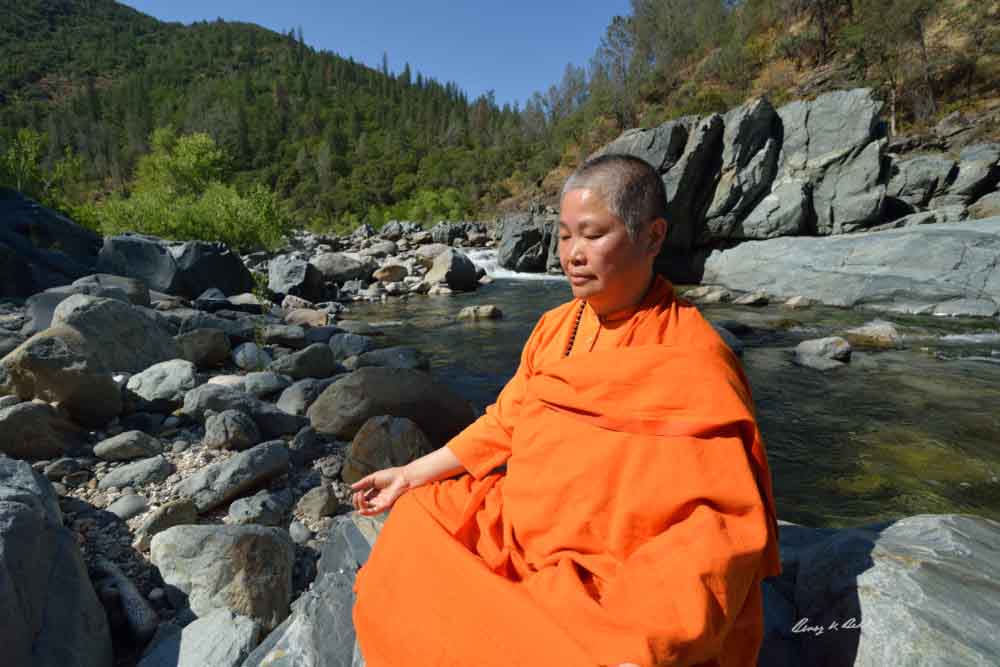
Swamiji meditating by the Yuba River which is recharging pranic energy.
3. Prana is connected with the mind, the emotions and thoughts.
Positive thinking makes you feel strong and energetic. Cultivate joy, appreciation, gratitude. Convert fears, anxieties to courage, faith, self-confidence and contentment. Write down and share five points of gratitude each day for mental health. For example, ”I am grateful for my health”, “I am grateful today for the fresh air I can breathe”, “I am grateful for the good food I have today”, “I am grateful for friends and family”, “I am grateful for this life at this time”.
4. Concentration of mind brings strength of mind and boost the immune system.
Keep yourself busy at home if you are not working. Catch up on the household chores or organization or cleaning. An idle mind is a devil’s workshop. Pay attention to obsession on negative thoughts. This is not proper practice of concentration which needs to be on positive thoughts.
5. Concentrate on positive and uplifting thoughts
Concentrate on sacred mantras such as OM, or uplifting objects like flowers, trees, blue sky, the movement of the breath in and out of our lungs. Stay away from distractions. Distractions bring viruses to the mind. Keep your mind strong and elevated. This supports your immune system.
6. Remedial measures and healing by specific mantras
Consciously repeat the sacred mantra “Om namah sivaya” . Lord Siva can drink poison and deal with the virus. The more you repeat a mantra, the better it is, as mantras work cumulatively, by repetition. Also download and play at low volume in your house, even at night, the well known “maha mrityunjaya” mantra for protection, healing and liberation Om Tryambakam… This will give you a positive and reassuring background of thought. If you know of someone who is sick, address the prayer to the person in your mind and send them the healing powers of the mantras by your chanting of this mantra, either 3 times, 9 times, 27 times, 54 times or 108 times.
7. Conquer your fears by affirming your inner strength
“Om Sri Durgayai Namah” or “Om Dum Durgayai Namah”. You can use a strong form of the mantra of Goddess Durga who is our own inner strength dwelling within us. This will remove the effect of Rahu in our confusing times (which brings fear and delusion). This continuous mantra repetition for at least 108 times, also seeing the form of the Goddess riding the lion with her 8 arms will bring calm and courage.
Durga represents our own inner power and strength. She holds the weapons of all the Gods.
8. Remember “What you think is what you become”
Think of strength, you will become strong. Think of weakness, you will become weak. Think of disease, you will invite the disease. The reality you live in is the reality of your thoughts. You are the master of your destiny. If you cannot come up with positive thoughts yourself at this time, read books from the Masters. They will inspire you. Stop feeding yourself with social media news and stop feeding yourself with negative thoughts of others. Even if others are negative or anxious, remaining calm and strong will help them.
9. Remember the Vedantic teaching on Truth and Reality
Detach from your own feelings of worries and assert your true nature as powerful spirit, the disease-less Atman. Ultimately the world as we see it is unreal, because it is only what our mind is thinking and projecting out, a habit reinforced by countless repetition. You have had countless fears and traumas before and you will see now many reasons to be afraid again (you will a see snake when there is only an innocent rope because the idea of the snake and the fear of the snake is in your mind).
Wake up, bring the light of wisdom and see things as they are. Things are not so bad. The virus is not so terrible. Our own weakness and readiness to let go of our self-confidence and mastery is the problem. Do not waste energy in drama and worries. This is just a test how strong you are. Apply the yogic principles and be victorious!
10. Assert your healthy Self and know that you are the master of your body and mind. The internet world is not the only reality
The internet amplifies and distorts. There are a lot of “verbal delusions” and “likes and dislikes” surrounding you. These are the types of thoughts (vrittis) that will bring you pain. Fewer of these is better. If you want to keep yourself informed, browse the news from authoritative sources quickly and get back to your grounded self. Your body and mind are your instruments. Your health is in your hands. You are not a victim. Do what is necessary (Wash your hands, be prudent, limit desires and needs) and take care of your health with self-confidence.
Siva also has the name Neelakanta – the one who drinks the poison of the world and remains unaffected by it.
11. This is a great opportunity for us to rethink our priorities
This is an opportunity to focus and change our lives by adopting new and good habits. You do not need much to be happy. Happiness is within when you calm down the mind. Let go of attachment to things the way they were.
12. Change our stressful lives by the practice of contentment
This is a great opportunity for you to spend time with yourself. Do more Yoga, not less. Do more meditation. Turn the mind inwards. Yoga helps you to be with yourself and have clarity. “Social distancing” is a great concept promoted by Yogis long ago. In the yogic context, it means not to depend on outside relationships for your happiness. Not to be needy and searching outside for happiness or support. Less social life, more inner life. Less thoughts, more peace. “Yoga chitta vritti nirodhah”
Namaste to yourself and others and find your strength within your own true Self. Love yourself! You will then find others as your heart opens. You are never alone. You are the essence of all. Connect to your wisdom heart. This is a good time to do it. The Universe is giving you this precious opportunity to do this.
Conclusion
This is a blessing in disguise. Turn inwards. Less travel, less movement. More opportunity to practice. More clarity. Instead of seeing this as depressing, see it as an opportunity to turn within and go straight to our own goal of happiness. Indeed, it is a blessing in disguise.
Practice the above step by step. If you need more guidance, we are here to support you.
The important thing here is that we are uniting together as yoga teachers, Sivananda Yoga teachers. We have a mission to be leaders in time of need and to help people. Which way we can help people is the topic of today. So I hope that you have seen my video and my article. If you have not, please do read it, “self-quarantine or yogic turning inward: how to live with yourself and be happy and healthy”. There is an article about this and it’s been also translated. So in this article there’s already a lot of teaching that is there that you need to communicate with people in your own way.
If you have difficulty communicating with people, then please write to me so that I can explain in a few words what to say and do. For example, if you want to help people convert from fear to self-confidence and faith, you can write to me. The idea is as a yoga teacher you need to feel that you have a responsibility. Sometimes we sit in our corner and we do not really know what to do. The meeting is for that reason, for you to know what you can do.
Thought Power: Time to Spread positive thoughts
The first thing you need to know is that this is a pandemic, but also this is a situation that touches the whole world, and it changes the vibration of the whole world. The whole world is in a panic, in the worrying and questioning mode. It is very important that yogic teaching is known at this time so people will turn from negative thoughts to positive thoughts and know the cumulative action of thoughts. This is what the yoga teacher needs to know, that his or her thinking is not only relating to him or her, or the people that are in the same room or house with him or her.
The thinking together as a collective consciousness, the positive thinking, affects the whole world. Now more than ever we need to be aware of that. We need to be aware that our positive thinking or positive talk affects the world and the way we can help the world to heal and to uplift their consciousness is to more consciously practice our sadhana or yoga. It is so important that you see everything collapsing, changing and the whole world is in lockdown. What that means is people will stay at home and they have a lot of time, things stop, what are all of these people going to do?
This is a moment of transition, a moment of choice, either we are going to be depressed and you will go down with everybody or we are going to rise up. That is why the teachers need to play a leading role.
Raise vibrations with mantras
Most importantly what a yoga teacher needs is to know that his / her thoughts are important. It is very important that you raise your thought vibration by continuing to do your practice. Even though you might think that you are alone in your house doing your practice, you need to do it for the sake of the world. When you do your practice, yoga and meditation, it is not only improving your life but also improving the vibration of the whole world.
So the easiest way to increase your vibration and help the world is repeating Mantras. Those who have been Sivananda yoga teachers know what is a Mantra. There are a few Mantras that you can do, now more than ever, and gather people together to repeat the Mantras because of the collective effect. It’s like adding the energy together and you know that, when you add energy, you don’t just add energy to your country but you add energy to the whole world.
We need to create this positive vibration to balance out all the negative vibration. It is a question of knowledge, not just of blind faith. That means that you know that vibration or thought or Mantra thoughts have effect. You need to repeat a few Mantras and teach people to repeat Mantras as well. Sit together to repeat Mantras. It helps them to have a strong mind, but also it is radiating out.
Good mantras to use in this time
Take
the mantra “Om Namo Narayanaya”. With
your heart, you send the Mantra out. You
know that it helps people to bring them to peace, to calm. The Mantra of Lord Shiva can remove poison, protects
you and brings you to high consciousness:
“Om Namah Sivaya!” You can
record this Mantra and play so people can hear all day long and they can learn
also how to pronounce it correctly. The next mantra is a mantra of protection
and strength. Goddess Durga is very
powerful and she can calm down all fears and all delusions. People are completely crazy and you let them
hear this mantra and also not only hearing but seeing the picture.
I have seen many times people with panic attacks. I made them repeat the mantra of Durga and I made them see the picture of Goddess Durga, and it calmed them down. Goddess Durga is very powerful because she can fight with all the demons and the negative forces within your self and outside of your self. The mantra is like this: “Om Sri Durgayai Namah”. Swami Vishnudevananda allowed us to use the strong form of the mantra of Durga with the bija mantra “Dum”. You repeat it like this “Om Dum Durgayai Namah!” Please record this mantra and give it to people to listen and broadcast it.
Now is the time for us to broadcast mantras. Usually we don’t broadcast mantras because people need to be initiated into a Mantra, but now in this time of need, you can work on the mantra “Om Namo Narayanaya”, which is the mantra that Swami Vishnudevananda decided to broadcast a long time ago to help the world. The Mantra “Om Namah Sivaya” is very good because of the virus. The Mantra “Om Sri Durgayai Namaha” or “Om Dum Durgayai Namaha” is excellent because the world is in panic mode.
Mantra for healing
There is another mantra that you can use, record, broadcast and play which is the Mahamrityunjaya Mantra, an excellent mantra for healing and for liberation. If you know people that are sick or very upset mentally because they lost their loved ones, the people that have died, or they are afraid of sickness, you can use this Mantra “Om Tryambakam Yajamahe Sugandhim Pushthivardhanam. Urvaarukamiva Bandhanaan Mrityormuksheeya Maamritaat”.
Please record this mantra and play if you have in your household and your community people that are very anxious. The best thing is to record this mantra and play it at low volume all the time, 24 hours, so they can hear it. Even though they might not understand it but it brings peace to their mind. For the people that just died or they’re on the sick bed, the best thing is to play mantras for them. Every yoga teacher needs to use his / her consciousness. You cannot really repeat the Mantra with only your lips, but rather you have to repeat the mantra with your heart, because consciousness or God is dwelling in your own heart.
Chant mantras with heart and consciousness
It is now the time for you to connect to your heart. When you want to send the mantra to somebody, in order for you the assure the healing power, physical healing and mental healing and also spiritual healing, then you need to do it with your own consciousness and with your heart addressing to the community or to the country or to the person that is in need. Everything really happens in the psychic world – the spiritual world. As a yoga teacher, this is the best time for you to apply.
You need to focus your mind and it’s like a prayer so you can deliver these masses of energy. Basically you have to imagine like this, that you are delivering masses of energy to an area of the world. You don’t need to run there and bring some water and some supplies but you are using this very powerful method of sending positive energy. In the psychic world, everyone receives it.
They might be confused at that time because their senses and their mind are switching their consciousness to another level but in between there will be times when they will be calm and they will be praying then they will receive your prayers. That’s the first action that all yoga teachers need to do, to spread positivity, by Mantra and also please read my article on how there’s a connection between Prana and thought.
Connection between Prana, Thought and Immunity
The more that you do things to increase prana, the more that you are strong and your immune system will be strong to prevent disease. You need to explain that to your students and to your family, the link between Prana and thought. Prana is that which you can find in nature. There will be a talk later about how you can get prana in nature, so you need to explain to them the link between prana, thoughts, emotions and immunity.
The best thing to prevent the world from being sick is to increase immunity, which is the fighting mechanism that nature has given us in order for us to prevent diseases. The prana needs to be high, so you need to increase the prana by absorbing the prana from nature by having a proper lifestyle, eating the right food and also by not spending the prana through negative thinking, worries and actions that are mindless.
Decrease expenditure of Prana through negative thinking
Train your mind. Concentrate your mind, doing mindfulness, mindful actions, the more the prana will be high, the more that you prevent disease, and you will have high immunity. Increase the prana intake from nature, decrease the lost a prana through the senses and through your thoughts, your worries and your negative emotions.
It is a very simple mathematic formula: increase prana, decrease energy waste. We will talk more in detail how you can lose prana and how you can increase prana.
increase the spreading of positive energy by mantra and positive thoughts.
increase prana, decrease the expenditure of prana through worries and negative thoughts and through too much information that you cannot digest. When you get too much information that you cannot digest, automatically you would be stressed. Gather the information that you can digest. It’s like food. If you eat too much, you cannot digest then you have toxins. If you eat the food that is not fitting to you, then you also have toxins. You need to do that.
Comforting people, be humble, learn to listen
The other thing that you need to keep in mind is that, in this time people need comfort. Not merely calmness but they need a comforting kind of presence and comforting words. Of course you cannot meet each other like before, you are in quarantine but you can call people on the phone and talk. You know that your presence is important. Sometimes you have some kind of feeling with people and relationship and you don’t want to talk to them, but now it’s a good time that you transcend this kind of limitation that comes from ego, relationship dynamics.
It’s good for you to call people, your friends and relatives, and reach out to your neighbors maybe by phone or email so that you can give comforting words. It’s very easy to give comforting words: “how are you, how are you doing, we are concerned about you, is everything okay, we love you “- these kind of comforting words, and offer empathy. Empathy means we understand why you lost your job, you are at home and you don’t know what to do and you’re depressed, you’re worrying. We understand. Just offer empathy by listening.
People need to be able to talk out their worry, so then at that time you have to just listen but without trying to give an answer because really truly nobody has an answer. Be humble and just try to listen, not only engaging people when you feel that you have an answer. Nobody is having an answer but it’s very helpful to just listen to people. Listen to their voicing out whatever they’re worried and concerned about. That’s enough to help them to feel comforted and to calm down. So know that it is a need to be listened to.
Physical Relaxation
The next point is you need to help people to increase relaxation because this is a time of stress. Know that there are three levels of relaxation. The first level is physical relaxation, because when your mind is tense, your body will be tense. By asana and simple stretch, you let the prana move, you are more relaxed. Savasana or tensing and releasing with attention are a very good exercise.
Maybe your family members or your neighbors are not ready to practice yoga; maybe they still have some kind of prejudice against yoga. It doesn’t matter if you just tell them to lie down and to do some stretch, tense and release, and use their mind to relax their body. It’s called Savasana or physical relaxation, releasing the tension from the body by stretching.
Mental relaxation
The second level of relaxation is mental. What that means you need to understand clearly. When the mind is distracted, it is not calm. When the mind is distracted, the mind has a tendency to worry. It needs to be concentrated. The best thing is that people concentrate on repeating Mantras, singing kirtan, reading books, and studying, but they need to keep their mind focused on something positive.
That is called mental relaxation, when they focus on something positive. It is wrong to think that mental relaxation means your mind is empty. It is wrong because when the mind is empty, it is time to worry. Even though you might not be aware, but thoughts of worry and all kinds of imagination can come into the mind when it is idle. Make sure that people understand that.
Spiritual Relaxation
The third level of relaxation is called spiritual relaxation. Spiritual relaxation is when you know who you are. Most of us are in the dark. This is not only virus crisis, is not only a mental-emotional crisis in the world, but also it is a spiritual crisis because we go on and denying the spirit. We got lost in the consumer world and technological world, and we can go on living our life very rajasic or very externally oriented. We don’t take time to sit down, to think, to study, to introspect, to make wise choices, because we’re being pushed here and there by the senses, by the pressure of advertising, by consumer society.
Now is the time also to spiritually rethink. Spiritual relaxation comes when you have more knowledge of the truth, of this life, when you have more knowledge of yourself, (called self-knowledge). That comes only when you are able to meditate or you have faith. We can talk about faith another time. Try to get people to relax, physically relax, mentally relax and spiritually relax. The more they are calm and positive, they are spiritually relaxed.
Nature helps people to relax
Being in nature is helping people to relax. Maybe you have to be quarantined in your house and you cannot go out but you can look at your plants and take care of your plants or flowers. Look through the window and look at the trees. Anything natural will help you to relax. You have to do it, focus on nature. Yesterday I had people doing an exercise in our advanced TTC class here, an exercise of contemplating nature. Nobody has to go anywhere.
Actually we sat in one place and we just looked at the tree and we looked at the water in the pond, looked at the dog that is passing. We were just contemplating. By being still, learning how to contemplate, everyone experiences a state of calmness, and not just calmness, but a state of joy and unity. This is exactly what we mean when we talk about spiritual relaxation. There are a lot of techniques of yoga that can bring you to that state. We will have a subsequent other kind of teaching so you can make use of all these. Yoga is the wealth of information that you can apply.
The more you apply and the more you see that it works, the more that it encourages you to use it more. Before yoga was regarded as marginal, but now you can see the world is collapsing the way it is, so now is the time for yoga and yoga teachers to bring the secret techniques and methods out and serve the world. There’s no time to lose. This is the time. I talked about relaxation and you need to explain to people that the way they can take care of their fear and anxiety is through increasing relaxation, physically, mentally and spiritually.
Yoga for overcoming anxiety
Now I just give to the yoga teacher a few tips. Actually we study all this in the yoga health education course that is very handy now because we train people to become a health educators, basically in a time of disease, what to do. Here are a few pointers. How do you teach yoga for overcoming anxiety? The first point is that you need to help people to improve the breath, body and mind awareness. Improve breath, body and mind awareness with rhythmical breathing. Just breathe with the diaphragm to get more oxygen, but also use rhythmical breathing, and then it will help.
When you do asana, make sure that people coordinate their breath with their movement and do pranayama. People are afraid sometime to breathe because they are afraid of bringing in the virus. It’s a kind of wrong thinking because it creates more tension. Unless you are already a yogi that you can hold your breath and survive but you are not an advanced yogi so you need to breathe.
Now the best thing is to find nature to practice breathing. You might not be able to go out in the street but you can open your window. You need to ventilate your room and your house. Don’t just close the windows. You need to sit near to the window and you need to breathe. Do pranayama. In general for yoga teachers, you need to know that now is not the time to do intense variations, intense yoga asanas. It’s the time to do gentle yoga to slow down so that you allow more mindfulness, more awareness in your breathing and in your movement. It will counteract the fear and anxiety. You need to do restorative yoga.
If you don’t know what is restorative yoga then you can learn. Basically it is be in very relaxing postures and put some kind of props like blankets and pillows on different parts of your body, on your chest primarily, but also on different parts of your body. It feels like weighed down and comforted. The focus is on mindfulness, awareness, slowing down and be comforted.
Asanas for stress resilience
The second point is to increase the prana, which I said already, by moving the body in order for the prana to move. If you feel that you are stuck and if you feel that you are panicking, then the prana is blocked. At that time your thought goes down more. You need to just keep moving, but in the yoga postures in order to move the prana and to balance the flow of prana.
It is very important at this time because it will help you for your stress resilience. People will increase in their capacity to deal with stress if the prana is balanced. Simple moving of the body, stretching but moving the body in the way of yoga, right and left, backward and forward, in a balanced manner with awareness. At that time the mind will be balanced and you increase your stress resilience.
Improve Mental-Emotional Balance
The third point is to improve the mental-emotional balance. The mental and emotional balance is most effectively accomplished by regulating the breath. If you feel tension, you need to learn to exhale, calmly and as slow as possible, so it releases the tension. Let’s say you are talking to the neighbor and the neighbor is panicking, you can say on the phone to the neighbor: “OK, calm down now, just exhale slowly. Inhale and exhale to the count of six. Inhale and exhale to the count of ten.
Go very slowly and they will calm down. Then the breath needs to go with the movement and the concentration of the mind. The awareness and the concentration need to be there. People cannot do yoga when they are stressed. Why? Because their mind is obsessed with something external and they cannot do yoga. At that time, you tell them to lie down, to stretch, to breathe, and then to concentrate on the breath.
Learn Ayurveda: Increase Ojas Shakti to avoid burnt out
The forth point is that for yoga teachers you need to know that you get burned out and the virus can attack you. One Ayurvedic teacher stated the virus is a pitta disease, which means too much heat in your body. That’s why more relaxation is important. And if you have too much heat and too much anger and too much thinking and too much stress, what you are doing is burning out your ojas, which means the helpful energy to sustain your life. So you are burned out.
What you need to do is to increase the ojas shakti, which means the power of sustenance of you own body that would bring you contentment, gratitude and the sense of relaxation. The key is increase ojas. This is the subtle energy that is taught by Ayurveda. This is a good time to learn Ayurveda and apply the Ayurvedic principle in your diet and your lifestyle to increase ojas, by sleeping well. When you see people that are anxious, they cannot sleep well. You need to apply some warm oil on your body, on your head. You can use warm sesame oil. Heat it up and anything warm, even warm water can be put on the body.
With warm water, you can rub your body. It is okay if you don’t have oil, but anything warm. You can eat properly. When you are stressed, you are going to do nervous eating. You are at home and you have the canned food that you have stored. You don’t know what to do, so you eat the canned food and sugar so it calms you down artificially. This is the worst thing to do. You need to eat very nutritious food, simple food. The essence of the food will feed you, feed the ojas and it helps you to calm down. If you have ghee, you can take one or two spoons of ghee in your food, and then you will be nourished.
Almond drink is also very good for increasing ojas. You need to have a positive feeling and connection to the Divine. That will also give you the direct connection to the source of life, and that will sustain you as well and increase your ojas Shakti. In this time of virus threat, you need to increase your ojas Shakti, which means increasing your quality of life, and not to destroy your life by wrong habits. It’s a time to be much more careful of what you eat, think and feel.
Increase the sense of safety
So now the fifth point we have already talked about. It is to create the sense of security, of warmth, of quiet and of support so that people feel safe. Okay, the key word is feeling safe. To let go of the worries and the defense mechanism because if you feel worried and your fight-or-flight response is increased, then your defense mechanism will wear you out.
So it is important that you relax, that you activate your parasympathetic nervous system by many different means, yoga asana in a conscious manner, rhythmical breath, all this is helping or increasing your parasympathetic nervous system activation and also the faith that I talked about. So use the right brain, increase the faith. If you have some kind of spiritual practice you need to do it now. Do not waste your time in worry but use your time in prayer. Decrease the defense mechanism in the mind.
Increase the detachment attitude
The sixth point is what I talked about a little bit already, the relaxation, but I add on now you need to change your attitude towards life. The attitude before we have is the attitude of being passionate about life, passionate about enjoyment of the senses, rajasic attitude, running here there so your life feels like more meaningful because you are experiencing everything and you are enjoying everything. So that is called rajasic kind of activity. And you need to decrease these kinds of rajasic activity and you need to increase the detachment attitude that means a meditative contemplative attitude towards life.
You step back and then you find the fullness within yourself and you detach about what is going on. We must think about this more and there is more teaching that needs to be involved in this matter because even though it is not that easy but basically I just give you a taste of this. You need to be detached towards your actions and the result of action, that means your work, your money and your life. Be detached from it. If you attach to it then you have more worry, so try to be detached from the result of your effort and the result of your action. I know it is difficult but still that is the way to go.
Either you worry about it and you cannot do anything about it, and then you will make yourself worse and then you get disease because your immune system is low or you can just basically take the stand of being detached and to be in the present. Then you will be more recharging yourself and things are not that bad. So basically change your attitude towards your whole life should be more detached be more centered.
The best person who can supports you is your Own Self
Point number 7 is you need to experience the connection with your own self and to others so the sense of connection is very important for mental health. People talk about social distancing; everyone needs to stay away from each other, not moving. But then people don’t know what to do. So they stay home and they are depressed. They miss their friends. They miss their social activities, so they are depressed, angry and worried. This will make things worse. You might help in not spreading the virus, but you are increasing the spreading of the negative virus of the mind.
When people are worrying and they send the negative thoughts out to the atmosphere. You need to be aware of that. You need to help people feel the connection to their own Self. These yoga techniques of asana, pranayama and meditation are helping at this time for people to feel the connection with their own Self. We are having the bad habit to always think of something external or somebody external to ourselves is supporting ourselves. And these relationships are very essential for our well being. Fine and good. You have your supportive network, your friends and people that you trust and love.
This is very good. I don’t say anything against this. But what I am saying is that you need to have your own support system in your own Self. And you need to turn you mind inward in order for you to find that support system within your own Self. And that would help you because even if you have your loved ones, they cannot be there with you 24 hours 7 days a week. They cannot be there for you all the time. And then you feel let down, worried and anxious when they are not there. So the best person who can support you is yourself. Turn inward, feel the strength from within.
Do Self Affirmation
Do Self-affirmation. Let’s say you never think about this kind of thought before. And now it is the time for you to do Self-affirmation. Right down the sentence and repeat yourself many times. “I am content and happy with myself.” You say something like this. Day by day, everything is improving, everything is better in every way. So say things like that: “I am happy with the present moment”. Do Self-affirmation, something that you feel is good.
The positive thought that helps you, and at that time you keep repeating that thought, because that thought will gain more momentum and more power in the psychic world and then at that time it helps you because when you are panicking, this thought will come up to the surface of the mind and will help you. You have to do Self-affirmation as a habit. Create a gratitude list. So your heart keeps opening, your worries and negative emotions, anger and frustration come only when you have your heart closed. Your heart becomes limited and closed, then you have the tendency to blame and to be negative.
This is not the time to blame, to be negative, you should not blame anybody, and try to cooperate and not blaming. Everyone is trying to do their best. If you blame people to lie, to cheat, to not do the right thing, you are sending more negativity in the world. Try to send positive energy. Try to focus on the positive, not on the negative and the blaming.
Teach a gentler Yoga class
So now the last point, in the yoga class, when you teach the yoga class, I said already, teach a gentler yoga class. It is encouraging and calming. That is the best that you can do. Of course in the time of social distancing and we advise that yoga teachers should not correct the students. You can teach people online. You can use Zoom, video conferencing, in order to teach people online. But only if you have people at a room in your house, it is advisable that you have them sit at a separate distance from each other and you are not touching them, correcting them.
So with your voice, that is what you can do. You can use the voice, the verbal cue with people and correct them. It is very important for yoga teachers to remember is to wash your hands with soap in the beginning and at the end of the class. If you do teach people, everyone needs to wash their hands with soap for at least 20 seconds, with awareness, as much as you can. That is the only way right now to not to spread the virus. We said a few tips for yoga teachers already.
Restoring Faith, faith gives you stronger immunity
The last point that I have before you ask questions is restoring faith. The idea is the virus comes from nature, and then we become suspicious of nature. We become afraid of nature that can be also, you can say, nature is God or Goddess, is the universal presence around us we call nature. So we need to reconnect with Mother Nature instead of being fearful and blameful of Mother Nature. You need to recognize that you have mistreated Mother Nature, not be as aware of her presence as you could.
You maybe have acted like a spoiled kid and think that mother will always be there for you. And when mother is upset, and she spanks you, you get angry. But you need not be angry with Mother Nature. That is my point. You need to rely on her, even though something is manifesting which you perceive to be negative and it comes out of the blue and it is mysterious, and you don’t understand but still you need to have you heart open toward Mother Nature. You know that she is there to take care of you, that she loves you and she gives you everything that you need. But stop acting like a spoiled kid and remember her. So restore your faith in nature. Those who have faith toward your particular god, prophet, religion, name and form of your faith, it is very good because you have your faith. In time of need, we usually turn toward our faith. We learn how to pray.
So what I am saying is you need to restore your faith. It is not the time to doubt even though the tendency is more to doubt at this time, to be anxious and doubting. It is the opposite of what you need to do. And you need to reconnect and to be appreciative and to pray. Why? Because faith keeps you going. In time you want to control but you cannot control. You want to understand but you cannot understand. At that time, faith is what you’ve got. Faith keeps you going and faith gives you stronger immunity. Faith gives you strength. This is the time to relate to our faith, not the time of doubt. Of course you have to do the thing that is needed. There are practical things that you need to do to not spread the virus, not to be sick yourself, increase your immune system as we talked about ealier. But you need to take care of your own spiritual Self, or your God. Try to find the connection with God.
For some of you, it might be not something that you are used to, but it is never too late for you to understand that you are never alone, that you are not in control. It is some intelligence that takes care of things, in a bigger scale than you can currently see. For a yoga teacher, it is very important to have strong faith, because you have to be positive and guide the students.
Vedanta philosophy about the Self and the Not Self
For a Vedanta student, Vedanta is Yoga philosophy, then we talk about the Self, and about the detachment toward the things that are transient and changing, and to discriminate, to know the difference between what is permanent, and that which is changing, which is the Self and that which is the not-Self. You need to have some basic education in Vedanta philosophy, which is Yoga philosophy in order for you to understand how to do this.
But in general you need to remember that there is some presence within you, consciousness within you that is there, no matter what. You need to tune to that. That consciousness can be seen outside as hands of God or the Divine, or can be seen inside as your own inner deeper presence.
Yoga Teachers and Health Educators need to be patient
That’s enough talk and we need to keep rehearsing because one time you hear, one time you practice is not enough. I’ve been doing this for almost 40 years basically, just rehearsing and rehearsing, hearing it again and again. For yoga teachers and health educators, just know that it is not one time that you need to say to your student to calm down. You need to be very patient, to repeat again and again.
Be available to the students and people because people hearing one time is not enough. Your presence needs to be there steady and constant, and you need to be repeating. Don’t be afraid of repeating yourself. It is not the question of information here but it is the question of self-transformation and to help people to go more deeply within themselves.
Swami Sitaramananda is a senior acharya of the International Sivananda Yoga Vedanta Centers and is director of the Sivananda Ashram Vedanta Yoga Farm, California and the Sivananda Yoga Resort and Training Center, Vietnam. She is acharya of China, Taiwan, and Japan as well. Swamiji is the organizer and teacher of the Sivananda Yoga Health Educator Training (SYHET) program, an 800-hour program on yoga therapy, accredited by the International Association of Yoga Therapists (IAYT).
Swami Sitaramananda is the author of “Essentials of Yoga Practice and Philosophy” (translated in Chinese, Japanese, Vietnamese, and Russian), “Positive Thinking Manual”, “Karma Yoga Manual”, “Meditation Manual”, “Swamiji Said, a collection of teachings by Swami Vishnu” in His Own Words. She is responsible for the Vietnamese translation of “Completed Illustrated Book of Yoga” (CIBY) and “Meditation & Mantras” by Swami Vishnu. Many of her video & audio lectures on Yoga life, philosophy, and psychology as well as articles and webinars can be found on this website.
Swami Sita is an ardent supporter of the integration of the Vedic sciences such as Vastu, Jyotish, Ayurveda, Yoga and Vedanta. She is an international teacher of the Sivananda Yoga Teachers’ Training Courses and Advanced Yoga teachers’ Training courses, as well as Meditation and Vedanta & Silence Courses both in Sivananda Ashrams in Vietnam and in Grass Valley, CA.
On the occasion of Sivaratri, the festival of Lord Siva, celebrated by millions, this is an offering to help understand how contemplation on Lord Siva can guide us in our life.
Lord Siva is the Lord of Yoga, and represents what yoga and meditation practitioners are aspiring towards. He is the Adi Guru, first guru of yoga, and taught the science of Hatha Yoga.
Symbolism of Lord Siva
He is
often depicted with eyes half closed and half open. This represents an ideal
state of mind that yoga practitioners want to achieve, of being “in the world
and out of the world”, seeing the world of names and forms and changing
phenomena that we live in, and at the same time seeing the essence of it, as
opposed to seeing the manifested world as devoid of spirit and intelligence.
He also
is depicted with the third eye open. This means that we are encouraged to see
the world with our eye of intuition, or with a mind that has been purified of
its lower propensities such as anger, greed, lust, hatred, jealousy and envy.
Intuition is higher than intellect. Intuition can be developed only when we
transcend duality, or the left brain/right brain split. It includes
devotion, or pure love, while intellect might miss half of the picture if there
is no pure love in the thinking, or when the thinking is motivated by the
ego.
Lord Siva blessing Parvati, while Parvati worships Siva
Lord Siva sits on a tiger skin. This shows that to attain to an elevated state, or to be successful in our yoga and meditation endeavours, we need to control our passionate, lower animal nature. Lord Siva accepts all creatures, for example insects and scorpions, thus he shows pure compassion for all beings. He is an example of pure detachment.
Siva is beyond the 3 gunas
Holding the three pronged trident, he indicates the journey of transcendence beyond the 3 gunas, the 3 qualities of nature: tamas, rajas and sattwa. The journey is from the state of tamas when we are in darkness, in ignorance, unawakened, and in denial of our true nature of peace and happiness, to the state of rajas. When rajas becomes predominant we experience a mistaken, separate identity, perform egoistic, self-motivated actions, and are judgmental of others, seeking for happiness externally. We then move to the state of sattwa and experience purity, harmony, calm, peace, knowledge, balance, wisdom, understanding and a non-judgmental attitude. Eventually we transcend these three states of mind altogether, to reach to the transcendental Siva or Yoga. Thus Lord Siva is said to be the ideal symbol of detachment and self-control.
Lord Siva
has a snake around his neck. The snake represents mystical wisdom, and is
related to the “serpent power”, the spiritual energy known as Kundalini Shakti.
He has the Kundalini as his ornament, having completed the journey of self-transformation
and purification represented by the journey of the spiritual energy through the
chakras. In His being, Siva (consciousness) and Shakti (manifested nature) are together.
Lord Siva represents for embodied beings such as ourselves the pure state of
absolute bliss or being, where there is no reincarnation, no mistake, no karma,
no desire.
The Ganga water flows from his head, this is the symbol of perfection and liberation, where the nectar of immortality flows from the highest chakra. Ganga water is purifying. The being that has attained this sublime state has the capacity to purify all who come in contact with him or her.
Lord Siva is sitting meditating on an icy mountain top. He represents the Yogi who practices austerity or tapas. The mountain represents a high ideal or hard to obtain goal, for which you have to climb and struggle. The yoga practitioner is encouraged to struggle hard to conquer the senses and the emotions, to do austerity, or tapas, and lift his being to a high level of stability and endurance in any conditions or circumstances. Physical tapas is to bear heat and cold. Mental tapas is to keep one-pointed concentration among distractions. Emotional tapas is to be able to bear insult, bear injury and stay calm among conflicts and controversies. Spiritual tapas is to dissolve all facets of ego in the Lord.
Siva rock painting at the Sivananda Ashram Yoga Farm
Attachments bring suffering
My
teacher used to say “we would not have come to this world if we did not
have attachment to anything.” We have come to this world with our karmic
tendencies and our likes and dislikes. We are always running towards something
and running away from something else. We get attached to what we like, and we
are afraid to be exposed to what we do not like. These mental and emotional
preferences keep us in this world of sufferings. It is attachment that makes us
suffer. Detachment frees us from these long formed tendencies and allows us to
see a bigger picture of ourselves and others.
There is both
temporary detachment and more lasting detachment. Lasting detachment must be
based on discriminative intelligence and deep thinking, so that we understand
the defects or the true nature of something and resolutely turn away from it. Temporary
detachment is based on fear of pain, for example when we became “detached’ from
ice-cream because it gave us stomach pain. But soon we forget, and will be
tempted again with new names, new forms of ice cream!
Think about the defects of this world, and cease to run after happiness in the external. Introspect and think about how many times you have suffered and caused sufferings due to illusions and attachments. Detachment seems to give pain in the beginning, but at the end, it gives joy. Attachment seems to give pleasure in the beginning, but at the end gives pain.
Conclusion
Our whole
journey is the journey to learn about detachment. May you contemplate on Lord
Siva and become an embodiment of detachment and clear thinking. May you stay
away from the temptations of the lower mind, the distortions of a split mind, and balance your mind so that you can go to sattwa and eventually see through the veils of maya.
May you
attain liberation from suffering through self-knowledge and wisdom.
Swami
Sitaramananda, acharya ISYVC
Swami Sitaramananda contemplating on Siva at the Ganges River in Gangotri, Himalayas, North India
Stress is a subjective feeling, when you feel that your survival is being threatened. You cannot avoid stress. Yoga teaches us how to increase prana so we can respond to stress properly, in a better manner.
Stress Resilience
Stress resilience is our capacity to be strong, to be able to deal with daily life-stress. Some people say, “Oh, you know I am so stressed, I won’t do anything.” They stay home. Do you think the stress will disappear? No, you cannot avoid the stress, so you do need to understand it properly in order to deal with it.
Stress arises when you don’t have the Prana (life force) to resolve questions or problems encountered in daily life. Prana can be increased by following a proper lifestyle (the 5 Points of Yoga). Decreasing the expenditure or wastage of Prana is also important, through healthy choices and proper lifestyle.
Prana
The question of Prana is very important if we want to understand stress. Because if you have high Prana then you can deal with anything. Any challenge that comes, you know you have the energy to deal with it.
But if you don’t have energy, you already function out of energy debt, called Pranic debt. That means you spend more energy than you make, and you don’t know how to recharge. Then a situation arises and you feel overwhelmed. You burn out.
When prana is low you develop a stress response that is inappropriate to the challenge. The best way to prevent stress is to always store up the Prana.
We should not spend everything that we get. We need to keep some Prana in storage and that we always need to rest and rejuvenate every day. Pranic debt (low energy) is the first cause of stress.
So, you need to learn how to recharge yourself by practice of the 5 Points of Yoga. Do the asanas to make the Prana flow. Learn how to breathe properly, so whenever you are feeling stress, the important thing is to stop for a moment and breathe.
Proper Breathing
We breathe all the time, but we forget to breathe properly. So, when you are stressed exhale, long exhalation. The long exhale switches your nervous system to the parasympathetic response, the relaxation response. You inhale, but you exhale long and deep.
If you are stressed and you feel the negative thoughts come up, then you might sit down, don’t run. Sit down, turn inward and practice deep breathing.
Relaxation and Diet
Proper relaxation allows us to recharge the Prana, to let go and detach from body and mind. Physical tension is released from the muscles and the Prana flows more easily.
Proper diet, eating fresh and easily digestible foods, increases Prana. Avoid foods that are difficult to digest, rich or heavy foods, that would decrease one’s Prana.
Eating a healthy diet full of whole grains, vegetables and protein is an important way to increase prana.
Conclusion
Finally, meditation and positive thinking help us to focus the mind and to channel the Prana. Connecting to our higher Self, we are less likely to stress the details. We are able to maintain a broader vision of our Self, channeling our Prana with inspiration and creativity to express our life’s purpose.
Receive weekly emails about the ashram programs and events.
Like most websites, we use cookies for various features according to our policy. We hope that’s okay with you – if not, please feel free to disable cookies in your browser.