Reflections by Swami Sitaramananda
After the Peace Pilgrimage in Hiroshima, Japan, I returned to Vietnam with a heartfelt intention to continue this journey: to reflect together on the suffering of the past, heal the memories that remain in our consciousness, and rediscover true peace within.
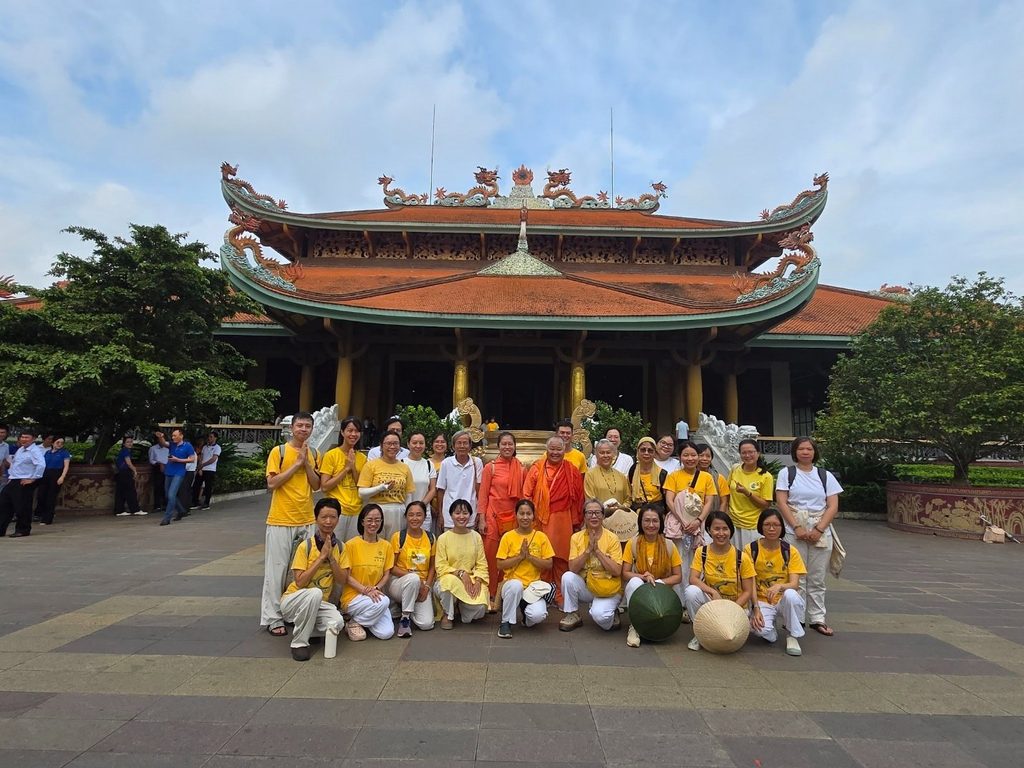
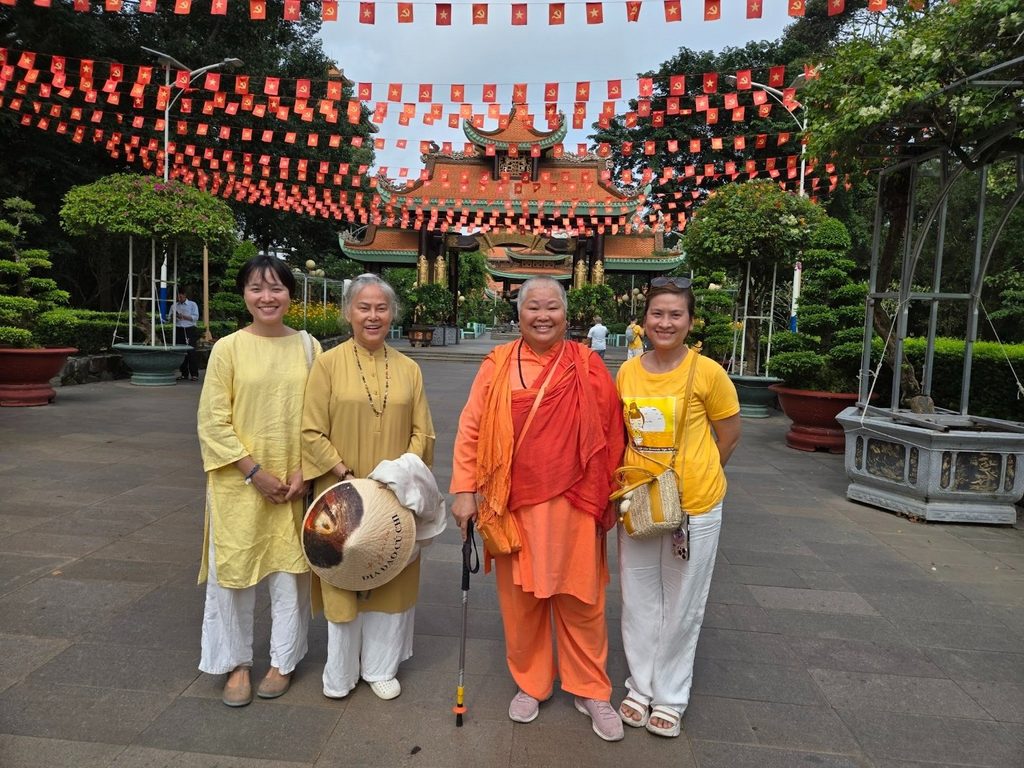
At 6:00 a.m., I set out for Củ Chi with 35 Vietnamese friends, traveling in two small vehicles and one large bus. Our first stop was the Bến Dược Military Memorial Temple, which honors approximately 45,000 people who sacrificed their lives for the country.
Returning to the “Land of Steel and Bronze”
Củ Chi was once known as the “Land of Steel and Bronze.” During the war, it endured such intense bombardment that it was at one point called a “white zone”—an area devastated and stripped of life. Countless lives were lost, and profound suffering remains deeply imprinted in the memories of many generations.
I have had a special connection with Củ Chi for many years. From 2010 to 2014, I taught yoga teacher training courses there. At the time, I felt that I was teaching yoga and yoga philosophy not only to those present in the classroom, but also to many souls in the surrounding area who were listening.
On the final day of one course, the sky was clear when a powerful wind suddenly arose. The atmosphere became joyful and mystical, as though many unseen beings were happily bidding us farewell. When we later reviewed the photographs, hundreds of white spots—commonly called “orbs”—appeared in them. Above my head was a very large circle of light that resembled a halo. It was a profound experience that has always remained with me, leading me to remember Củ Chi as a place in need of remembrance, love, and healing.
Today, as I conduct peace programs in many places, I carry with me a heartfelt intention: to help heal what happened in the past but still lingers in the human subconscious. Painful memories need to be acknowledged with compassion so that they may gradually be released.
We intentionally use the word inner peace, because peace begins within. Peace may refer to external circumstances or cessation of war, but inner peace is something each person can cultivate through a yogic life. Through the practice of asana, pranayama, and meditation, we connect with the peace that already exists within us. When we understand ourselves and live in harmony with ourselves, we can understand others, bring harmony into our relationships, and help create peace in our communities and throughout the world.
Remembrance at Bến Dược Memorial Temple
Before passing through the main gate of Bến Dược Memorial Temple, I asked everyone to remain solemn, refrain from talking, and silently repeat two mantras: Om Namo Narayanaya, a prayer for peace; and Om Tryambakam Yajamahe, a mantra praying for the liberation of those who have passed away and for peace for those who are still living.
After taking a group photograph in front of the gate, we slowly entered while chanting the mantras. In the middle of the broad pathway stood a majestic incense burner. The entire memorial complex was beautifully maintained, with tall rows of trees, flowers, greenery, and solemn architecture resembling that of a temple. Many leaders and generals have planted commemorative trees there.
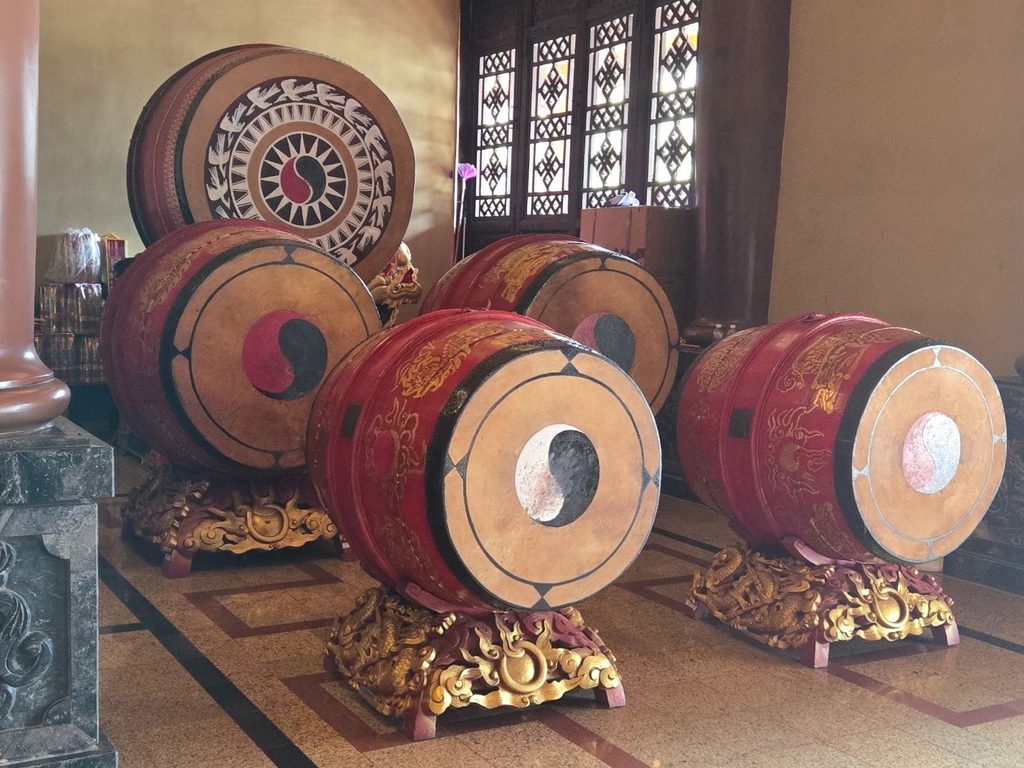
Upon entering the main sanctuary, we observed one minute of silence. The resounding great bell, the drums, and the sacred music deeply moved many people. Two floral wreaths bearing the name Sivananda Yoga were placed respectfully before the altar.
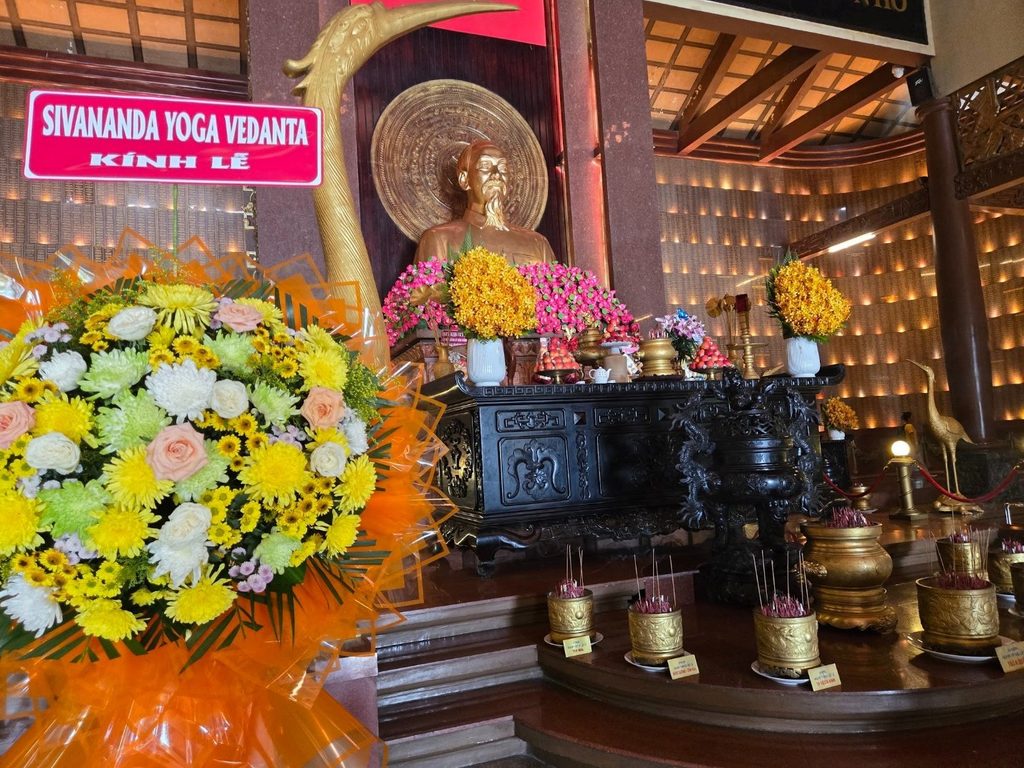
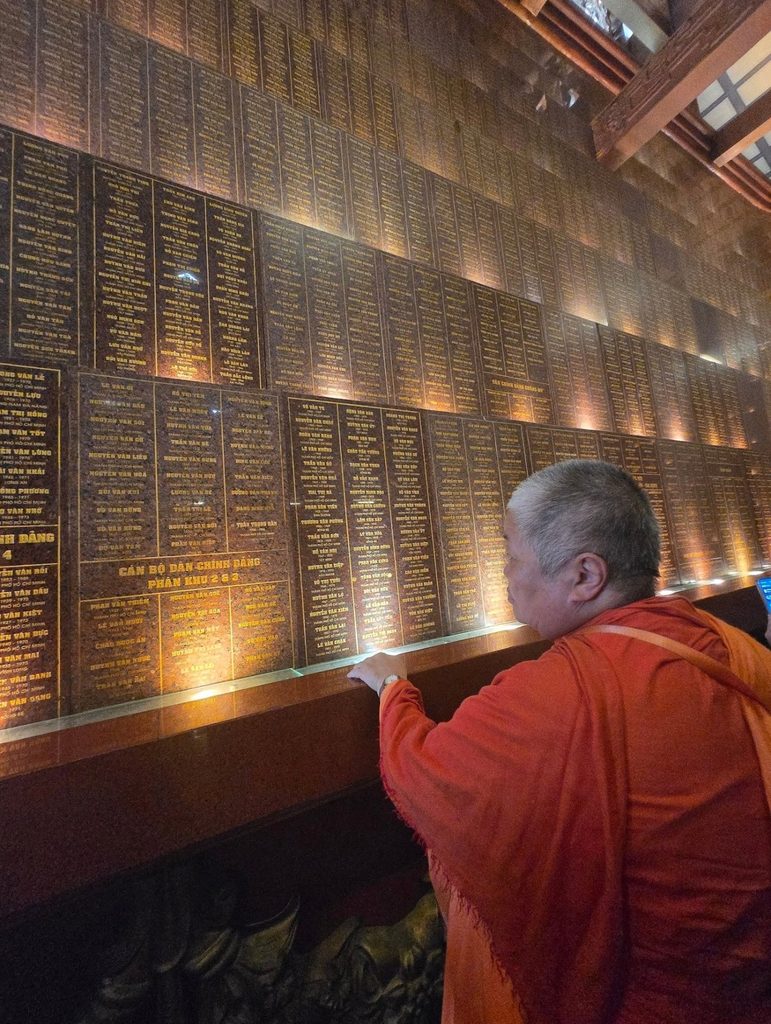
At the center stood a statue of President Hồ Chí Minh. Along the three surrounding walls were bronze plaques engraved with the names of the fallen soldiers, together with their places of birth and the years of their birth and death. Most of them were very young—only 18, 20, 22, or 23 years old—when they sacrificed their lives for their homeland.
Everyone walked around quietly, reading the names one by one. One member of our group, Ms. Mỹ, found the name of her older brother, a fallen soldier who had been missing, and requested an official confirmation. Tarini was also deeply moved when she asked for help locating her maternal grandfather’s name. Among the tens of thousands of names, history was no longer something abstract; each name represented a life, a family, and a story that continues to be remembered.
Behind the temple, we sat together in a Peace Circle and chanted Jaya Ganesha. When other groups of visitors arrived, we lowered our voices and continued chanting softly. Many people shared that the energy of this place felt very pure, gentle, and sacred. Perhaps, through so many years of remembrance, prayer, and sincere offerings, those who passed away have found peace.
Each day, ceremonial tables at the temple are carefully prepared with Vietnamese food as offerings to the fallen soldiers. The enduring care and gratitude of the living seem to have transformed a land once filled with suffering into a place of serenity and sacred beauty.
Một Thoáng Việt Nam: Transforming Bomb Craters into a Place That Preserves Vietnamese Culture
Leaving Bến Dược Memorial Temple, we traveled to the Một Thoáng Việt Nam cultural and traditional craft village. Ms. Trần Thị Tuyết Nga, its founder and General Director, warmly and formally welcomed our group. As a war veteran, she has devoted herself wholeheartedly to preserving and sharing the values of traditional Vietnamese culture with both Vietnamese people and international visitors.
The site preserves many historical artifacts, statues, altars, and teachings of distinguished Vietnamese figures, military leaders, and poets. I was especially drawn to the memorial plaque honoring Trần Quốc Tuấn, also known as Hưng Đạo Đại Vương, who three times led the soldiers and people of Đại Việt in resisting the Mongol–Yuan invasions. Wooden stakes evoke the victory at Bạch Đằng and the wisdom of our ancestors, who harnessed the tides to defend their homeland.

At the center of the traditional house stood the Altar of the Nation and the Land, built with sacred soil gathered from all 63 provinces and municipalities, symbolizing the unity of the Vietnamese people. It is also a place where Vietnamese people can return to their roots and honor the ancestors of the nation’s many family lineages, from the earliest days of settling the land and founding the country.

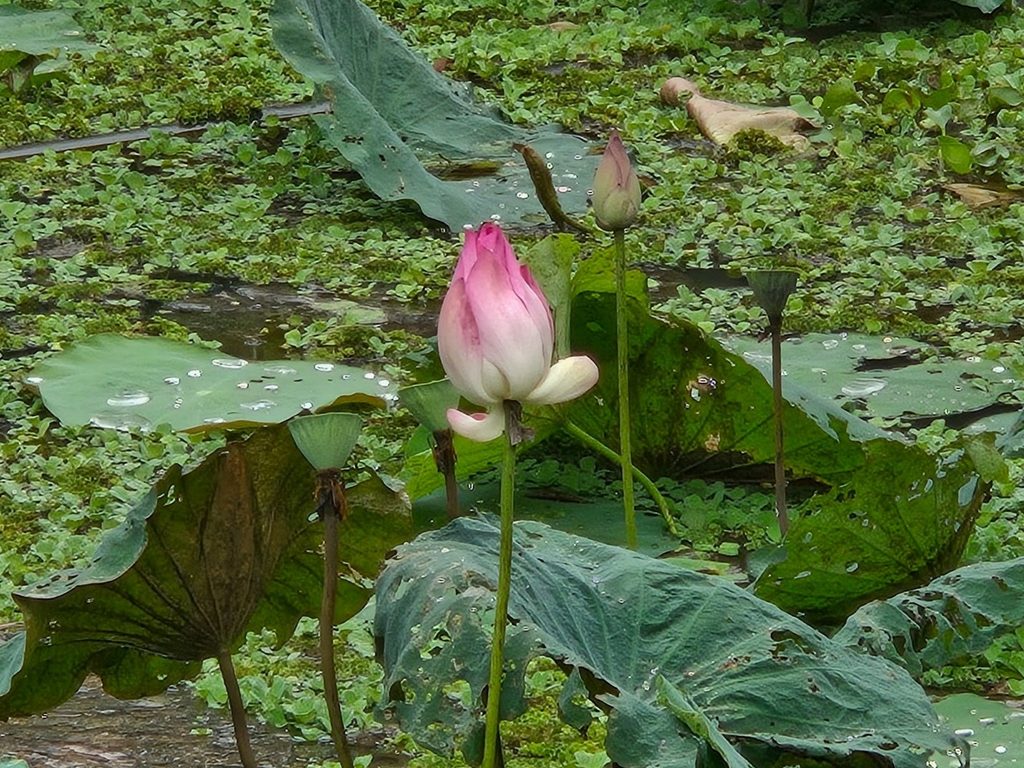
Ms. Nga explained that this land was once a muddy bomb crater. She overcame many difficulties and used nearly one million cubic meters of soil to fill it, transforming a scar of war into a lush cultural sanctuary with brick pathways, rows of bamboo, climbing vines, flowers, greenery, and lotus ponds. It is a deeply meaningful image of transformation: from destruction to life, and from memories of war to beauty and culture.

Puja for Universal Peace
After offering incense at the ancestral altar, we performed a traditional Indian puja to pray for universal peace. Ms. Nga shared that while deeply honoring Vietnamese culture and our homeland, we should also open our hearts and pray for all humanity.
At the center of the puja was a large stone Shiva Lingam from the Cham culture. Its lower part represents feminine energy, while its upper part represents masculine energy. The Shiva Lingam symbolizes the harmony of yin and yang and the union of cosmic consciousness with cosmic energy—the two aspects that bring this world into being.
Beside the Shiva Lingam, we placed a statue of Ganesha and images of the spiritual masters of the Sivananda tradition. The presence of the masters helps us understand the deeper meaning of worship, so that ritual does not become superstition but remains a path of understanding and spiritual connection.
The altar also held a small statue of Vishnu, believed to be approximately one thousand years old. Although only about 20 centimeters tall, it radiated a powerful vitality and possessed a uniquely captivating beauty. Vishnu symbolizes preservation, inner peace, and peace throughout the world.
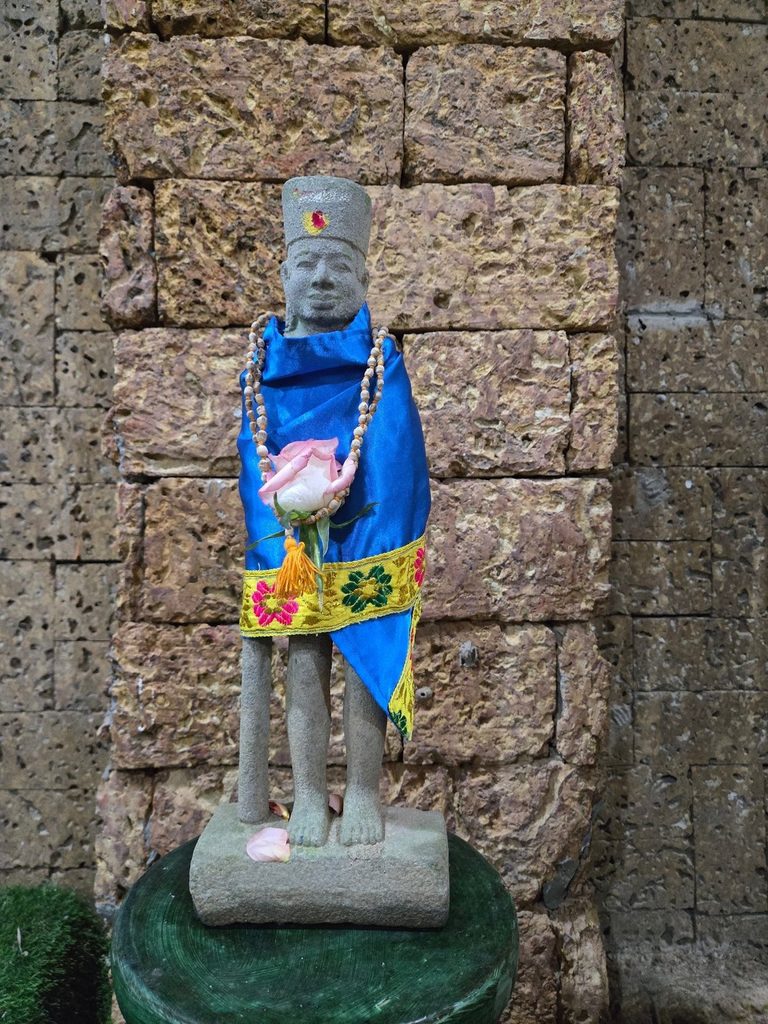
Ms. Nga shared that, in preparation for this day of prayer, she had visited the Cát Tiên Sanctuary—where traces of Shiva Lingam worship remain—and the Cao Đài Holy See in Tây Ninh to seek blessings and pray for the ceremony’s successful completion.
One by one, each member of the group came forward to offer milk, water, and flowers to the Shiva Lingam while we chanted the 108 names of Lord Shiva together. The solemn ceremony served as a bridge connecting Vietnamese culture, Cham culture, and the spiritual traditions of India in a shared prayer for peace.
Afterward, everyone enjoyed a generous vegetarian meal beside the lotus pond. The dishes were light and wholesome, beautifully presented, and given meaningful names.
A Peace Circle in the Rain
After the meal, the group gathered in a Peace Circle. I gave each person a topic to reflect upon and share. Rather than speaking in general terms, each participant looked deeply within and spoke from personal experience. A flower and a microphone were passed from one person to the next. As everyone began to open their hearts, heavy rain started to fall.
The topics shared by all are centered on restoring inner peace: ahimsa—nonviolence; satya and satyagraha—truthfulness and the power of truth; selflessness and service; courage; forgiveness; grief and loss; yoga and meditation; self-mastery; and conscious action.
Some remembered the soldiers who had sacrificed their lives in service to their country. Others expressed regret for having lost their temper or behaved harshly toward their children. Some admitted that forgiveness was very difficult, yet they remained committed to trying. One person spoke of losing a close friend and wept for a beloved cat who had been a companion for 17 years. Through grief, there is inner realization how important it is to keep the heart open.
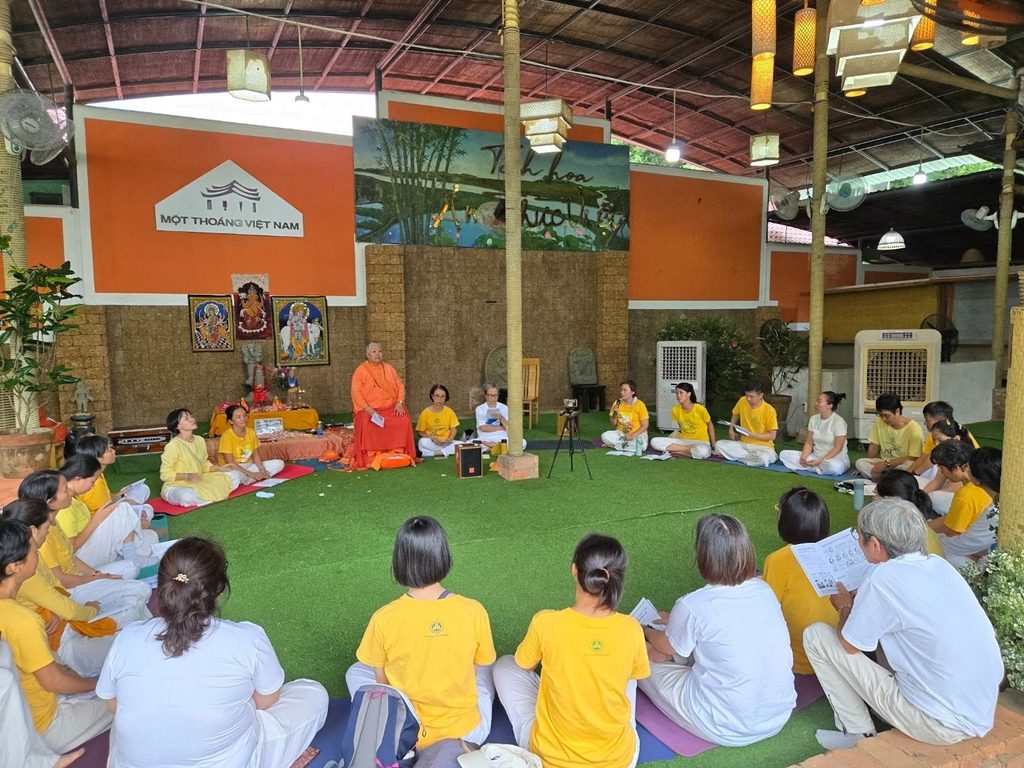
One person shared that she needed to become gentler and more feminine in the way she treated others. Another said that living truthfully had led her through a divorce, but had also helped her rediscover peace within herself and with her children. Someone who had previously been very afraid to visit Củ Chi and Bến Dược Memorial Temple felt happy afterward for having made the journey, connected with others, and gained a deeper understanding. Another person sincerely apologized to the younger generation for words spoken in the past that may have caused them pain.
One participant read a poem written at the vegetarian restaurant:
“Live without anger, resentment, or blame.
Live with a smile through trials and hardships.
Live by rising toward the morning light.
Live in harmony with all living beings.
Life is movement, yet the heart remains still.
Live with love, but without attachment.
Live in peace and joy, untouched by fame or gain.
Keep the mind unchanging amid life’s countless changes.”
These verses embody much of the spirit of yoga. To live without anger, resentment, or blame is to avoid identifying with our emotions. To smile in the face of hardship is to maintain a positive outlook. To rise toward the morning light is to continually seek light and wisdom. To live in harmony is to cultivate peace in our relationships.
“Life is movement, yet the heart remains still” recalls the teaching of the Bhagavad Gita about seeing inaction in action. “Live with love, but without attachment” expresses the spirit of non-attachment in Jnana Yoga. Regarding fame and material gain lightly reflects the virtue of aparigraha—non-possessiveness. And “Keep the mind unchanging amid life’s countless changes” reminds us of the Atman, our true Self, which is eternal and unchanging even as the outer world is constantly changing.
Another piece of calligraphy displayed these words by Master Thanh Sơn:
“We do not know what tomorrow may bring,
but whatever it brings, it is all right.”
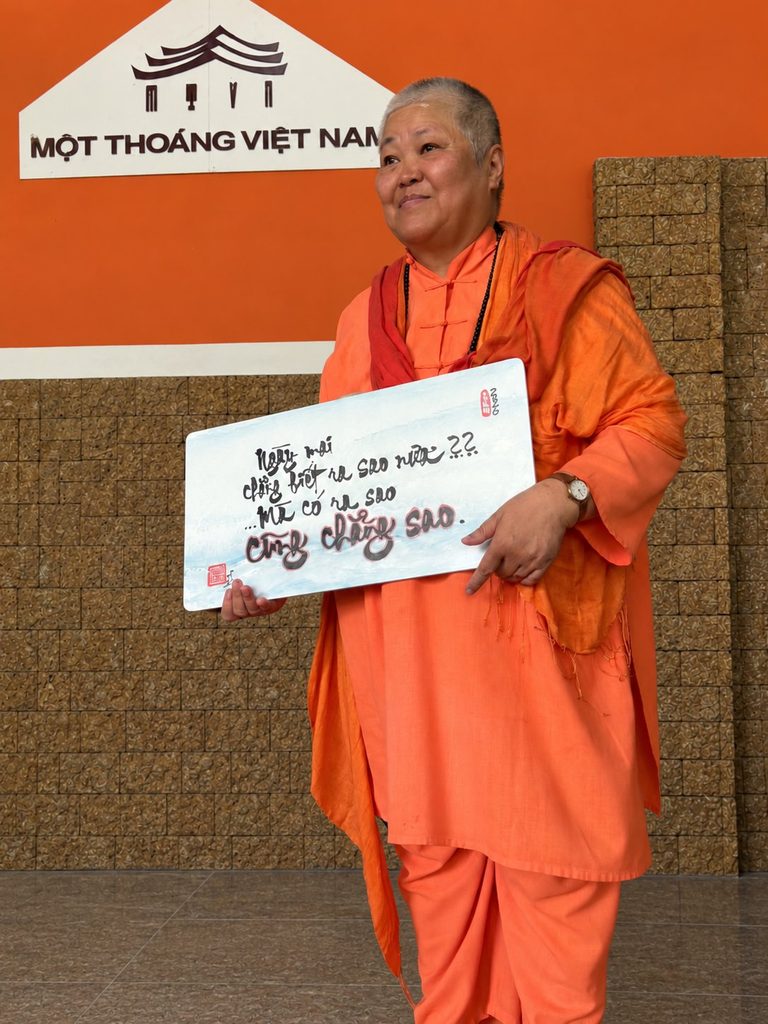
It is a simple reminder to let go and trust in the face of the unknown.
Asana for Peace and the Closing of the Circle
After the Peace Circle, we practiced an asana class for peace. Through the breath, gentle movements, and relaxation, everyone brought the message of the day deeply into their own body and mind.

At the end of the day, we gathered once more in a closing circle. Many participants felt deeply moved and grateful to have been there. Some had initially decided not to come because they were tired or busy, yet after spending the day together, they felt renewed and full of energy, with their fatigue gone. Many shared their stories through tears.
One person recalled the story of a poor elderly woman who ran a small roadside food stall. When someone felt sorry for her and remarked that her life must be very difficult, she replied that she was not suffering at all, but felt deeply blessed. During the war, whenever she heard a sound, she had to jump into a shelter. Now she could live in peace without hiding from bombs and gunfire—and to her, that alone was an immense happiness.
One person compared the atmosphere at the Ba Chúc Memorial, where approximately 3,000 people were killed—a place that still feels heavy—with that of Bến Dược Memorial Temple, which commemorates approximately 45,000 fallen soldiers. Through many years of continual remembrance, offerings, and reverence, Bến Dược today feels serene and carries a profoundly uplifting energy. The sincere remembrance of the living has the power to heal the past.
Some realized that they now understood their parents more deeply. Their parents had lived through the war, and some of the difficulties in their personalities and lives may bear the imprint of those years of fear and uncertainty. This understanding opened the heart to compassion rather than judgment.
Many people said they now better understood the difference between external peace and inner peace: external peace is generally understood in relation to outer circumstances, while inner peace begins within. One participant expressed gratitude and felt a deeper connection with her own father after the pilgrimage. Everyone wished to bring peace into their daily lives, rather than experience it only on one special day.
Through these heartfelt reflections, everyone developed greater empathy for those seated with them in the circle. From that shared understanding, each person felt strengthened to live in peace and spread peace to others.
As the pilgrimage came to an end, everyone boarded the vehicles, said their farewells, and returned home. But what we carried with us was more than the memory of a journey. It was the understanding that inner peace is not a distant ideal. It is created through every breath, every word, and every conscious action—through forgiveness, gratitude, remembrance, and our willingness to open our hearts to our own suffering and that of others.
When a person finds inner peace, they can bring peace into their family. When families live in harmony, communities can begin to heal. And from such small circles of truthfulness, empathy, and love, peace can spread throughout the world.
Om Shanti, Shanti, Shanti.

Author: Swami Sitaramananda
Swami Sitaramananda is a senior acharya of the International Sivananda Yoga Vedanta Centers and is director of the Sivananda Yoga Farm, California and the Sivananda Yoga Resort and Training Center, Vietnam. She is acharya of China, Taiwan, and Japan as well. Swamiji is the organizer and main teacher of the Sivananda Yoga Health Educator Training (SYHET), an 800-hour program on yoga therapy, accredited by the International Association of Yoga Therapists (IAYT). Swamiji is the author of Essentials of Yoga Practice and Philosophy (translated in Chinese, Japanese, and Vietnamese), Positive Thinking Manual, Karma Yoga Manual, Swamiji Said, a collection of teachings by Swami Vishnu in His Own Words, as well as two poem books. She is responsible for the Vietnamese translation of The Completed Illustrated Book of Yoga. Some of her audio lectures on Yoga Life, articles, and webinar presentations can be found on the website.