Personal impressions by Swami Sitaramananda
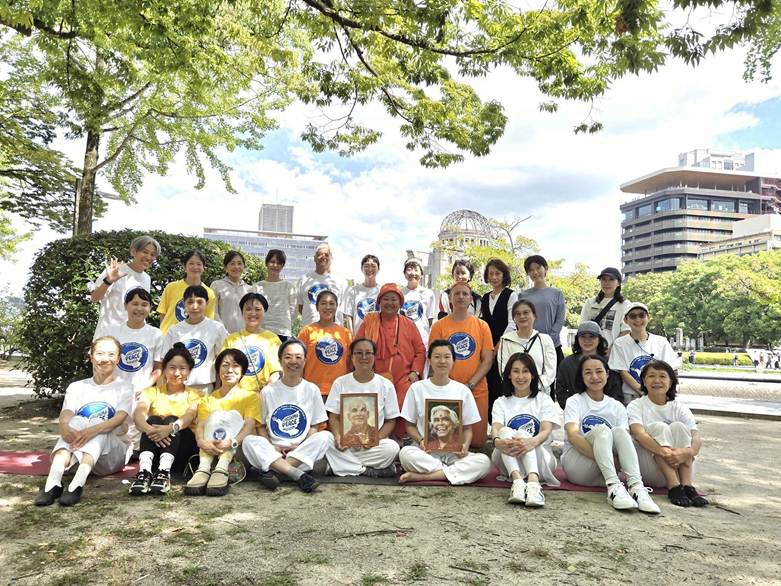
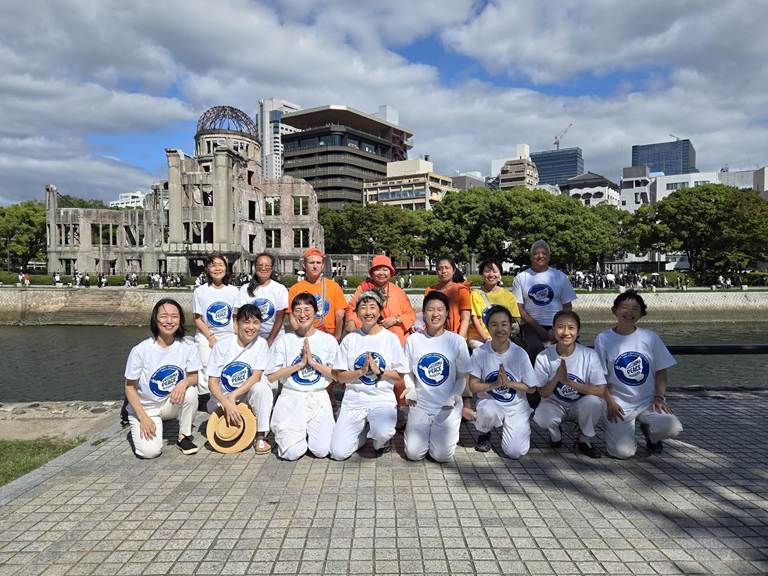
Hiroshima peace pilgrimage group.
I want to record my impressions of our Hiroshima yaatra—a sacred pilgrimage for peace.
The Journey Begins
It was one extraordinary day. We left the Tokyo Yoga Center at 6:00 a.m. and traveled for four hours by Shinkansen, the high-speed bullet train, to Hiroshima. We spent the entire day at Hiroshima Peace Memorial Park and returned to our hotel after dark, at around 9:00 p.m.
Our group numbered more than twenty. Three local Sivananda Yoga teachers from Hiroshima joined us, along with Neelakantha, whom we knew well. A graduate of the Sivananda Yoga Health Educator Training, an audiovisual documentarian, and a participant in our two-day Tokyo retreat, he lives in a nearby town and came to welcome us. Four others from the Tokyo retreat also joined us. Seven traveled by train, seven by plane, one by bus the previous day, and four were local. We also counted the Gurus as one among us.
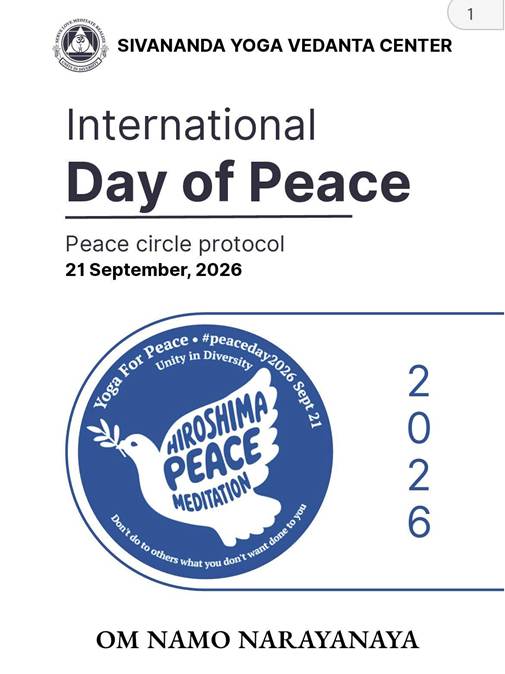
We followed the itinerary in our Sivananda Peace Circle Protocol booklet.
From our small hotel, we walked about ten minutes to the Peace Memorial Park. It was a beautiful, spacious place, with broad stone walkways, large trees, and small shrines. We first arrived at the great Peace Bell.
A Window Opened for Our Peace Mission
The night before our departure, a very large typhoon was heading toward Tokyo. We followed its path online. Strong winds and heavy rain were expected, and I imagined my large body being blown away while holding on to Swami Adiparashaktiananda! Yet I was not afraid. Come what may, I felt that this first official peace mission must go forward.
Silently, I prayed. I could not imagine that we would remain trapped in Tokyo, unable to travel to Hiroshima. If the typhoon made landfall, there would be no trains and no planes. We braced ourselves. Then, unexpectedly, the typhoon turned northward during the night, and we were able to board our train. Atmashakti called it a miracle. After we arrived that morning, we heard that train services were disrupted by the storm. It was as though the universe had opened a small window for our peace mission.
This pilgrimage had been prepared for six months through many preliminary Peace Circles. The first one in India took place in Ayodhya, following our visit to the Gandhi Museum in Delhi. We also made a deeply moving visit to Varanasi, encountering directly death at the burning ghats. Swami Padmananda facilitated many Peace Circles in Hanoi and Ho Chi Minh City, and we held two circles during the Tokyo retreat.
Our Peace Circle booklet outlined the protocol and explored essential themes: ahimsa, satya, selflessness, grief, nonviolent communication, forgiveness, yoga and meditation, and conscious action. It was translated into Vietnamese and Japanese. We also prepared 300 peace buttons and thirty white-and-blue T-shirts in Vietnam, along with three orange shirts and two yellow ones.
The Peace Bell
Hiroshima calls itself a City of Peace, yet it is also a city of continuing remembrance and grief. I was deeply moved because everything there speaks of peace. I was relieved to feel that its grief was not rooted in bitterness. It was an active remembrance, carrying the determination that such evil must never happen again.
Swami Adiparashaktiananda and I sounded the Peace Bell three times: once for Asia, once for Europe, and once for the Americas. I trust that Africa and Australia were included, as a map of the entire Earth was engraved on the bell, together with Sanskrit writing.
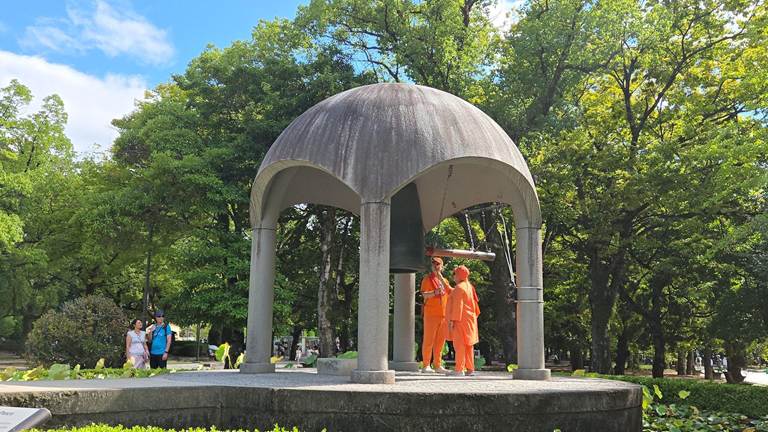
Swami Padmananda recorded its sound. She said that every step we took might be upon the remains of someone who had disappeared there. Throughout our visit, she chanted the Maha Mrityunjaya Mantra—Om Tryambakam.
The energy was extraordinary and elevated, as though we were inside a sacred church. We felt uplifted. Swami Adiparashaktiananda reminded us, “All is for the best. God’s will is supreme. In the face of suffering, we find God.” The Peace Memorial Park bears witness to this truth. It is sacred ground formed from eighty-one years of suffering: the suffering of those who died, the survivors, their descendants, the Japanese people, and visitors from around the world.
As we approached the heart of the park, I could no longer contain my emotions. I tried not to sob because I was leading the group, but I felt overwhelmed—not only by those who died in Hiroshima, but also by the suffering that continues everywhere today. Wherever we turn, we find ignorance, violence, abuse, threats, and cruelty.
Since childhood, I have been deeply involved in this work: facing grief of humanity, actively alleviating suffering, and helping myself and others awaken to the True Self beyond it. I knew that I was supposed to remember the Atman while bearing witness to the atrocities committed here. Yet, from my very first steps, even before beginning our Om Namo Narayanaya peace walk, I found myself falling apart.
Bearing Witness at the Atomic Bomb Dome
We crossed the bridge and arrived at the Atomic Bomb Dome. The structure that survived the blast stood beside the river—a stark and beautiful testimony to what had been.
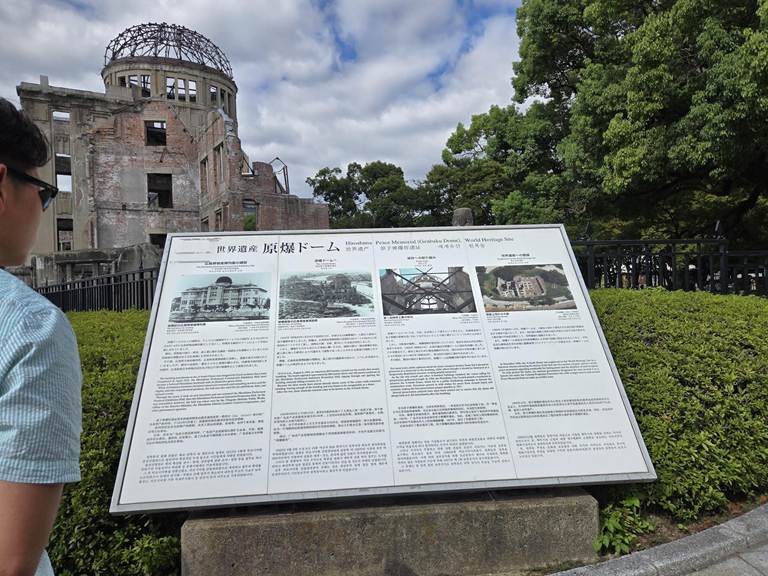
We sat in a circle on the ground under curious eyes and began to share. People from the United States, Taiwan, China, Vietnam, Hiroshima, and Tokyo spoke about their childhood memories of learning about the atomic bomb. We shared the pain of hearing people say that the bomb was good because it ended the war. Others told stories about grandparents who lived through that time and survived. We spoke of the different kinds of casualties and of suffering transmitted from one generation to the next. There were many tears. Together, we learned to honor grief.
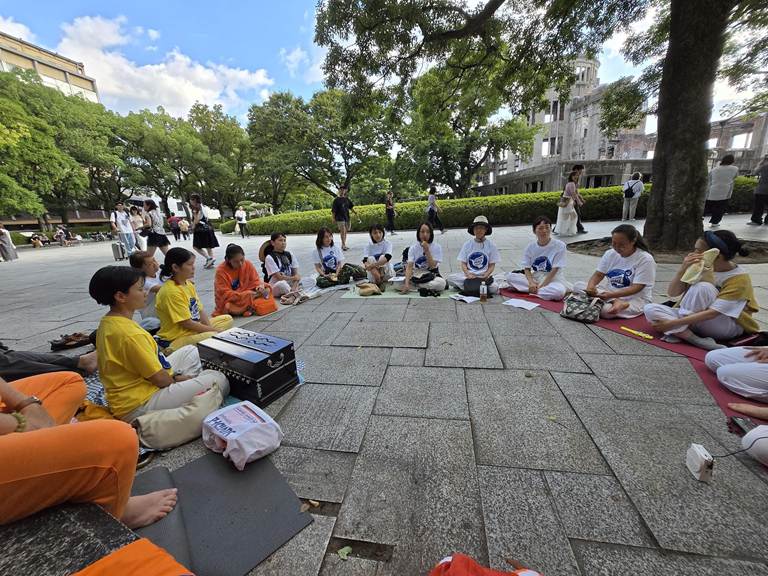
One person expressed surprise at seeing so many tourists while so few were engaged in meditation, prayer, or dialogue in this extraordinary place. We felt that more kirtan and more Peace Circles should be offered here for healing.
The kirtan uplifted us immediately. If we forget God, evil can happen. An Indian passerby who joined us with his wife said, “If good people do nothing, evil happens.” He belonged to a spiritual organization based in London and India. He offered dakshina, bowed to me, and acknowledged the importance of spiritual leadership.
Neelakantha said, “Swami Sita helped us to heal something very deep in the Japanese subconscious—a feeling of being a loser.”
But humanity lost, Neelakantha—not Japan alone. We are all lost in war. In war, there are no winners and no losers. Hiroshima belongs to the whole world. It is a City of Peace and eternal remembrance—a place that transforms grief through forgiveness and light. Sometimes it takes great suffering for humanity to learn the lesson of Oneness.
Remembering the Children
We shared from 2:00 until 5:00 p.m. Then we walked to the memorial honoring the schoolchildren who lost their lives. Their names are inscribed on bronze plaques near the great statue of the Goddess of Peace, whose face reminded us of Quan Yin and whose form has two large wings.
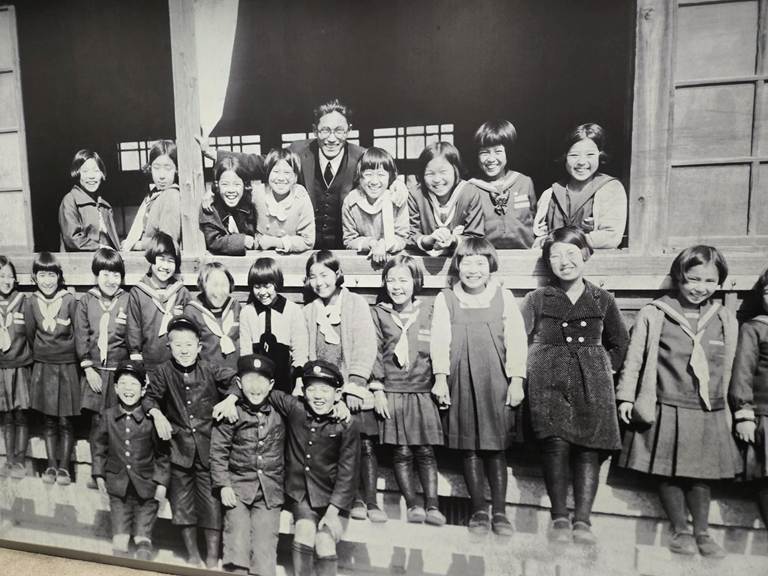
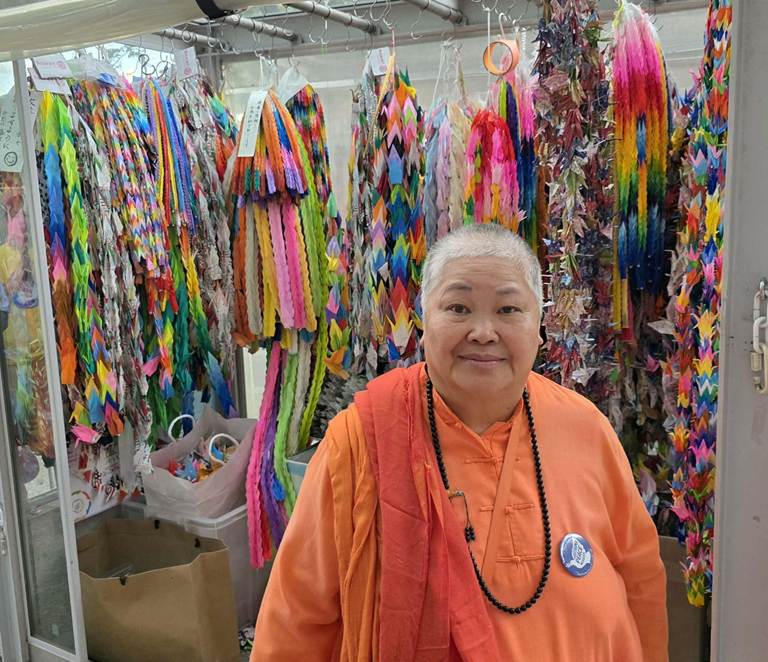
We offered strings of two hundred colorful paper cranes at the Children’s Peace Monument and rang the bell. Thousands of children died without ever having the chance to live out their lives. We remembered them with tenderness and prayer.
Peace Puja Beside the Eternal Flame
We then walked to the Eternal Flame. The setting was profoundly beautiful: the symbolic tomb, the flame surrounded by water, and the Atomic Bomb Dome visible in the distance.
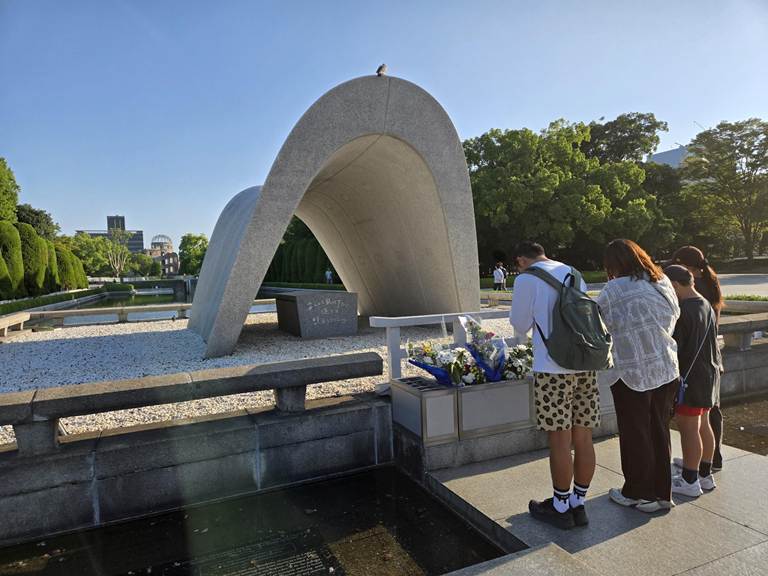
Near the memorial to a mother and child, we prepared our Peace Puja. We had carried statues of the Gurus and statues of Lord Krishna and Goddess Lakshmi from Tokyo. I added a box containing cloth from Swami Sivananda and Swami Vishnudevananda, which I had received during my Acharya initiation. In this way, the Sivananda lineage was present with us beside the Eternal Flame, at the edge of the trees.
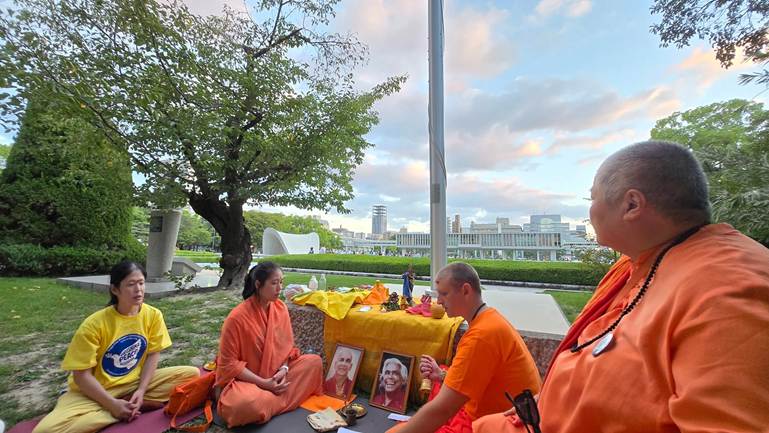
We performed a full abhishekam for Lord Ganesha, the Shiva Lingam, and Mother Durga. We repeated Om Tryambakam, Om Namo Narayanaya, and Om Sri Durgayai Namah.
I felt Mother Durga to be the presiding deity of Hiroshima—the Divine Mother who protects, confronts the demons, and emerges victorious. Om Sri Durgayai Namah.
We completed the puja in the gathering darkness, with arati, the ringing of the bell, and the darshan of the moon above the trees. It was magic. May peace prevail. May the Divine Mother protect us all.
The Peace Memorial Museum
The following day, we visited the large Hiroshima Peace Memorial Museum. It presents a powerful reconstruction of Hiroshima before and after the bombing. When we walked through its pitch-dark corridors, the reality of what had happened truly hit home. We saw photographs of young students full of life and, afterward, pictures of them burned and bald, lying in pain. We saw paintings depicting unbearable scenes. The most striking ones for me were a painting of stacks of bodies filling the river and another of people with hanging flesh. There were photographs of the devastation and heartbreaking testimonies from survivors.
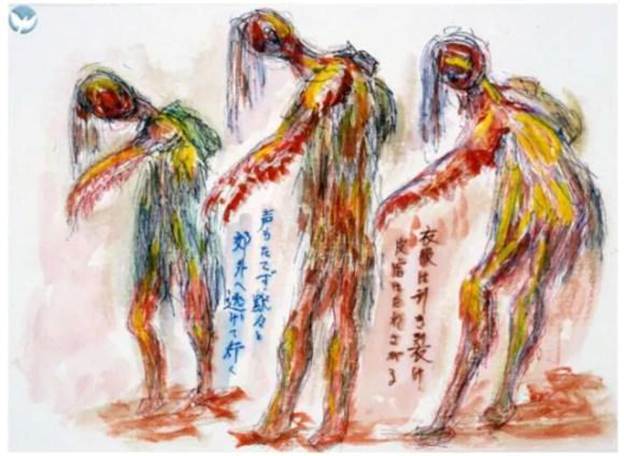
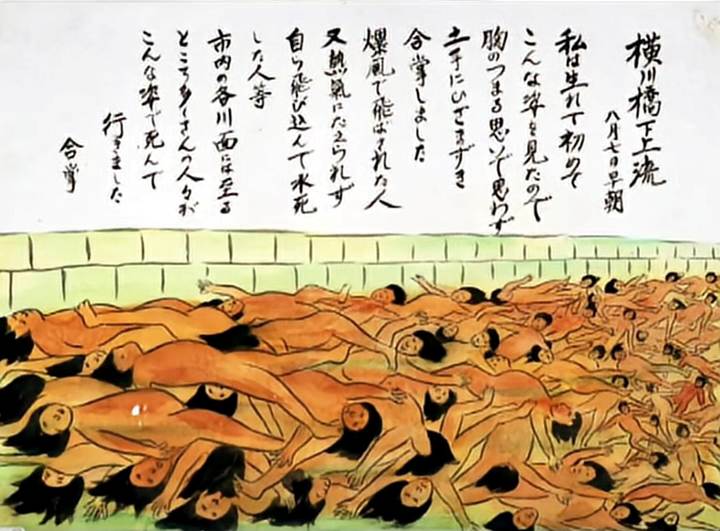
One of the most powerful exhibits showed the bomb exploding above the city and the destructive force radiating across a vast area. Its message was unmistakable: such an atrocity must never be allowed to happen again.
Approximately 140,000 people are estimated to have died in Hiroshima by the end of 1945. Many others suffered and died later from injuries, illness, and radiation exposure, and not every death was fully accounted for.
I saw an exhibit showing the pained face of Pope Francis, who had visited, and the solemn face of President Barack Obama, who signed in support of nuclear nonproliferation at that time. I also saw pictures of nations’ delegates at conferences discussing deterrence and the use of the atomic bomb. I prayed for wisdom for our world.
Yoga Is Peace in the Making
A full yoga class was held beneath the trees, just across from the Atomic Bomb Dome, beside the river. One participant shared that she truly felt the intensity of the yoga class while lying on the ground near the epicenter, where so many people had died. She was now relaxing and breathing, with the images she had seen in the museum revolving in her mind, while at the same time hearing the Peace Bell nearby.
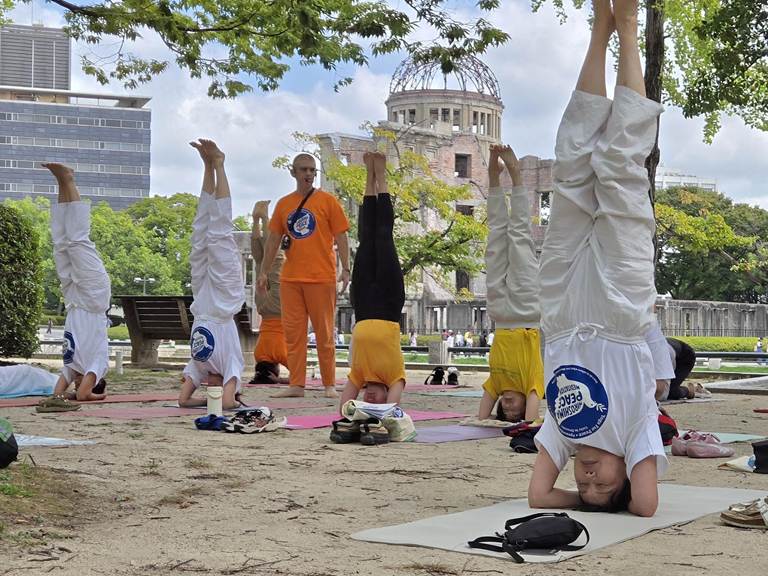
The yoga class brought the five-day peace retreat from Tokyo to Hiroshima to a meaningful conclusion. The fact is that many people do not make the connection between asanas and peace, yet asana, pranayama, and meditation are at the very heart of peace.
We held a final sharing circle, once again listening attentively without moving for two and a half hours. We chanted Jaya Ganesha and talked about our gratitude for being there. We shared our admiration for the resilience of the Japanese people—how they persevered and rebuilt the city after only a few years. We talked about the silence of a Japanese grandfather who was unable to share, perhaps because he was still in denial or suffering from PTSD.
Someone mentioned the necessity of taking responsibility for wrong actions and egoistic thinking that contribute to war, and how recognizing our part in conflicts is the way toward acceptance and true healing. We talked about our determination to continue, one step at a time, holding on to our inner peace in our daily lives. We promised ourselves that we would take action to help and share.
“This kind of peace retreat really helps us become aware of what peace truly is,” exclaimed Swami Padma afterward. “We need to do more and more of it.”
Yoga is not merely talking about peace. It is peace in the making.
When the body becomes steady, the breath becomes calm. When the breath becomes calm, the mind becomes peaceful. From peace of mind come clarity, compassion, forgiveness, and wise action.
“Peace of mind is happiness. Yoga shows the way,” Swami Vishnudevananda said. He was the one who imprinted Hiroshima in my mind years ago, in the 1980s, as he remembered to commemorate the 6th of August by having us walk around the village of Val Morin with banners and posters: “No to nuclear bombs!”
Indeed, Swamiji’s peace missionary spirit lives on today in this Hiroshima pilgrimage.
Om Namo Narayanaya!
WordPress Publishing Notes
Suggested URL slug: hiroshima-pilgrimage-peace-remembrance
Suggested excerpt: A personal reflection by Swami Sitaramananda on the Sivananda peace pilgrimage to Hiroshima—bearing witness, honoring grief, practicing prayer and yoga, and renewing the commitment to peace.
Suggested category: Peace / Yoga Philosophy (choose the closest categories already used on your site).
Suggested featured image: the opening group photograph in front of the Atomic Bomb Dome.
Publishing: In WordPress go to Posts → Add New, copy the article text, use each Heading 1 in this document as an H2 on the website, upload the corresponding photographs to the Media Library, set the opening group photo as Featured Image, preview on desktop and mobile, then publish.

Author: Swami Sitaramananda
Swami Sitaramananda is a senior acharya of the International Sivananda Yoga Vedanta Centers and is director of the Sivananda Yoga Farm, California and the Sivananda Yoga Resort and Training Center, Vietnam. She is acharya of China, Taiwan, and Japan as well. Swamiji is the organizer and main teacher of the Sivananda Yoga Health Educator Training (SYHET), an 800-hour program on yoga therapy, accredited by the International Association of Yoga Therapists (IAYT). Swamiji is the author of Essentials of Yoga Practice and Philosophy (translated in Chinese, Japanese, and Vietnamese), Positive Thinking Manual, Karma Yoga Manual, Swamiji Said, a collection of teachings by Swami Vishnu in His Own Words, as well as two poem books. She is responsible for the Vietnamese translation of The Completed Illustrated Book of Yoga. Some of her audio lectures on Yoga Life, articles, and webinar presentations can be found on the website.