After the Peace Pilgrimage in Hiroshima, Japan, I returned to Vietnam with a heartfelt intention to continue this journey: to reflect together on the suffering of the past, heal the memories that remain in our consciousness, and rediscover true peace within.
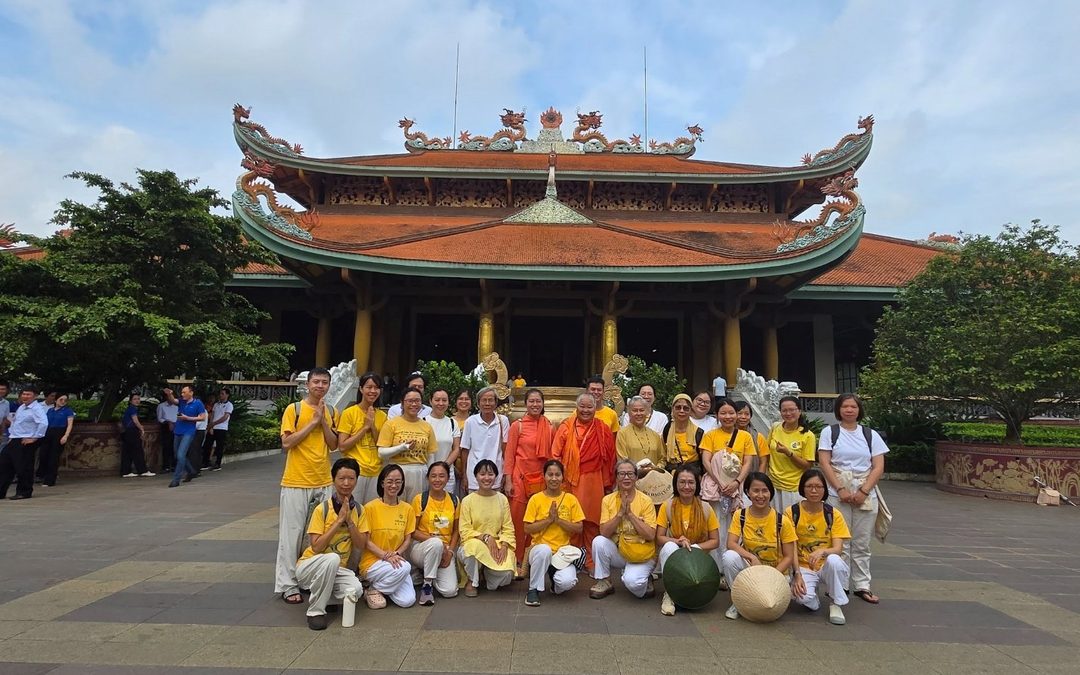
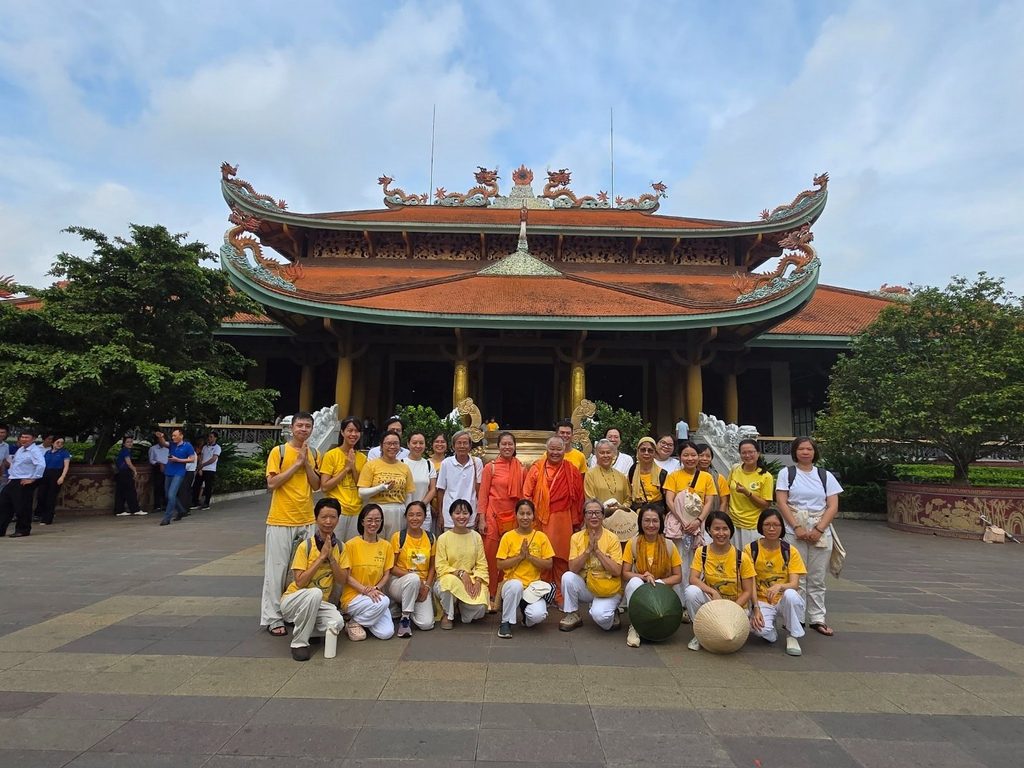
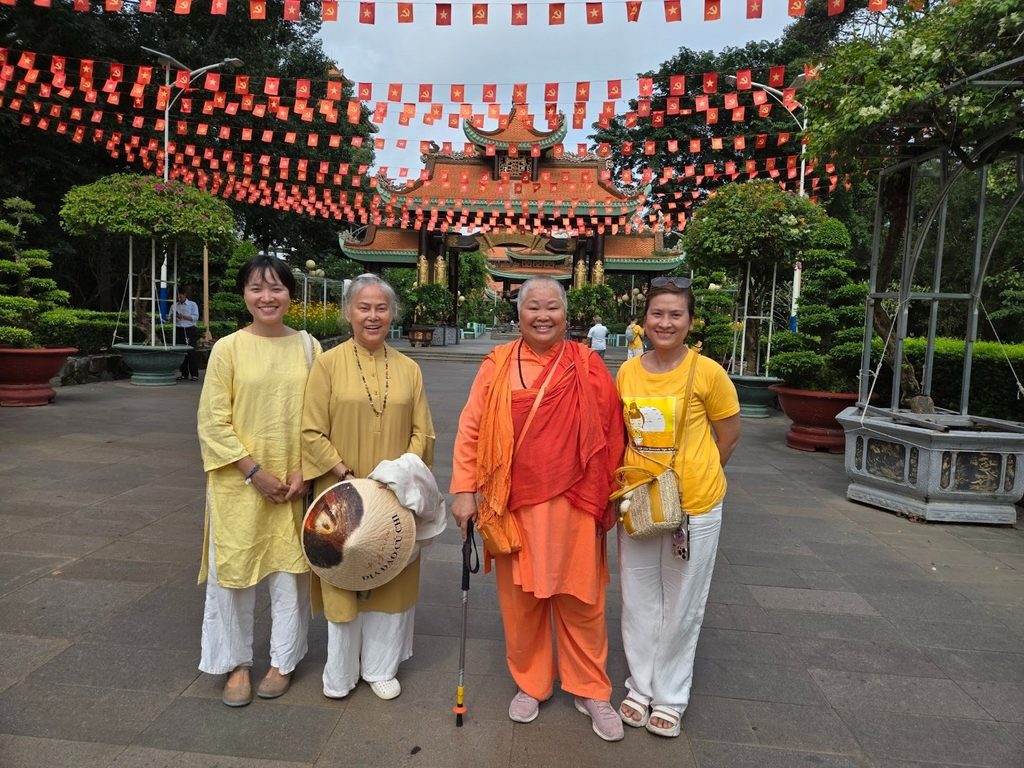
At 6:00 a.m., I set out for Củ Chi with 35 Vietnamese friends, traveling in two small vehicles and one large bus. Our first stop was the Bến Dược Military Memorial Temple, which honors approximately 45,000 people who sacrificed their lives for the country.
Returning to the “Land of Steel and Bronze”
Củ Chi was once known as the “Land of Steel and Bronze.” During the war, it endured such intense bombardment that it was at one point called a “white zone”—an area devastated and stripped of life. Countless lives were lost, and profound suffering remains deeply imprinted in the memories of many generations.
I have had a special connection with Củ Chi for many years. From 2010 to 2014, I taught yoga teacher training courses there. At the time, I felt that I was teaching yoga and yoga philosophy not only to those present in the classroom, but also to many souls in the surrounding area who were listening.
On the final day of one course, the sky was clear when a powerful wind suddenly arose. The atmosphere became joyful and mystical, as though many unseen beings were happily bidding us farewell. When we later reviewed the photographs, hundreds of white spots—commonly called “orbs”—appeared in them. Above my head was a very large circle of light that resembled a halo. It was a profound experience that has always remained with me, leading me to remember Củ Chi as a place in need of remembrance, love, and healing.
Today, as I conduct peace programs in many places, I carry with me a heartfelt intention: to help heal what happened in the past but still lingers in the human subconscious. Painful memories need to be acknowledged with compassion so that they may gradually be released.
We intentionally use the word inner peace, because peace begins within. Peace may refer to external circumstances or cessation of war, but inner peace is something each person can cultivate through a yogic life. Through the practice of asana, pranayama, and meditation, we connect with the peace that already exists within us. When we understand ourselves and live in harmony with ourselves, we can understand others, bring harmony into our relationships, and help create peace in our communities and throughout the world.
Remembrance at Bến Dược Memorial Temple
Before passing through the main gate of Bến Dược Memorial Temple, I asked everyone to remain solemn, refrain from talking, and silently repeat two mantras: Om Namo Narayanaya, a prayer for peace; and Om Tryambakam Yajamahe, a mantra praying for the liberation of those who have passed away and for peace for those who are still living.
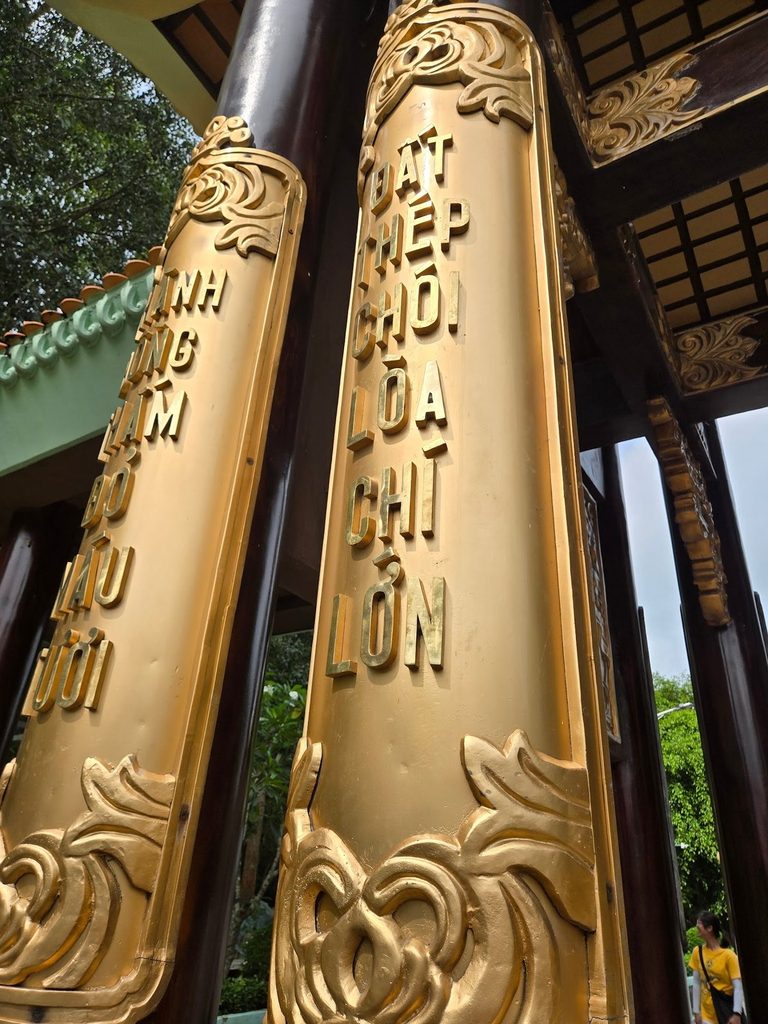
After taking a group photograph in front of the gate, we slowly entered while chanting the mantras. In the middle of the broad pathway stood a majestic incense burner. The entire memorial complex was beautifully maintained, with tall rows of trees, flowers, greenery, and solemn architecture resembling that of a temple. Many leaders and generals have planted commemorative trees there.
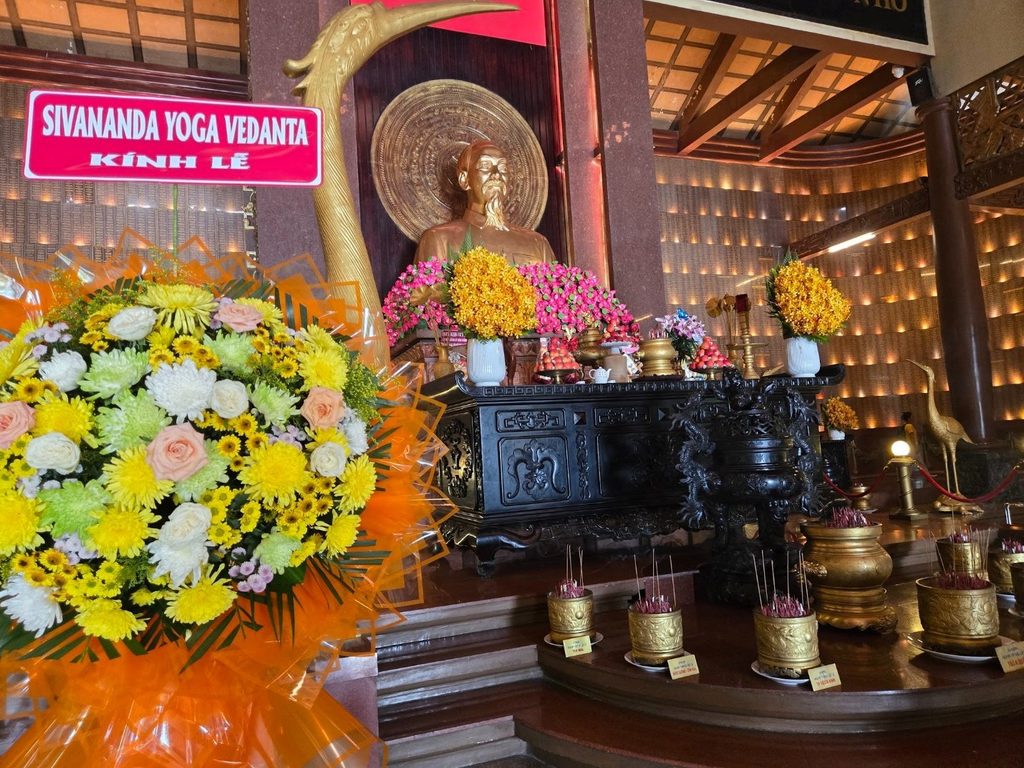
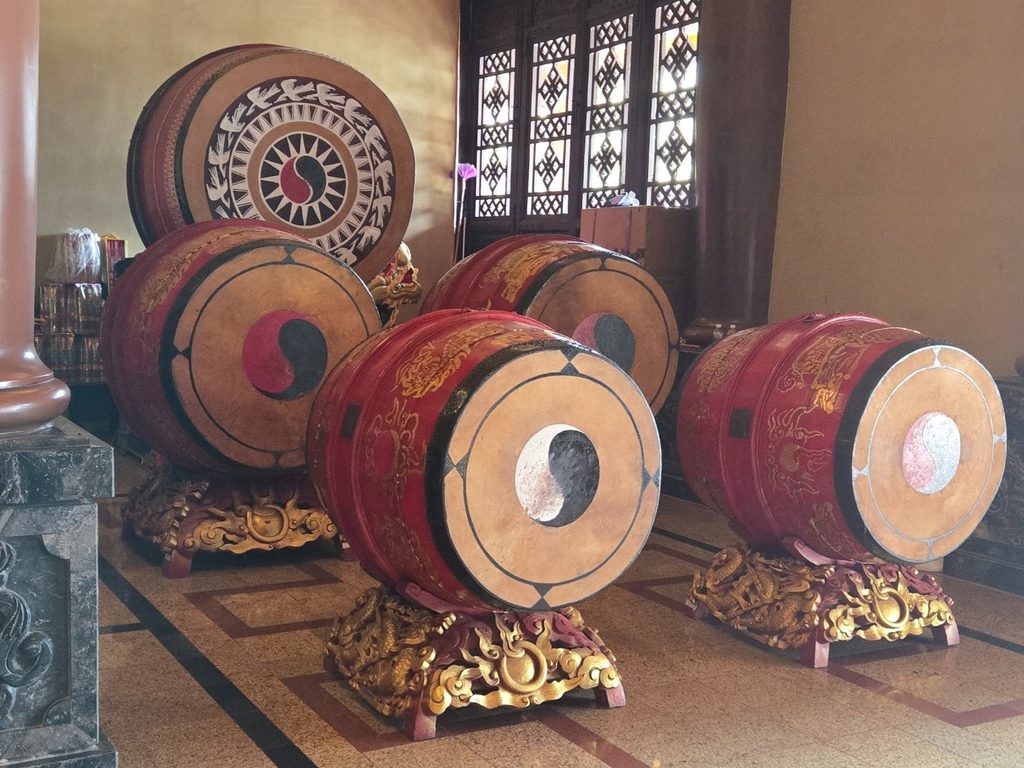
Upon entering the main sanctuary, we observed one minute of silence. The resounding great bell, the drums, and the sacred music deeply moved many people. Two floral wreaths bearing the name Sivananda Yoga were placed respectfully before the altar.
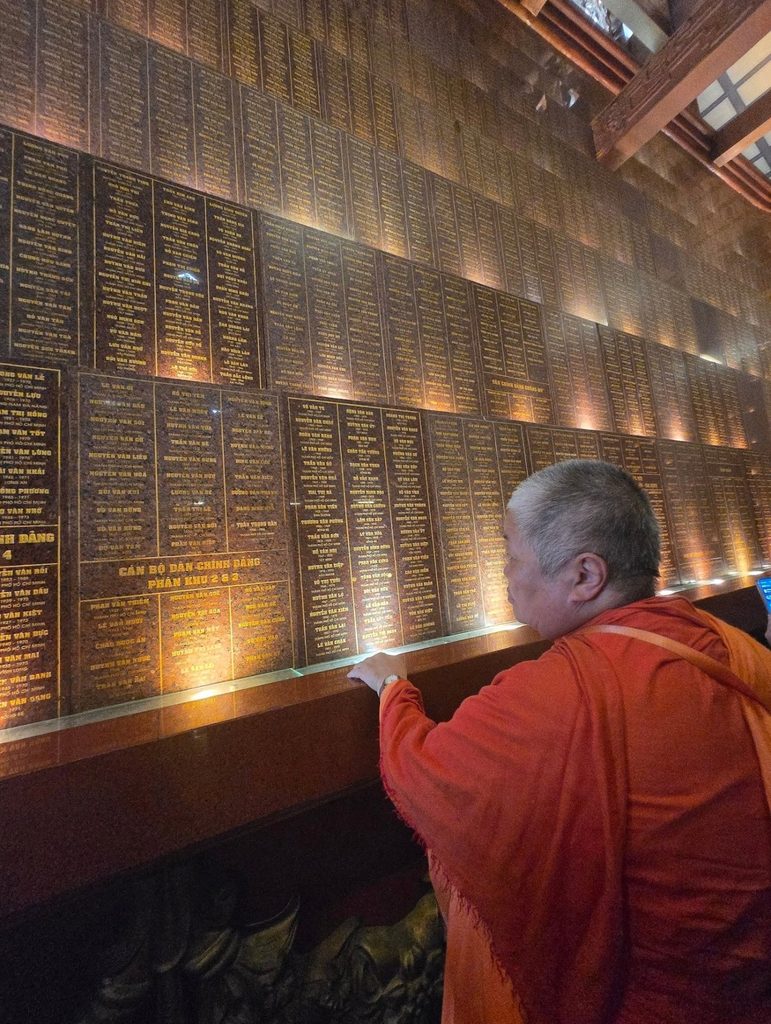
At the center stood a statue of President Hồ Chí Minh. Along the three surrounding walls were bronze plaques engraved with the names of the fallen soldiers, together with their places of birth and the years of their birth and death. Most of them were very young—only 18, 20, 22, or 23 years old—when they sacrificed their lives for their homeland.
Everyone walked around quietly, reading the names one by one. One member of our group, Ms. Mỹ, found the name of her older brother, a fallen soldier who had been missing, and requested an official confirmation. Tarini was also deeply moved when she asked for help locating her maternal grandfather’s name. Among the tens of thousands of names, history was no longer something abstract; each name represented a life, a family, and a story that continues to be remembered.
Behind the temple, we sat together in a Peace Circle and chanted Jaya Ganesha. When other groups of visitors arrived, we lowered our voices and continued chanting softly. Many people shared that the energy of this place felt very pure, gentle, and sacred. Perhaps, through so many years of remembrance, prayer, and sincere offerings, those who passed away have found peace.
Each day, ceremonial tables at the temple are carefully prepared with Vietnamese food as offerings to the fallen soldiers. The enduring care and gratitude of the living seem to have transformed a land once filled with suffering into a place of serenity and sacred beauty.
Một Thoáng Việt Nam: Transforming Bomb Craters into a Place That Preserves Vietnamese Culture
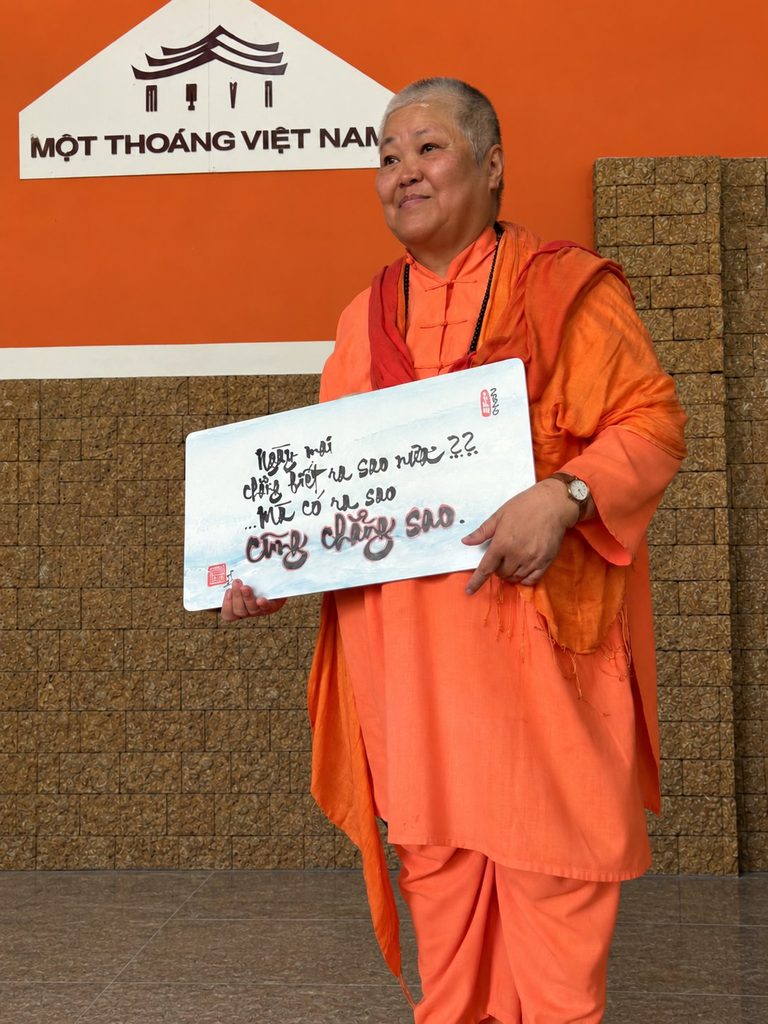
Leaving Bến Dược Memorial Temple, we traveled to the Một Thoáng Việt Nam cultural and traditional craft village. Ms. Trần Thị Tuyết Nga, its founder and General Director, warmly and formally welcomed our group. As a war veteran, she has devoted herself wholeheartedly to preserving and sharing the values of traditional Vietnamese culture with both Vietnamese people and international visitors.
The site preserves many historical artifacts, statues, altars, and teachings of distinguished Vietnamese figures, military leaders, and poets. I was especially drawn to the memorial plaque honoring Trần Quốc Tuấn, also known as Hưng Đạo Đại Vương, who three times led the soldiers and people of Đại Việt in resisting the Mongol–Yuan invasions. Wooden stakes evoke the victory at Bạch Đằng and the wisdom of our ancestors, who harnessed the tides to defend their homeland.
At the center of the traditional house stood the Altar of the Nation and the Land, built with sacred soil gathered from all 63 provinces and municipalities, symbolizing the unity of the Vietnamese people. It is also a place where Vietnamese people can return to their roots and honor the ancestors of the nation’s many family lineages, from the earliest days of settling the land and founding the country.
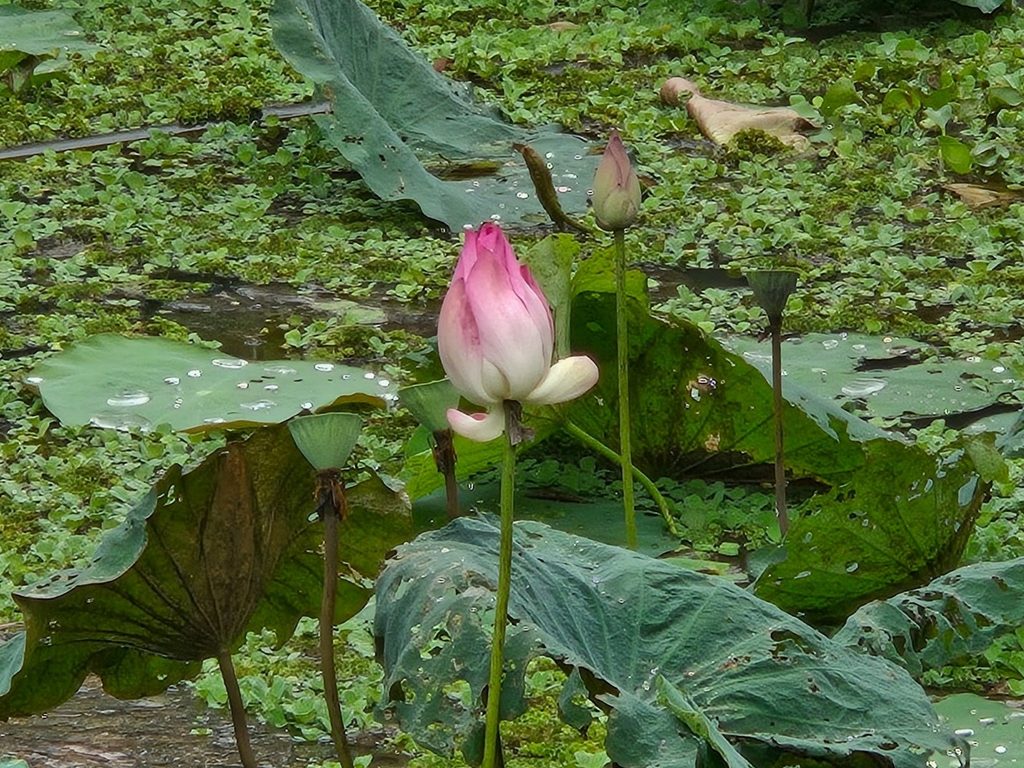
Ms. Nga explained that this land was once a muddy bomb crater. She overcame many difficulties and used nearly one million cubic meters of soil to fill it, transforming a scar of war into a lush cultural sanctuary with brick pathways, rows of bamboo, climbing vines, flowers, greenery, and lotus ponds. It is a deeply meaningful image of transformation: from destruction to life, and from memories of war to beauty and culture.
Puja for Universal Peace
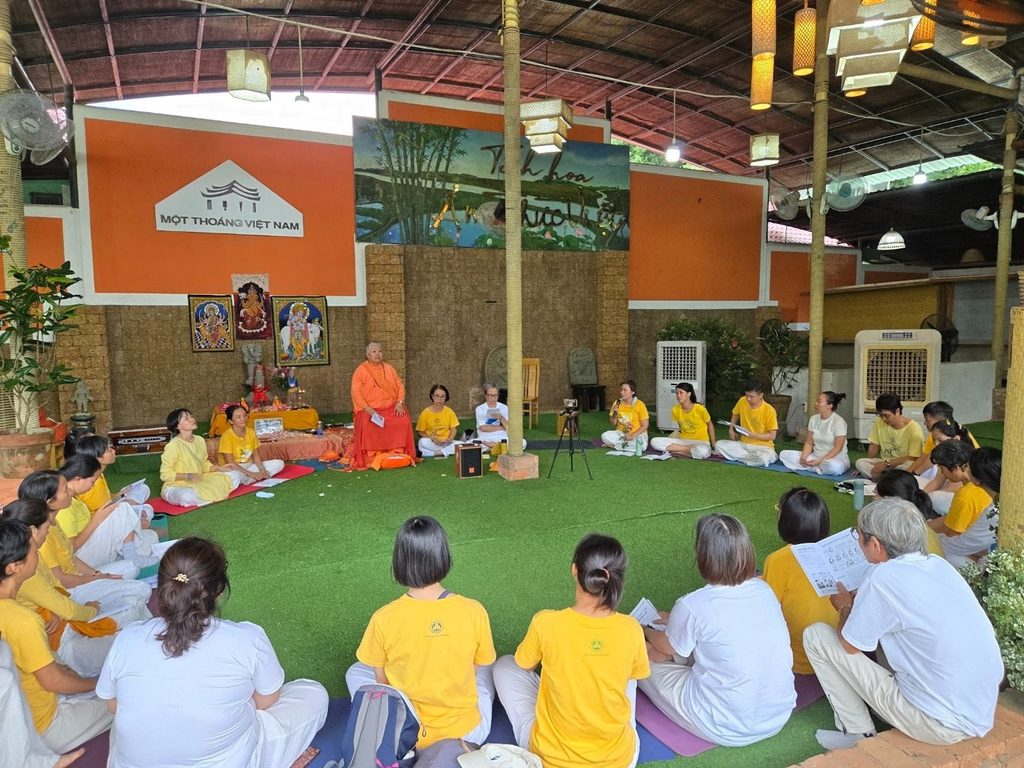
After offering incense at the ancestral altar, we performed a traditional Indian puja to pray for universal peace. Ms. Nga shared that while deeply honoring Vietnamese culture and our homeland, we should also open our hearts and pray for all humanity.
At the center of the puja was a large stone Shiva Lingam from the Cham culture. Its lower part represents feminine energy, while its upper part represents masculine energy. The Shiva Lingam symbolizes the harmony of yin and yang and the union of cosmic consciousness with cosmic energy—the two aspects that bring this world into being.
Beside the Shiva Lingam, we placed a statue of Ganesha and images of the spiritual masters of the Sivananda tradition. The presence of the masters helps us understand the deeper meaning of worship, so that ritual does not become superstition but remains a path of understanding and spiritual connection.
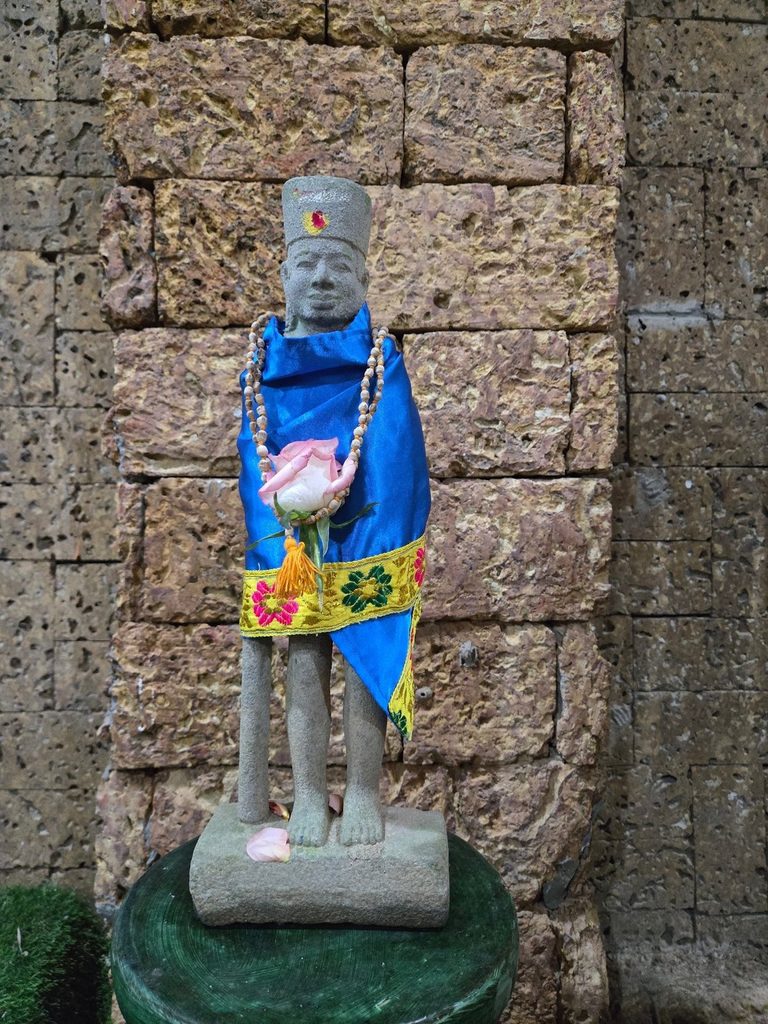
The altar also held a small statue of Vishnu, believed to be approximately one thousand years old. Although only about 20 centimeters tall, it radiated a powerful vitality and possessed a uniquely captivating beauty. Vishnu symbolizes preservation, inner peace, and peace throughout the world.
Ms. Nga shared that, in preparation for this day of prayer, she had visited the Cát Tiên Sanctuary—where traces of Shiva Lingam worship remain—and the Cao Đài Holy See in Tây Ninh to seek blessings and pray for the ceremony’s successful completion.
One by one, each member of the group came forward to offer milk, water, and flowers to the Shiva Lingam while we chanted the 108 names of Lord Shiva together. The solemn ceremony served as a bridge connecting Vietnamese culture, Cham culture, and the spiritual traditions of India in a shared prayer for peace.
Afterward, everyone enjoyed a generous vegetarian meal beside the lotus pond. The dishes were light and wholesome, beautifully presented, and given meaningful names.
A Peace Circle in the Rain
After the meal, the group gathered in a Peace Circle. I gave each person a topic to reflect upon and share. Rather than speaking in general terms, each participant looked deeply within and spoke from personal experience. A flower and a microphone were passed from one person to the next. As everyone began to open their hearts, heavy rain started to fall.
The topics shared by all are centered on restoring inner peace: ahimsa—nonviolence; satya and satyagraha—truthfulness and the power of truth; selflessness and service; courage; forgiveness; grief and loss; yoga and meditation; self-mastery; and conscious action.
Some remembered the soldiers who had sacrificed their lives in service to their country. Others expressed regret for having lost their temper or behaved harshly toward their children. Some admitted that forgiveness was very difficult, yet they remained committed to trying. One person spoke of losing a close friend and wept for a beloved cat who had been a companion for 17 years. Through grief, there is inner realization how important it is to keep the heart open.
One person shared that she needed to become gentler and more feminine in the way she treated others. Another said that living truthfully had led her through a divorce, but had also helped her rediscover peace within herself and with her children. Someone who had previously been very afraid to visit Củ Chi and Bến Dược Memorial Temple felt happy afterward for having made the journey, connected with others, and gained a deeper understanding. Another person sincerely apologized to the younger generation for words spoken in the past that may have caused them pain.
One participant read a poem written at the vegetarian restaurant:
“Live without anger, resentment, or blame.
Live with a smile through trials and hardships.
Live by rising toward the morning light.
Live in harmony with all living beings.
Life is movement, yet the heart remains still.
Live with love, but without attachment.
Live in peace and joy, untouched by fame or gain.
Keep the mind unchanging amid life’s countless changes.”
These verses embody much of the spirit of yoga. To live without anger, resentment, or blame is to avoid identifying with our emotions. To smile in the face of hardship is to maintain a positive outlook. To rise toward the morning light is to continually seek light and wisdom. To live in harmony is to cultivate peace in our relationships.
“Life is movement, yet the heart remains still” recalls the teaching of the Bhagavad Gita about seeing inaction in action. “Live with love, but without attachment” expresses the spirit of non-attachment in Jnana Yoga. Regarding fame and material gain lightly reflects the virtue of aparigraha—non-possessiveness. And “Keep the mind unchanging amid life’s countless changes” reminds us of the Atman, our true Self, which is eternal and unchanging even as the outer world is constantly changing.
Another piece of calligraphy displayed these words by Master Thanh Sơn:
“We do not know what tomorrow may bring,
but whatever it brings, it is all right.”
It is a simple reminder to let go and trust in the face of the unknown.
Asana for Peace and the Closing of the Circle
After the Peace Circle, we practiced an asana class for peace. Through the breath, gentle movements, and relaxation, everyone brought the message of the day deeply into their own body and mind.
At the end of the day, we gathered once more in a closing circle. Many participants felt deeply moved and grateful to have been there. Some had initially decided not to come because they were tired or busy, yet after spending the day together, they felt renewed and full of energy, with their fatigue gone. Many shared their stories through tears.
One person recalled the story of a poor elderly woman who ran a small roadside food stall. When someone felt sorry for her and remarked that her life must be very difficult, she replied that she was not suffering at all, but felt deeply blessed. During the war, whenever she heard a sound, she had to jump into a shelter. Now she could live in peace without hiding from bombs and gunfire—and to her, that alone was an immense happiness.
One person compared the atmosphere at the Ba Chúc Memorial, where approximately 3,000 people were killed—a place that still feels heavy—with that of Bến Dược Memorial Temple, which commemorates approximately 45,000 fallen soldiers. Through many years of continual remembrance, offerings, and reverence, Bến Dược today feels serene and carries a profoundly uplifting energy. The sincere remembrance of the living has the power to heal the past.
Some realized that they now understood their parents more deeply. Their parents had lived through the war, and some of the difficulties in their personalities and lives may bear the imprint of those years of fear and uncertainty. This understanding opened the heart to compassion rather than judgment.
Many people said they now better understood the difference between external peace and inner peace: external peace is generally understood in relation to outer circumstances, while inner peace begins within. One participant expressed gratitude and felt a deeper connection with her own father after the pilgrimage. Everyone wished to bring peace into their daily lives, rather than experience it only on one special day.
Through these heartfelt reflections, everyone developed greater empathy for those seated with them in the circle. From that shared understanding, each person felt strengthened to live in peace and spread peace to others.
As the pilgrimage came to an end, everyone boarded the vehicles, said their farewells, and returned home. But what we carried with us was more than the memory of a journey. It was the understanding that inner peace is not a distant ideal. It is created through every breath, every word, and every conscious action—through forgiveness, gratitude, remembrance, and our willingness to open our hearts to our own suffering and that of others.
When a person finds inner peace, they can bring peace into their family. When families live in harmony, communities can begin to heal. And from such small circles of truthfulness, empathy, and love, peace can spread throughout the world.
I want to record my impressions of our Hiroshima yaatra—a sacred pilgrimage for peace.
The Journey Begins
It was one extraordinary day. We left the Tokyo Yoga Center at 6:00 a.m. and traveled for four hours by Shinkansen, the high-speed bullet train, to Hiroshima. We spent the entire day at Hiroshima Peace Memorial Park and returned to our hotel after dark, at around 9:00 p.m.
Our group numbered more than twenty. Three local Sivananda Yoga teachers from Hiroshima joined us, along with Neelakantha, whom we knew well. A graduate of the Sivananda Yoga Health Educator Training, an audiovisual documentarian, and a participant in our two-day Tokyo retreat, he lives in a nearby town and came to welcome us. Four others from the Tokyo retreat also joined us. Seven traveled by train, seven by plane, one by bus the previous day, and four were local. We also counted the Gurus as one among us.
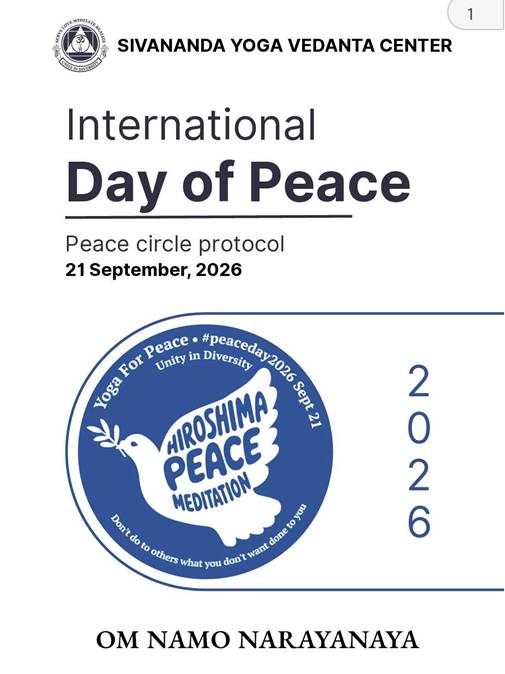
We followed the itinerary in our Sivananda Peace Circle Protocol booklet.
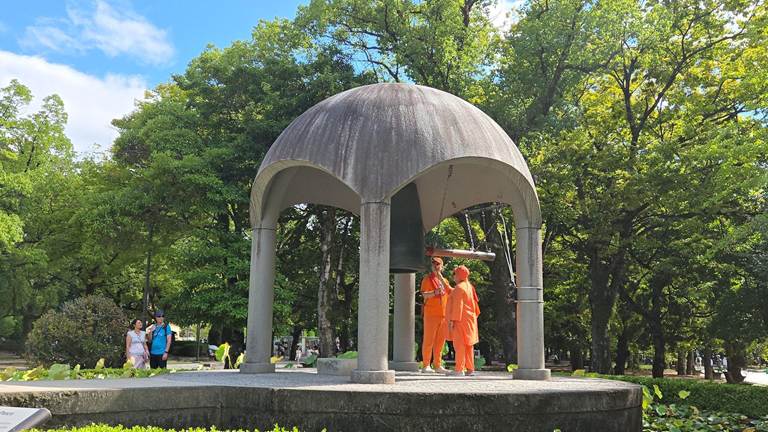
From our small hotel, we walked about ten minutes to the Peace Memorial Park. It was a beautiful, spacious place, with broad stone walkways, large trees, and small shrines. We first arrived at the great Peace Bell.
A Window Opened for Our Peace Mission
The night before our departure, a very large typhoon was heading toward Tokyo. We followed its path online. Strong winds and heavy rain were expected, and I imagined my large body being blown away while holding on to Swami Adiparashaktiananda! Yet I was not afraid. Come what may, I felt that this first official peace mission must go forward.
Silently, I prayed. I could not imagine that we would remain trapped in Tokyo, unable to travel to Hiroshima. If the typhoon made landfall, there would be no trains and no planes. We braced ourselves. Then, unexpectedly, the typhoon turned northward during the night, and we were able to board our train. Atmashakti called it a miracle. After we arrived that morning, we heard that train services were disrupted by the storm. It was as though the universe had opened a small window for our peace mission.
This pilgrimage had been prepared for six months through many preliminary Peace Circles. The first one in India took place in Ayodhya, following our visit to the Gandhi Museum in Delhi. We also made a deeply moving visit to Varanasi, encountering directly death at the burning ghats. Swami Padmananda facilitated many Peace Circles in Hanoi and Ho Chi Minh City, and we held two circles during the Tokyo retreat.
Our Peace Circle booklet outlined the protocol and explored essential themes: ahimsa, satya, selflessness, grief, nonviolent communication, forgiveness, yoga and meditation, and conscious action. It was translated into Vietnamese and Japanese. We also prepared 300 peace buttons and thirty white-and-blue T-shirts in Vietnam, along with three orange shirts and two yellow ones.
The Peace Bell
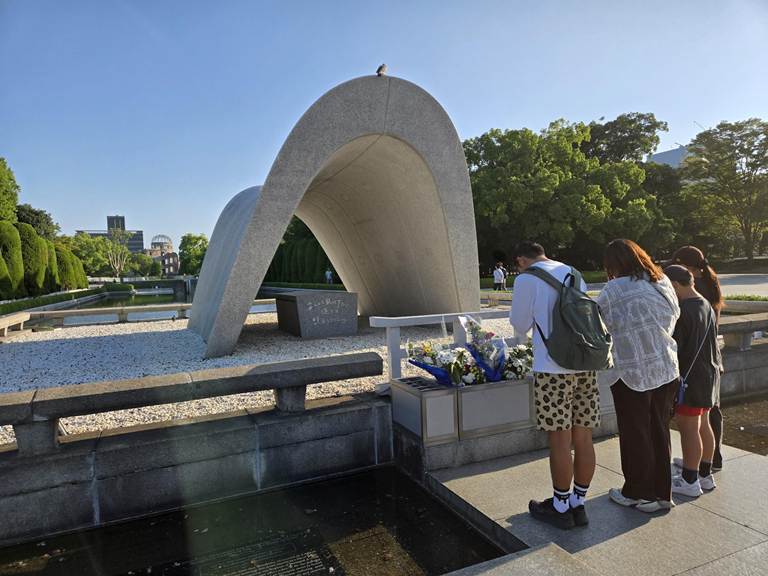
Hiroshima calls itself a City of Peace, yet it is also a city of continuing remembrance and grief. I was deeply moved because everything there speaks of peace. I was relieved to feel that its grief was not rooted in bitterness. It was an active remembrance, carrying the determination that such evil must never happen again.
Swami Adiparashaktiananda and I sounded the Peace Bell three times: once for Asia, once for Europe, and once for the Americas. I trust that Africa and Australia were included, as a map of the entire Earth was engraved on the bell, together with Sanskrit writing.
Swami Padmananda recorded its sound. She said that every step we took might be upon the remains of someone who had disappeared there. Throughout our visit, she chanted the Maha Mrityunjaya Mantra—Om Tryambakam.
The energy was extraordinary and elevated, as though we were inside a sacred church. We felt uplifted. Swami Adiparashaktiananda reminded us, “All is for the best. God’s will is supreme. In the face of suffering, we find God.” The Peace Memorial Park bears witness to this truth. It is sacred ground formed from eighty-one years of suffering: the suffering of those who died, the survivors, their descendants, the Japanese people, and visitors from around the world.
As we approached the heart of the park, I could no longer contain my emotions. I tried not to sob because I was leading the group, but I felt overwhelmed—not only by those who died in Hiroshima, but also by the suffering that continues everywhere today. Wherever we turn, we find ignorance, violence, abuse, threats, and cruelty.
Since childhood, I have been deeply involved in this work: facing grief of humanity, actively alleviating suffering, and helping myself and others awaken to the True Self beyond it. I knew that I was supposed to remember the Atman while bearing witness to the atrocities committed here. Yet, from my very first steps, even before beginning our Om Namo Narayanaya peace walk, I found myself falling apart.
Bearing Witness at the Atomic Bomb Dome
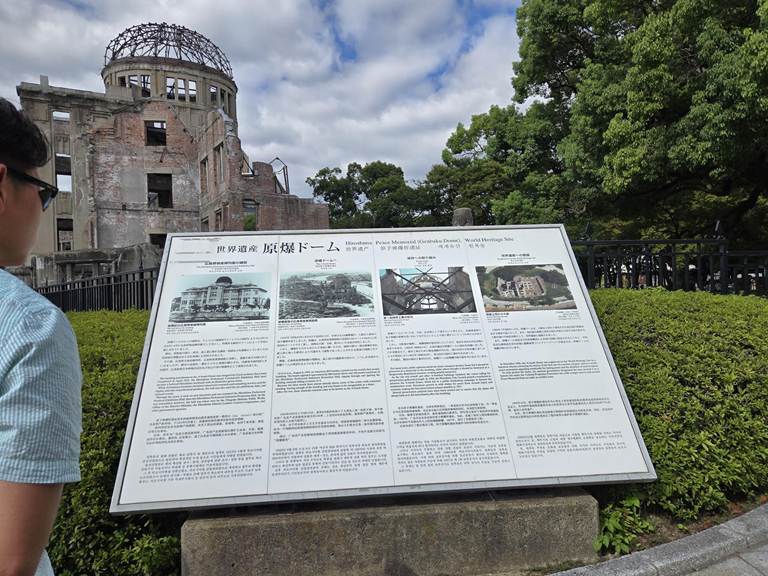
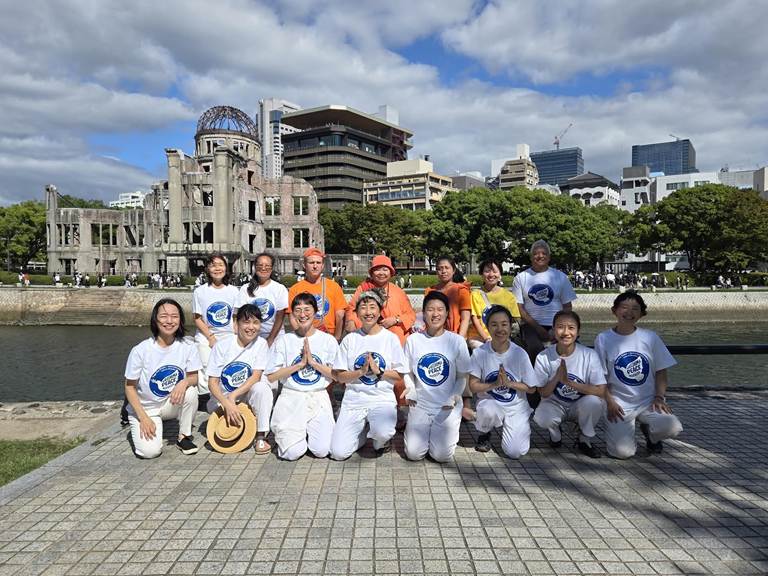
We crossed the bridge and arrived at the Atomic Bomb Dome. The structure that survived the blast stood beside the river—a stark and beautiful testimony to what had been.
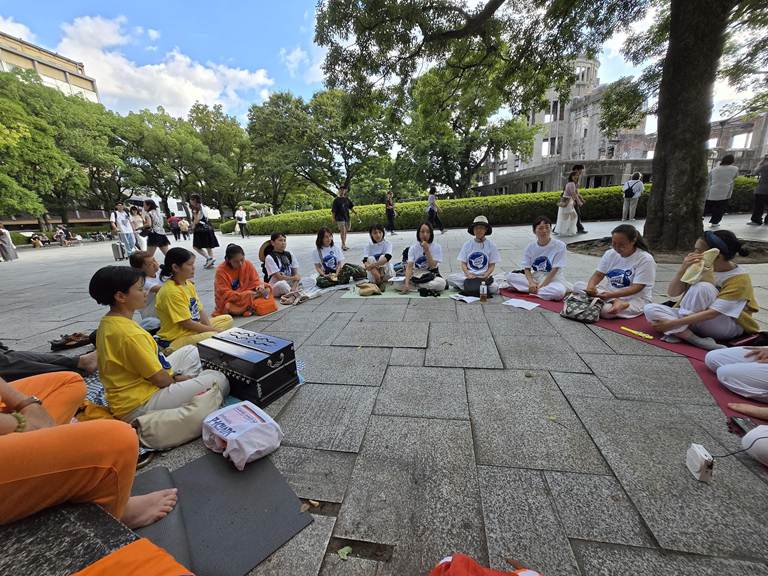
We sat in a circle on the ground under curious eyes and began to share. People from the United States, Taiwan, China, Vietnam, Hiroshima, and Tokyo spoke about their childhood memories of learning about the atomic bomb. We shared the pain of hearing people say that the bomb was good because it ended the war. Others told stories about grandparents who lived through that time and survived. We spoke of the different kinds of casualties and of suffering transmitted from one generation to the next. There were many tears. Together, we learned to honor grief.
One person expressed surprise at seeing so many tourists while so few were engaged in meditation, prayer, or dialogue in this extraordinary place. We felt that more kirtan and more Peace Circles should be offered here for healing.
The kirtan uplifted us immediately. If we forget God, evil can happen. An Indian passerby who joined us with his wife said, “If good people do nothing, evil happens.” He belonged to a spiritual organization based in London and India. He offered dakshina, bowed to me, and acknowledged the importance of spiritual leadership.
Neelakantha said, “Swami Sita helped us to heal something very deep in the Japanese subconscious—a feeling of being a loser.”
But humanity lost, Neelakantha—not Japan alone. We are all lost in war. In war, there are no winners and no losers. Hiroshima belongs to the whole world. It is a City of Peace and eternal remembrance—a place that transforms grief through forgiveness and light. Sometimes it takes great suffering for humanity to learn the lesson of Oneness.
Remembering the Children
We shared from 2:00 until 5:00 p.m. Then we walked to the memorial honoring the schoolchildren who lost their lives. Their names are inscribed on bronze plaques near the great statue of the Goddess of Peace, whose face reminded us of Quan Yin and whose form has two large wings.
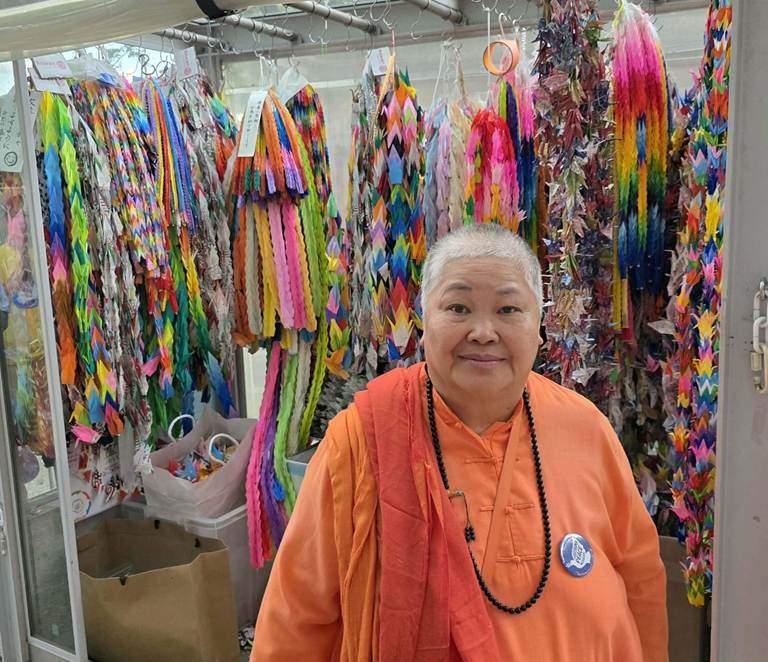
We offered strings of two hundred colorful paper cranes at the Children’s Peace Monument and rang the bell. Thousands of children died without ever having the chance to live out their lives. We remembered them with tenderness and prayer.
Peace Puja Beside the Eternal Flame
We then walked to the Eternal Flame. The setting was profoundly beautiful: the symbolic tomb, the flame surrounded by water, and the Atomic Bomb Dome visible in the distance.
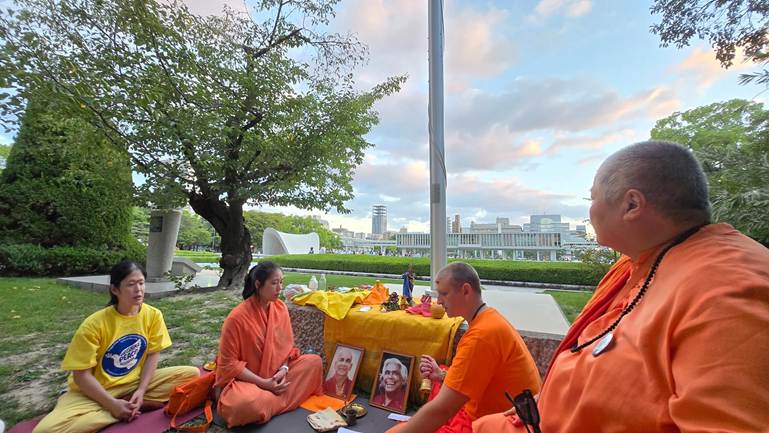
Near the memorial to a mother and child, we prepared our Peace Puja. We had carried statues of the Gurus and statues of Lord Krishna and Goddess Lakshmi from Tokyo. I added a box containing cloth from Swami Sivananda and Swami Vishnudevananda, which I had received during my Acharya initiation. In this way, the Sivananda lineage was present with us beside the Eternal Flame, at the edge of the trees.
We performed a full abhishekam for Lord Ganesha, the Shiva Lingam, and Mother Durga. We repeated Om Tryambakam, Om Namo Narayanaya, and Om Sri Durgayai Namah.
I felt Mother Durga to be the presiding deity of Hiroshima—the Divine Mother who protects, confronts the demons, and emerges victorious. Om Sri Durgayai Namah.
We completed the puja in the gathering darkness, with arati, the ringing of the bell, and the darshan of the moon above the trees. It was magic. May peace prevail. May the Divine Mother protect us all.
The Peace Memorial Museum
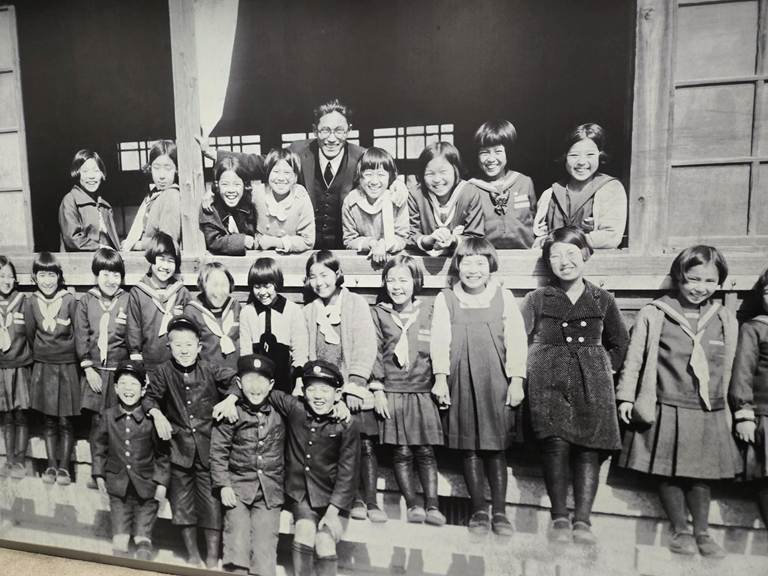
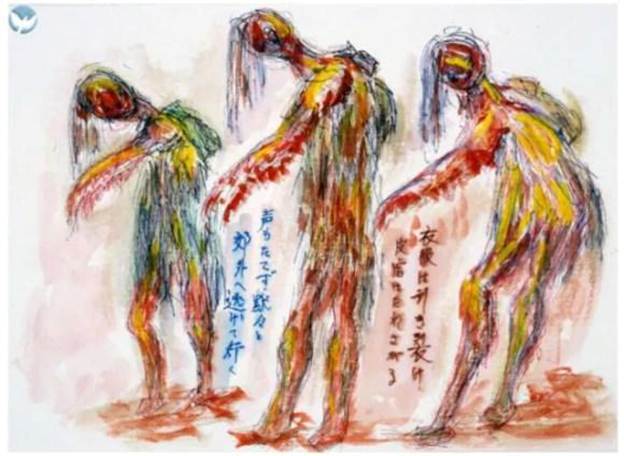
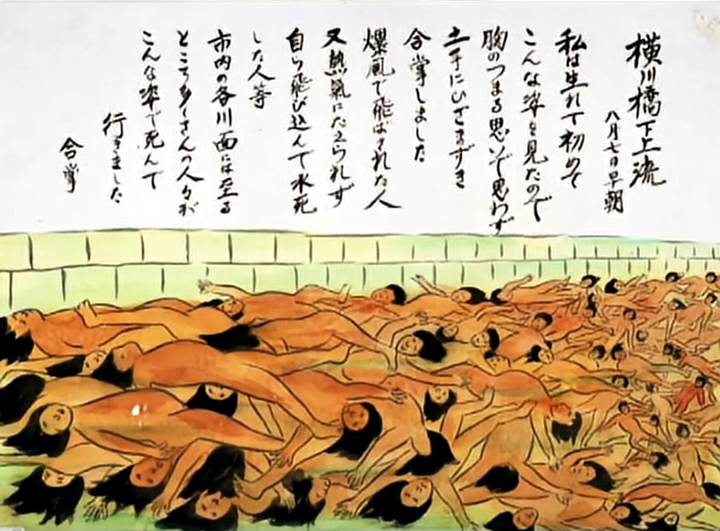
The following day, we visited the large Hiroshima Peace Memorial Museum. It presents a powerful reconstruction of Hiroshima before and after the bombing. When we walked through its pitch-dark corridors, the reality of what had happened truly hit home. We saw photographs of young students full of life and, afterward, pictures of them burned and bald, lying in pain. We saw paintings depicting unbearable scenes. The most striking ones for me were a painting of stacks of bodies filling the river and another of people with hanging flesh. There were photographs of the devastation and heartbreaking testimonies from survivors.
One of the most powerful exhibits showed the bomb exploding above the city and the destructive force radiating across a vast area. Its message was unmistakable: such an atrocity must never be allowed to happen again.
Approximately 140,000 people are estimated to have died in Hiroshima by the end of 1945. Many others suffered and died later from injuries, illness, and radiation exposure, and not every death was fully accounted for.
I saw an exhibit showing the pained face of Pope Francis, who had visited, and the solemn face of President Barack Obama, who signed in support of nuclear nonproliferation at that time. I also saw pictures of nations’ delegates at conferences discussing deterrence and the use of the atomic bomb. I prayed for wisdom for our world.
Yoga Is Peace in the Making
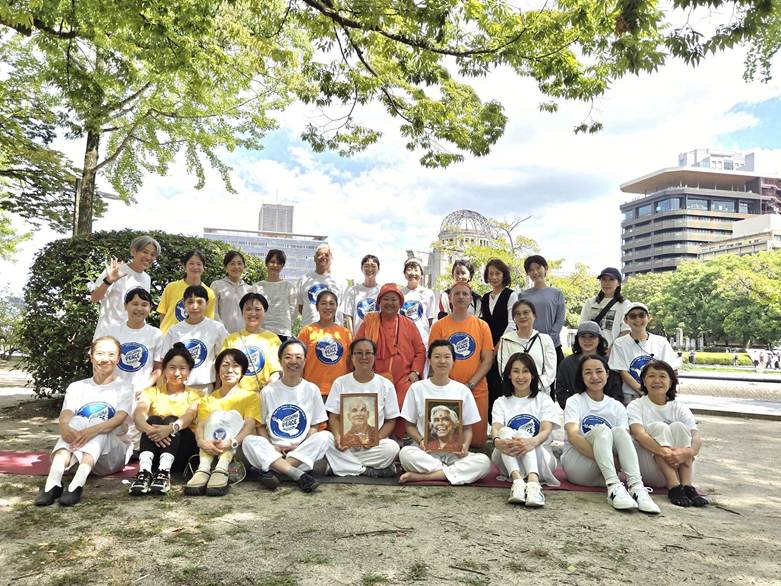
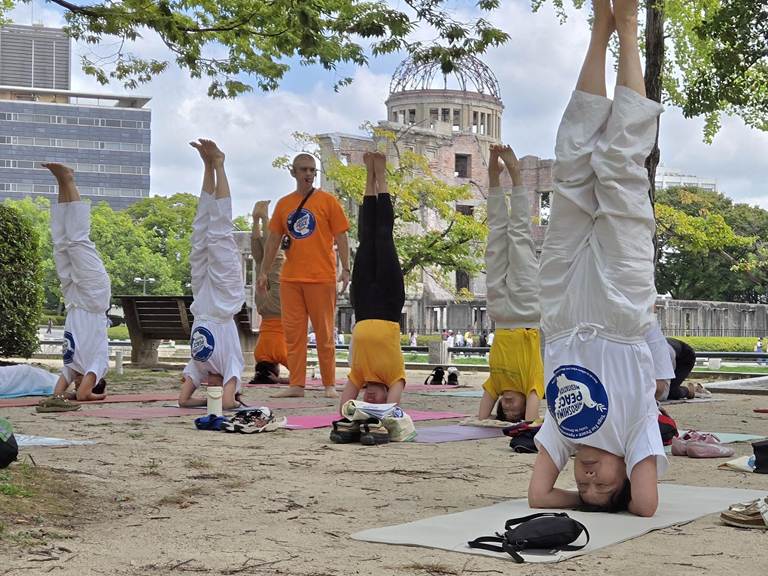
A full yoga class was held beneath the trees, just across from the Atomic Bomb Dome, beside the river. One participant shared that she truly felt the intensity of the yoga class while lying on the ground near the epicenter, where so many people had died. She was now relaxing and breathing, with the images she had seen in the museum revolving in her mind, while at the same time hearing the Peace Bell nearby.
The yoga class brought the five-day peace retreat from Tokyo to Hiroshima to a meaningful conclusion. The fact is that many people do not make the connection between asanas and peace, yet asana, pranayama, and meditation are at the very heart of peace.
We held a final sharing circle, once again listening attentively without moving for two and a half hours. We chanted Jaya Ganesha and talked about our gratitude for being there. We shared our admiration for the resilience of the Japanese people—how they persevered and rebuilt the city after only a few years. We talked about the silence of a Japanese grandfather who was unable to share, perhaps because he was still in denial or suffering from PTSD.
Someone mentioned the necessity of taking responsibility for wrong actions and egoistic thinking that contribute to war, and how recognizing our part in conflicts is the way toward acceptance and true healing. We talked about our determination to continue, one step at a time, holding on to our inner peace in our daily lives. We promised ourselves that we would take action to help and share.
“This kind of peace retreat really helps us become aware of what peace truly is,” exclaimed Swami Padma afterward. “We need to do more and more of it.”
Yoga is not merely talking about peace. It is peace in the making.
When the body becomes steady, the breath becomes calm. When the breath becomes calm, the mind becomes peaceful. From peace of mind come clarity, compassion, forgiveness, and wise action.
“Peace of mind is happiness. Yoga shows the way,” Swami Vishnudevananda said. He was the one who imprinted Hiroshima in my mind years ago, in the 1980s, as he remembered to commemorate the 6th of August by having us walk around the village of Val Morin with banners and posters: “No to nuclear bombs!”
Indeed, Swamiji’s peace missionary spirit lives on today in this Hiroshima pilgrimage.
Suggested excerpt: A personal reflection by Swami Sitaramananda on the Sivananda peace pilgrimage to Hiroshima—bearing witness, honoring grief, practicing prayer and yoga, and renewing the commitment to peace.
Suggested category: Peace / Yoga Philosophy (choose the closest categories already used on your site).
Suggested featured image: the opening group photograph in front of the Atomic Bomb Dome.
Publishing: In WordPress go to Posts → Add New, copy the article text, use each Heading 1 in this document as an H2 on the website, upload the corresponding photographs to the Media Library, set the opening group photo as Featured Image, preview on desktop and mobile, then publish.
Tips from Niranjan Babu, a visiting Indian expert teacher on Vastu
Mandala Puja performed by Swami Vasishtananda at the Sivananda Yoga Farm, Grass Valley
The front (main) door is the door that allows energy to flow into the habitation, residence or business. Our scriptures mention that a properly constructed and placed front door not only brings powerful benefic energies which calm the minds of you and your guests, but also enable proper discussions and interactions that create harmony in the family and improve business.
Here are powerful do and don’ts that will help you invite peaceful, healing energy and luck into your home or office:
1. The front door should have two shutters with dimensions of length equal to twice the breadth. The front door should be the biggest of all the doors with dimensions of length being equal to twice the breadth. If possible, have two shutters (just like you have two nostrils) where life breath comes in. Let the door be gorgeous, well-carved with good, strong wood that emanates warmth. Your guests should feel welcome when they see the door and enter into your habitation. What happens inside will be a reflection of the auspiciousness, beauty and strength of the front door. When the main door is beautiful and generous, prospects—finance and harmony—and opportunities flow into the habitation.
2. The pathway from the main gate to the front door should be illuminated and move in a clockwise direction. The pathway should gracefully curve in a clockwise movement (pradakshina). Keep either side of the pathway brightly lit (during evening). This way powerful energy is always in the front area and whenever the door opens, the energy brightens up the inside. At no point in time should this pathway go dark. Replace burnt-out bulbs immediately.
3. Have low-growing, assorted-color, flowering plants that give out fragrance lining the pathway. A powerful pathway with healthy plants can contribute to better health and set the thinking processes to find opportunities for you and your children. Proper maintenance of the pathway leading to the front door can indeed generate a better lifestyle for you that allows your desires to be fulfilled.
4. A Yantra has to be installed to ward off negative energies. A copper Yantra on the front door can ward off the negativities that set in when you have ‘guests’ (who do not like your growth) entering your home. The Yantra has to be designed based on the horoscopes of the inhabitants and the topography of the area. A properly dimensioned and designed yantra can contribute to limiting your expenses and increasing your wealth.
5. Name your home in harmony with your Nakshatra. Select a name that begins with a character compatible with your and/or your spouse’s Nakshatra. It can be ‘Sri Nilaya’, Anantha Griha, Divya Nilaya, etc. It could be your spouse’s name, your child’s name and your parents’ name, too. Let it be any name that creates comfort but vibes astrologically with your/spouse’s Nakshatra. Display the name at eye level next to the Yantra so that creative energy finds its way into the habitation.
6. Keep the pathway and the front door clean, inviting and litter-free. Vastu identifies the planet Jupiter with the primary element water. Jupiter stands for wealth, intellect and the younger generation. The proper maintenance of the path to the front door can assist in the residents being affluent. Avoid dirt, your footwear and other obstructions (including pillars, trees, bushes, vehicles, etc.) in front of the door. Allot a separate cabinet to the side of the door to hold your shoes and sports equipment. See that none of this is placed in front of the door. When the pathway and the front of the door is dirty and with litter, the negative energies get concentrated and drastically affect finances and harmony—and your health, too. A front door badly done and with obstructions is indicative of everything being in short supply—finances, compatibility and health. An inviting front door, on the other hand, can tell the story of an abundance of all these traits.
The important thing is that we unite together as Yoga teachers, Sivananda Yoga teachers. We have a mission to be leaders in this time of need. The aims and goals of the Sivananda Yoga Teacher Training Course is to create leaders who themselves have experienced the way to peace and in turn can show others the way to peace in times of crisis.
Yoga teachers as influencers, spreading positive thoughts
When the world is in panic and confusion, it is important to understand that crisis changes the vibration of the whole world. It is important that yoga teaching becomes known at this time, so people learn to turn their negative thoughts into positive thoughts and begin to understand the cumulative actions of their thoughts. This is what the Yoga teacher needs to know, that his or her thinking not only relates to him or herself or to the people in the same room or house with them, but thinking as a collective consciousness, our positive thinking affects the whole world.
Now more than ever we need to be aware of this, that our positive thoughts or positive words affect the world. We can help the world to heal by uplifting our consciousness through the conscious practice of Yoga sadhana. You may think you are alone in your house doing your practice and your voice does not count, but any thoughts that you broadcast during and after sadhana are very powerful. Moreover, as you practice Yoga and meditation now, you can switch your intention and do it for the sake of the world. This way, your practice not only improves your life but also improves the vibration of the whole world.
Yoga teachers are empathetic, sensitive, and realize the suffering of people in their communities. They feel what people are going through when everything in their life is collapsing or changing. We know that this is a moment of transition, a moment of choice for everyone. Yes, as Yoga teachers, we have a choice, either we are going to be depressed and spiral down or we are going to stay strong in satsanga and rise up, shifting our consciousness with the whole world.
Yoga teachers are like a lighthouse that radiate positive thoughts all around and influence the world’s collective thoughts, thus, playing a leading role in shifting the world’s consciousness.
Yoga teachers as powerhouses raising vibrations with mantra
The easiest way to increase your vibration is to repeat mantra. Sivananda Yoga teachers understand the healing effect of mantra, how it strengthens the mind, especially when chanted in a group. The energy is multiplied and touches the whole world to balance out the negative energy.
The best mantra for healing is Mahamrityunjaya Mantra. You can repeat this mantra daily or have it playing at low volume in your home or sacred space for someone that is sick or suffering:
Om Tryambakam Yajamahe Sugandhim Pushthivardhanam. Urvaarukamiva Bandhanaan Mrityormuksheeya Maamritaat
Play mantras for those who have just died or are on the sick bed. Repeat the mantra with your heart as consciousness (God) is dwelling in your own heart.
Yoga teachers as counselors
When the world is lost and afraid, it is important that Yoga teachers explain a few helpful points:
The connection between Prana, Thought and Immunity The higher the prana, the more we increase immunity to prevent disease. You need to explain this to your students and to your family, the link between prana and health.Prana is found in nature. By changing your lifestyle to connect to the prana in nature you improve your immunity. The best thing to prevent sickness is to increase immunity, the mechanism nature has given us to prevent diseases. Prana needs to be high. You increase the prana by absorbing the prana from nature.This is done by leading a proper lifestyle, by proper contact with the earth (eating the right food, contemplating trees, mountains, gardening, etc.); water (drink pure water, bathe in rivers, oceans); fire (being in the sun daily, eat warm food); air (breathing exercises in the clean air) and; ether (being in a positive thought atmosphere).
We need to learn how to conserve prana and not waste prana through negative thinking, useless worries and actions. We need to train and concentrate the mind and perform only mindful actions.
Too much information on the Internet that you cannot digest will cause you to lose prana. Gather only the information that you can digest. Like food, if you eat too much, you cannot digest what you eat, toxins will build up and the mind will be restless.
Listening, comforting, being present
People need comfort, not merely calmness, but also a comforting presence and comforting words. The Yoga teacher’s presence is important. Now is the time to call your friends and relatives and to reach out to your neighbors to give them comforting words. It’s very easy to give comforting words, “How are you? We are concerned about you. Is everything okay? We love you.” Offer these comforting words with empathy.Empathy means we understand why you lost your job. We understand why you are home and don’t know what to do and you’re depressed, you’re worried. We understand. Empathy comes by listening. People need to be able to talk out their worry. Then you just listen without trying to give an answer, because really no one has the answer. Be humble and just try to listen, not just engaging people only when you feel that you have the answer. No one has the answer.Listen to what the person has to say, whatever they’re worried and concerned about. That’s enough to comfort them and to help them to calm down. It is a need to be listened to.
Relax by contemplating Nature
Being in nature helps us to relax. We don’t have to go anywhere. Actually, we can sit and just look at the trees and the water in the pond, look at the dog that is passing by. Just contemplating.By being still, learning how to contemplate, everyone experiences a state of calmness, and not just calmness, but a state of joy and unity. This is exactly what we mean when we talk about spiritual relaxation. There are a lot of techniques of Yoga that can bring you to that state. Yoga offers a wealth of information to apply for physical, mental and spiritual relaxation. The more you apply, the more you see that it works, and the more that it encourages you to practice.
Yoga for overcoming anxiety
There are many Yoga practices overcome fear and anxiety: 1) Breathing: The first point is to help people to improve the breath-body-mind awareness with rhythmical breathing. Just breathe with the diaphragm to get more oxygen, but also use rhythmical breathing to help calm the mind. When you practice asana, make sure to coordinate the breath with your movement and do pranayama. 2) Asanas for stress resilience: The second point is to increase prana by moving the body. If you feel that you are stuck or anxious, the flow of prana is blocked. When the flow of prana is blocked thoughts go down or repeat.You need to just keep moving, but consciously, by performing Yoga postures in the proper sequence to move the prana and to balance the flow of prana. Simply by moving the body in a balanced manner with awareness helps to balance the prana and increase stress resilience. 3) Improve mental-emotional balance: Mental and emotional balance is accomplished by regulating the breath. If you feel tension, you need to learn to exhale properly, calmly, and slowly to release tension. Let’s say you are talking to the neighbor and the neighbor is panicking, you can tell them, “OK, calm down now, just exhale slowly. Inhale and exhale to the count of six, or inhale and exhale to the count of ten.”
Go very slowly and they will calm down.Breath is connected to the mind. Awareness of the breath helps to concentrate the mind. People cannot practice Yoga when they are stressed. Why? Because their mind is obsessed with something external. At that time, you tell them to lie down, to stretch, to breathe, and to concentrate on the breath. 4) Learn to increase ojas shakti to avoid burn out: The fourth point is to understand that if we burn out our immunity goes down. One Ayurvedic teacher states that too much heat in the body leads to anger, too much thinking, and too much stress. So, you burn out your ojas. Ojas is the energy that sustains life.
The key is to increase ojas. Ojas shakti is the power of sustenance that brings contentment, gratitude and the sense of well-being. This is the subtle energy as taught by Ayurveda. Apply Ayurvedic principles in your diet and lifestyle to increase ojas shakti:
Apply warm sesame oil to your body and head.
Eat nutritious, simple food. The essence of the food will nourish you, feed the ojas and will help you to calm down.
Take one or two teaspoons of ghee in your food and you will be nourished.
Drink warm almond milk is also very good for increasing ojas.
Cultivate faith and positive feeling in the Divine. Direct connection to the source of life will sustain you and increase your ojas shakti.
5) Increase the sense of safety: Create a sense of security, warmth, of quiet and support. The key is feeling safe. Let go of the worries and the defense mechanism. If you feel worried and fight-or-flight response is activated, your defense mechanism will wear you out.
It is paramount to relax, to activate your parasympathetic nervous system by Yoga asana in a conscious manner with rhythmical breathing along with faith.
6) Increase detachment: The sixth point is relaxation but going to a deeper level. It is about a change in attitude towards life. The prevalent attitude before was of being passionate about life, passionate about enjoyment of the senses. We call this a rajasic attitude, running here and there so that life gains meaning by experience and enjoyment.
We need to decrease these rajasic activities by increasing our detachment. This is a meditative, contemplative attitude towards life, stepping back to find the fullness within ourselves rather than attaching to what is “happening” outside.
Self-Affirmation Affirm your Self and repeat what you feel is positive and good. If you repeat a positive thought, that thought gains more momentum and more power in the psychic world and helps you in due time. For example, write down this sentence and repeat it many times, “I am content and happy with my Self,” or “Day by day, everything is improving, everything is better in every way,” or “I am content and with the present moment”.When you feel anxious, this affirming thought will rise to the surface of the mind to help you. Self-affirmation needs to be done daily until it becomes a positive habit. Another practice is to create a daily gratitude list and use what we are grateful for as affirmations.
Faith increases immunity
In times of crisis, people tend to doubt, to be fearful, and to lose faith. You have an inherent connection with Mother Nature, the mother Goddess, the universal presence within your own body that is always with you and in your surroundings. Swami Sivananda reminds us to follow the laws of nature and to live in harmony with nature. Having this deep connection with our own true nature dispels fear and restores faith.
Vedanta philosophy about the Self and the not-Self The Self, the immortal Atman, is ever-present, untouched, blissful. It is the consciousness underlying all things. Remember the Atman and detach from all that is transient and changing. Use your higher faculty to discriminate, to know the difference between what is permanent and that which changes; what is the Self and that which is the not-Self.Remember that there is a presence within you, a consciousness within you, no matter what. Find safety and comfort in that presence as your own inner reality. Tune to that divinity that we see outside as the all-present, nourishing and caring Mother Nature.
Swami Sitaramananda is a senior acharya of the International Sivananda Yoga Vedanta Centers (ISYVC) and is director of the Sivananda Ashram Yoga Farm in Grass Valley, California and the Sivananda Yoga Resort and Training Center in Dalat, Vietnam as well as more city centers in Ho Chi Minh, Dalat, Hanoi, and Tokyo, Japan. Swamiji is the acharya for Asia as well as the organizer and teacher of the Sivananda Yoga Health Educator Training (SYHET) program, an 800-hour program on yoga therapy, accredited by the International Association of Yoga Therapists (IAYT).
Does our suffering have any use to us? And where does suffering come from? According to the Raja Sutras, all of our suffering comes from five main sources. They are ignorance, pleasure, aversion, the ego, and the fear of death. When we begin to investigate these qualities in ourselves we can more clearly understand our path towards liberation.
During her international Satsang on Nov. 15, Swami Sitaramananda introduces the ancient teachings of Maharishi Patanjali to help us understand why we suffer.
The Five Kleshas
The concept today is about understanding the root causes of our suffering. When we understand this we can continue to invest the right amount of energy in the right place. Because when you know the root causes of your suffering you can begin to heal by cultivating an intelligent approach to your sadhana practices. These teachings come from Patanjali Maharishi, who wrote the Raja Yoga Sutras over 2000 years ago. Patanjali says there are five causes of suffering, and the misery that has not yet manifested should be avoided. If you have a certain cause of suffering and you carry on to do certain things out of ignorance, then you will suffer. The misery that has not yet manifested needs to be avoided. This means you need to go to the root cause of the suffering and do the right thing to avoid any future suffering.
The Sanskrit term kleshas means cause of affliction, or poisons. Klesha number one is avidya or spiritual ignorance. When you start on your spiritual journey in order to be enlightened, the more light you will have coming in your mind. And this will make you wiser. You’ll be able to go into the root cause of all suffering. Avidya is the main cause of suffering. The other four reasons come from Avidya. The second klesha is called asmita or egoism. With asmita you don’t know who you are. So you believe that you are this personality called the ego or the ahamkara.
The third Klesha is Raga. Raga is translated as attachment. Because of our attachments we suffer.
Number four, Dvesha means repulsion, and is the opposite of Raga. Raga means you attach to something you like, and Dvesha means you run away from something. So the two together, Raga and Dvesha means your likes and dislikes, your array of love and hate.
And the fifth klesha is called Abhinivesha which means your will to live, or in other words, your fear of death. These are the five main causes of suffering according to Patanjali. It’s important we understand them well.
Forgetting Ourselves
Avidya is forgetting our true nature as the immortal, unchanging pure consciousness called the Atman. We make the mistake of taking the perishable, impure, external world and appearance for that which is real, true, permanent, and eternal. Avidya means not understanding our true nature as Sat-chit-ananda Atman. Instead, we mistake our body and mind to be ourselves. We do not know the difference between that which will bring pain, and that which will bring immortality. We are unaware of the truth, and that is called Avidya or ignorance. And this is the root cause of all the afflictions. So, if the root cause of all our afflictions is Avidya, the way to cure our afflictions is through self-knowledge.
We need to understand the teachings of Vedanta, which is a yoga philosophy that teaches us about the nature of the self. Vedanta teaches us about self-healing, self-realization, and the nature of liberation or enlightenment. When we suffer from our own negativity, we are suffering from our perceived imperfections in our mind. We may have low confidence, low self-esteem, insecurities, or anxiety. In this case we need to go to the root of the problem and ask ourselves the questions, ‘who am I?’ ‘Am I these impressions in my mind or my habitual thinking?’ ‘Am I my past?’ ‘Am I my pain?’ ‘Am I my past mistake?’ You need to ask these questions about your perceptions from the mind that perpetuate this false idea of yourself.
Detaching from the Body
The problem is we identify with the body and the mind. We believe that we are this body, and describe ourselves with terms like 30-years-old, male, female, pretty, or ugly. We think we are this vehicle. And this is the first mistake. The body and the mind is like a car, with the purpose being to experience life. The vehicle is a vehicle of self-knowledge. You are born in a body with a mind to experience the fruit results of your karma in order for you to wake up and learn the lesson of ‘who am I.’ So, the body and the mind are your vehicle.
It’s like you drive a car, and you say, ‘I’m a Honda. I’m Japanese. I’m 10 years old. I’m red from the outside. And I’m worth $10,000.’ You make the mistake of identifying with your vehicle. You use your vehicle to go from one place to another. This body and this mind are your vehicles in order for you to experience this life. You experience this life the best you can. The vehicle is very sharp and powerful and has lots of skills and equipment so that you can experience this life.
So you need to understand that you made a mistake. You need to detach from this false identification with the vehicle so you can recognize who you are. This body and mind vehicle that you are born into is there for you to wake up. For you to experience life and to know that it is not yourself, and to know that this experience is the condition of your thinking. You can change your thinking and you can progress to have a better idea of who you truly are.
In Vedanta, your true nature is known as sat-chit-ananda. It means who you are is more than this body. We come for a short time to experience something in this body, but your life is more than this body. You are unlimited. You come for a short time to explain something in this body. Sat-chit means you are immortal, it means you are your own knowledge, you are the source of all knowledge.
Ananda means bliss. That means the true nature of yourself is that bliss absolute. So this is something that we need to remember. Otherwise we experience objects of the senses and we believe that these objects can give us the happiness we want. But it’s impossible, you can possess all these objects you desire, but you will not be happy because they are just objects.
You are the power, you are the existence, and you are the truth. The problem is we constantly have an illusion projecting a different idea outside of us and we run after these illusions and think that we can get some happiness from them. This is Avidya or spiritual ignorance. We need to wake up from avidya and understand our body and mind are only our vehicles. In order to understand this, you need to have some level of detachment.
The body is ours only to be used by the mind. You have to know that the core of your consciousness is not your mind or body, but that you are the immortal spirit. This knowledge requires continual training of the mind to be a more detached person.
Turning Inward
You have three bodies: the physical body, the astral body, and the causal body. The three bodies help us to understand ourselves properly.
The physical body is the envelope of food. What you eat becomes the body. In the astral body you have you have a layer called prana. Prana is your vital energy and your aura in the subtle body. Then you have the mind with emotions and a subconscious. And then you have your intellect and your ego. All this is in the astral body. And what this means is that the mind is a very subtle tool for you to experience life. And your mind experiences pleasure and pain. When you experience pleasure and pain, pleasure is limited and pain is limited. You have to know that there is something unlimited that is beyond the pleasure and pain.
You experience pleasure and you take that to be the truth, but when it ends you suffer. And when you suffer, you have to turn inward. Then you will find a place of peace, the unlimited peace that is within yourself. This is how you learn. Pain is also limited but the mind will swing between pain and pleasure. We’ll talk about this swinging nature later on.
The experience of pain and pleasure helps to guide you to the truth within yourself. You withdraw yourself and you recognize yourself, that’s the reason why you are equipped with the body and mind. Then you can recognize yourself, and that is called the process of waking up or self-realization. We need to cultivate this true knowledge by practicing self-remembrance. You forget yourself in the objects of the senses, and your mind says you are the ego but you need to detach and reflect on your true self. Remembering your true self happens when you do sadhana or your spiritual practice like yoga or meditation. These practices help you remember the truth of who you are.
We need to truly understand the cause of our problem. Usually when we have problems we always blame something external. You think if an object gives you happiness now, and it does not give you happiness later, something must be wrong with the object. But you don’t see that it’s your mind that projects an illusion upon the object expecting it to perform how you want it. The object will never behave exactly how you want. Permanent happiness is not possible from an object. You need to turn your attention inward to find the lasting happiness that is within you.
For example, you think that if the body is very pretty and youthful that it will give you happiness. Eventually the body will get old or an accident can happen. The body is relative. You try to make it perfect, but it can never be perfect. Some people spend so much time and money to make the body perfect. But the body is not new, it cannot be perfect. It changes every moment. You have to detach and use the body wisely. The true nature of the body is to grow, get old, and eventually self-destruct. You know that the nature of the body is to grow old, so don’t put all your energy in the body. Instead, put your energy in living your life meaningfully by doing your sadhana practice so you can recognize your mistake in thinking.
We function out of our mistaken identity. We cannot see beyond our thinking. It’s similar to thinking the sun does not exist when a cloud is blocking our view. If we only pay attention to the cloud, then we only see the external. We will only see the external appearance when we don’t do any kind of practice according to yoga or Vedanta.
Vedanta’s Teachings
Vedanta gives you a practice of meditation and self-inquiry. So even if the clouds are there and you don’t see the sun, you can know within that the sun is there. This is called self-remembrance. Even through the ups and downs in your life, when everything seems to be changing, you know that the sun is behind it all. The light is there behind your changing life. You have to remember the teachings and the words of the scripture. You have to hear the teachings from the guru again and again so that you keep a healthy idea of who you are. And you have to reflect. Nobody can reflect for you because people looking from the outside will just give you the false idea of who you are. Millions of dollars are spent for beauty supplies every year. You spend so much money to try to make yourself beautiful. All this spent on the body instead of spending money to go to a yoga class or go to yoga retreat. Go to a yoga retreat and I will talk to you about who you are.
So you have this false concept of who you are. People don’t like you. You feel lonely and you’re thinking ‘oh, because I’m not pretty enough, people don’t like me.’ And again you go to a beauty parlor to make yourself look nicer to create that aura of beauty, but inside you are empty. So when this happens you need to put more energy into the practices that make you feel full. When you feel complete, you feel you know who you are. You feel strong.
The outside is bound by nature. The body is bound by nature, it can regrow and change. When people buy a perfect apple for me, I refuse to eat it. Because in nature, there is no perfect apple. It’s perfect because it’s made naturally. But manmade perfection is different. People now do all kinds of things to fruit and food to make it perfect. But that perfection is artificial.
Seek the truth of perfection within you. Don’t try to have perfection outside. Nature is changing all the time. There are no two leaves that look the same. No day on earth will look the same. The sunlight from day to day will change. And no flower will ever be an exact replica of another flower. Similarly, no person looks exactly the same. Everything is changing. That is the true nature of the universe, the true nature of maya, and the nature of the world. So learn to accept your body for what it is – it’s a part of nature. And remember that at the core of yourself, there is an unchanging spirit. That unchanging consciousness that is creating this and is the source of everything.
Reflecting on the Scriptures
I cannot explain to you the true nature of the self in this short discussion. I teach all day long and there many different courses. Please, I encourage you to take a course if you’re serious about developing your knowledge and understanding. There’s no way I can explain the self in this short discussion. You need to make an effort for self-knowledge.
Number one, you have to listen to the Scripture. Then you have to think about yourself. The scriptures say the body is only your vehicle. So go around and think about this every day. Think to yourself, ‘in which way is my body a vehicle, I am not the body, so then who am I?’ You have to take the effort to think, because I cannot think for you. And then think deeply about the teaching of the truth in Scriptures. They say that you are the immortal spirit. You are the Satchidananda atman so think about it. Otherwise you buy a newspaper and you think all kinds of things that is not really the truth. So try to find self-knowledge in order for you to wake up from the ignorance. This is the first teaching.
Identifying with the Ego
The second lesson is when you don’t know who you are, so you start to believe what you are not to be. That is called egoism. You believe that your limited self is who you are. You think your body, mind, and personality is who you are. This is the second cause of suffering, the ego. The ego is called the self-arrogating principle of the mind.
In our mind, we have the ahamkara, that means you have to assert and affirm who you are in your mind in order for you to experience life well. You came here to experience life and to wake up and know that it is limited. It’s not the truth. Therefore the ego is a necessary instrument for your enlightenment and for waking up. Because if you don’t have the ego, you don’t have the personality. You may believe you’re Elizabeth Taylor or the queen or something. If you think like this you’ll never learn about yourself. You have to learn from your lessons. The lessons that come with your life, personality, and ego. But don’t think that the ego is yourself – this is the teaching.
You need to have the ego, so there’s nothing wrong with self-confidence and going through your life as an integrated personality experiencing your life. It’s good that you are clear in mind and you know your personal experience and what is wrong for you and what is good.
But egoism comes from the idea that you get attached to this idea of who you are. You become attached to this personality of who you are. The moment you get attached to it, then you cannot see who you are not. You are more unlimited, powerful, and complete than your personality, because the personality is limited. So that’s why you constantly feel incomplete, because you identify with your personality. And when you compare yourself to others you will feel incomplete.
So this is one of the causes of suffering, when you identify with your ego. And when you attach to your own way or your own desire, your own action will create pain because it’s not possible to get everything that you desire because its illusory, it comes from your mistaken identification of your limited self. And from there comes problems. The ego can bring a lot of negative emotions – the problem of selfishness, egoism, anxiety, pride, arrogance, using others, anger, jealousy. The ego brings a lot of problems if you believe the ego to be yourself. Thats why we say the second cause of suffering is the ego.
Know who you are, then the ego becomes small, then you will learn whatever lesson you need to learn. Don’t believe that you are this false ego which is your instrument only. When the ego becomes thinner and thinner, you know inside who you are. With the personality, you still have to function in this world, but you do not believe that it is yourself. So this is a very important lesson. You have to repeatedly ask yourself the question, ‘Who am I?’ And then you have to come to the better version of yourself – an ego that is more sattvic, is more open, has more compassion, and is more enlightened. You’re trying to get out of the tamasic ego. The rajasic ego always thinks, ‘mine mine mine.’ The rajasic ego always says, ‘me, mine, me, mine, look at me, look at me.’
So this is how suffering occurs. So if you can come to the sattvic ego it means you have a greater sense of self, but you are not denying the greater truth. And you are not asserting your difference with others. You assert your limited personality with others. You don’t assert this. You use this but you don’t assert this. This is not you.
So you are able to be flexible, to be adaptable, to be compassionate, and to understand more than what your ego can come up with. This is the second cause of suffering. We need to think a lot about this so you can wake up your own ego. So be humble. To work through your ego, you need to learn humility, flexibility, adaptability, and compassion.
The Swinging of the Mind
The third and fourth causes of suffering are to be understood together. Let’s call them raga and dvega. These are the likes and dislikes and the swinging of the mind. They cause the mind to swing from one side to another. The mind always has the tendency to swing to whatever it likes, and to run away from whatever it dislikes.
Why does the mind swing? If your mind is calm, then you’ll be able to see yourself. It’s like when a lake is calm, then you can see through the movement of the lake, and you can see your true reflection of yourself as beautiful. But why can’t you calm the mind? It’s always swinging and some people swing more than others. Some people are more calm than others, and some people just want to swing in opposite directions all the time. Because of the swinging you are not peaceful. Patanjali asked, ‘why does the mind swing? Why does the mind have this raga or attachment?’ Raga’s definition is an attraction in that which dwells on pleasure. That means that we had an experience of pleasure before, so we want to repeat this experience of pleasure, but pleasures are ending all the time because the true nature of pleasure is not to last forever. We have this experience in our mind of pleasure and we want to go back to this experience. We have these impulses within us of attraction, always learning and remembering this experience of pleasure and always wanting to repeat it. We become attracted like glue to this experience of pleasure.
Let’s say you have the experience of ice cream. Oh, so good! Right? So you want to repeat it. Every day you go around looking for some ice cream that will give you that experience of pleasure. So then the opposite happens – after three ice creams then you have stomach pain. Aversion means that which you don’t like. Aversion is that which attempts to avoid pain. After you experience pleasure from the ice cream, you will then experience pain. You may have diarrhea or stomach pain from the ice cream, and now you have an aversion of ice cream. The moment you hear the word ‘ice cream’ you run away. Why? Because you have the experience of pain in the past and you want to avoid pain.
So aversion, or dislikes, is made up of pain and things that cause discomfort. They don’t last, they’re precarious. You get attached to things that are precarious and when they change, then you have an experience of pain.
And then you dislike this thing that gives you pain. Some people have the experience of being hurt in a relationship and they decide to close off and they don’t want any relationship anymore. And they think that all men or all women give them pain, and they run away and become isolated. They’re the phenomena of people that become so hurt they become isolated. They don’t want to experience the pain anymore. They don’t want to experience anything anymore and they close off. They become depressed and they think they want to die like this in isolation and depression.
You have to know the right way of dealing with the ups and downs of attraction and repulsion. The mind always going towards what it likes, and running away from dislikes. So, you have to know why is it like this? It’s because of ignorance. You cannot see yourself and only see objects, and objects are limited in nature. The senses are always looking for objects. When the senses are glued to the object then you have the experience of calmness, you have the experience of the mind stopping its swinging. The mind stops swinging because the senses are glued to the object. At that time you have the experience of happiness that comes from within. When your mind stops for a moment, then you feel the experience of bliss. But then you wrongly attribute your happiness to the possession of the object. The object doesn’t give you happiness.
It is bliss absolute, the truth within that gives you happiness when the mind stops moving. But then the mind will move to the opposite direction. And this move to the opposite is painful. So once again, you’ll fall into the trap of believing that the object gives you pain.
You are all the time looking for the bliss absolute within you, because we are all the time looking for ourselves. We are all the time looking for ourselves, but we wrongly attribute the happiness or the unhappiness with the objects. We attribute happiness to the object, or pain to the object. But we do not recognize this because we are moving in the external, sensual world of objects, and seeking for happiness in that world of objects is impossible. You have to turn your gaze inward through yoga and meditation. The teachings can guide you to limit the effects of raga and dvesha. They can help you to stop running away from pain and to stop chasing happiness in objects. The answer is to withdraw. Don’t blame the external objects. They are whatever they are. If you want to go deep into the cause of the suffering created by your constantly swinging mind then you need to withdraw your mind and turn inward. Don’t spend all your life blaming. People spend all their life blaming something that creates pain to them.
Don’t spend all your life running towards something better and better. These are illusions. The more that you chase after the next best thing, the more you’ll continue to find yourself seeking happiness externally. You don’t need to have 100,000 experiences of pleasure, or 100,000 experiences of pain in order for you to realize that it’s possible to find peace. So turn within and understand the cause of the suffering. Try to calm your mind from all these illusions of happiness and pain. Try to find yourself. Turn within and you will find yourself.
Freeing Yourself from Attachments
Sometimes you dislike these yoga techniques because they’ve made you turn within and you realize you’re always running externally, trying to find happiness in the external world. So you dislike the yoga techniques, you dislike withdrawing of the senses, you dislike asana, pranayama, meditation, repeating a mantra, you dislike these things, or you can try a little but you never go deeper. So therefore, you never go to the other side which is a place of peace within you. You keep falling into the illusion of the central objects that gave you happiness or pain. So you are attached.
Attachment is a big problem in life. We are attached to our emotions, we are attached to our passions, we want to reproduce so we attach to our to action, to work, we are attached to the ego, we are attached to things or situations and thinking that they will last forever. We attach to the object of our senses. The nature of our mind is attachment. So, you need to contemplate on the nature of our attachment and know that it is not the way to happiness.
We are attached to relationships. We are attached to what we dislike. And continue disliking it, because we are attached to this feeling. We are attached to our misery. Even when the memory and misery is felt, you are still attached to it. You are attached to the idea of being a victim. You are lost in the attachment basically, attachment is the description of your life. So you need to learn to detach. In karma yoga, you do the action and let go of the result. We can detach from emotions too. Love but don’t be attached. The detachment that you learn in meditation leads you to let go of the thoughts. When you sit in meditation, you have to learn to withdraw and detach and let go of these thoughts so you can go straight into the experience of something beyond the mind. In Jnana yoga, you detach by asking yourself if this is real or illusory, and then you try to stay away from that which is changing.
So remember the five main causes of suffering. The first is ignorance, the second is ego, the third is attachment, and the fourth is running away. Remember, running toward and running away, these are the swinging’s of the mind. And the fifth cause of suffering is called fear of death.
Connect to yourself and feel alive
Patanjali goes quite deep and says the cause of suffering is life itself. Fear of death means your attachment to this life. And you’re afraid of something you don’t know. You are afraid of the unknown. You believe this life in this body to be the only life. So you are afraid of death. This is a common fear. We are quite afraid of death, because we are very attached to life in the body and our personality. Because we think that if we die then our whole self is gone. We fear the ‘I’ or our personality will disappear.
So you see this is the root cause a lot of wrong thinking. We need to learn by reading the scripture and thinking through meditation and yoga. Eventually, you will have the direct experience that you are more than the physical body. I remember my first experience of meditation. It was not a long time ago, about 40 years ago. I was meditating for the first or second time, and I came out of the meditation and I said ‘I’m not afraid of death.’ Why? Because then you have the true experience that you are existing and something is very vibrant and alive inside of you. And you come back to this physical reality and you know that you experienced something better not worse. You see, people are afraid of death because they think that it will eliminate what they have. That is why they are attached to it. And this attachment will turn them to the place of nothingness.
So they are very afraid of it, but you have to contemplate on that. The subtle is not worse than the gross. You live in the gross manifestation of body and mind and your sense of self that is limited. But if you go to the subtle and you experience your consciousness, you’ll find its more expanded and enriching. And it’s in that space where you feel very good. Then you come back to the gross and you accept that you still have to live in the material world because that’s why you are born, but at the same time you’re not afraid of death anymore. People that experience a near-death experience die and come back unafraid of death. They become huge, dutiful, and good people because they have a greater perspective of who they are.
So Swami Vishnu said if you live this life but don’t recognize your true nature, then that is called death. And some people are like this. They live this life in this body and mind, but they don’t know who they are. They’re so disconnected from themselves. They’re so depressed, so it’s like death. It’s not better you live life attached to the body and the mind. If you live like this, you have no connection with your soul. So you’re like death. You have no feeling or inspiration. People that understand the spirit know they are alive, and they are life. So the definition of life and death is that if you are getting connected to yourself, and if you are in connection with yourself, then you are alive.
When you’re not in connection with yourself then you are dead. Then you will you start to become depressed. Depression is like that, they want to die. And some people are suicidal. Some people want to die because they want to escape. They want to escape the fact that they are not feeling alive. Instead of feeling the need to terminate your life out of ignorance, they need to take more time to be more serious with sadhana practice. So you have to be very serious with your practice. If you don’t feel good, you do a set of asana. That is a proper way to feel better. Then you feel alive right away. You’re connecting with yourself right away. So then if you feel your emotions go up and down, you go do a set of pranayama. If you calm your mind and emotions down you feel alive right away. So life always is a truth. Life is your life. Life is eternal.
But because you identify with the veils, you think that you are not alive. But life is there, life is beautiful. Life is alive. So try to be alive. But don’t identify with the body, because the more you identify with the body the more you will want physical immortality, and the more you’re dead. Can you find immortality in the body? No, it’s impossible. The body is born. It’s an instrument only. It’s not meant to last forever. You lasts forever. You are the owner of the vehicle. You are the boss of the vehicle. You are the boss of your life. You are immortal. But the body is not. Your instrument is not meant to last forever.
Ponder the five causes of suffering so you’re not in the illusion of happiness when you are not truly happy, when you don’t know what true happiness is. You are not buying into the idea of who I am, when you don’t know who you are. You’re not buying into the idea of this thing. You may think, ‘is this object likeable? I hate this person.’ And you’re not buying into this idea that this person is the source of my happiness, you’re not attaching to a person. Anything external you are not buying into because you go inward, and you become more detached to whatever is around you. And then you find something that shows more truth.
Letting go of attachments to objects doesn’t mean abandoning a relationship, or losing the object, or feeling insecure. This is wrong thinking. If you have a bigger picture of who you are, and you understand that you are with the person in order for you to learn a lesson about who you are, then you will cherish the person even more. You’ll be able to love this person even more because a person is your own self. You have to see that love is not attachment.
And remember, the self is not the ego. So please do contemplate on the nature of your suffering. Stop the blaming, stop being the victim, because you cannot be a victim forever. If a mistake has happened, or somebody did something wrong to you, you need to let it go. If you’re a victim forever, then you’ll lose your life. Your life is for you to experience. You can learn from this negative experience. There’s something you need to learn from it, that’s why it happened to you. It’s no accident. So don’t blame but look inside and learn your lesson. Don’t play the victim, and become the master of your life and come out free. All of Vedanta’s teachings are for you to come out free. You’ll come out strong, with a perspective of right thinking about yourself and about your life.
Swami Sitaramananda leads an International Satsang every Wednesday at 3 pm (PST). During the Satsang we will meditate, chant, and listen to Swami Sita speak on a new topic each week. Join the mailing list to get updates on the international satsangs.
Receive weekly emails about the ashram programs and events.
Like most websites, we use cookies for various features according to our policy. We hope that’s okay with you – if not, please feel free to disable cookies in your browser.





 Swami Sitaramananda is a senior acharya of the International Sivananda Yoga Vedanta Centers (ISYVC) and is director of the Sivananda Ashram Yoga Farm in Grass Valley, California and the Sivananda Yoga Resort and Training Center in Dalat, Vietnam as well as more city centers in Ho Chi Minh, Dalat, Hanoi, and Tokyo, Japan. Swamiji is the acharya for Asia as well as the organizer and teacher of the Sivananda Yoga Health Educator Training (SYHET) program, an 800-hour program on yoga therapy, accredited by the International Association of Yoga Therapists (IAYT).