After the Peace Pilgrimage in Hiroshima, Japan, I returned to Vietnam with a heartfelt intention to continue this journey: to reflect together on the suffering of the past, heal the memories that remain in our consciousness, and rediscover true peace within.
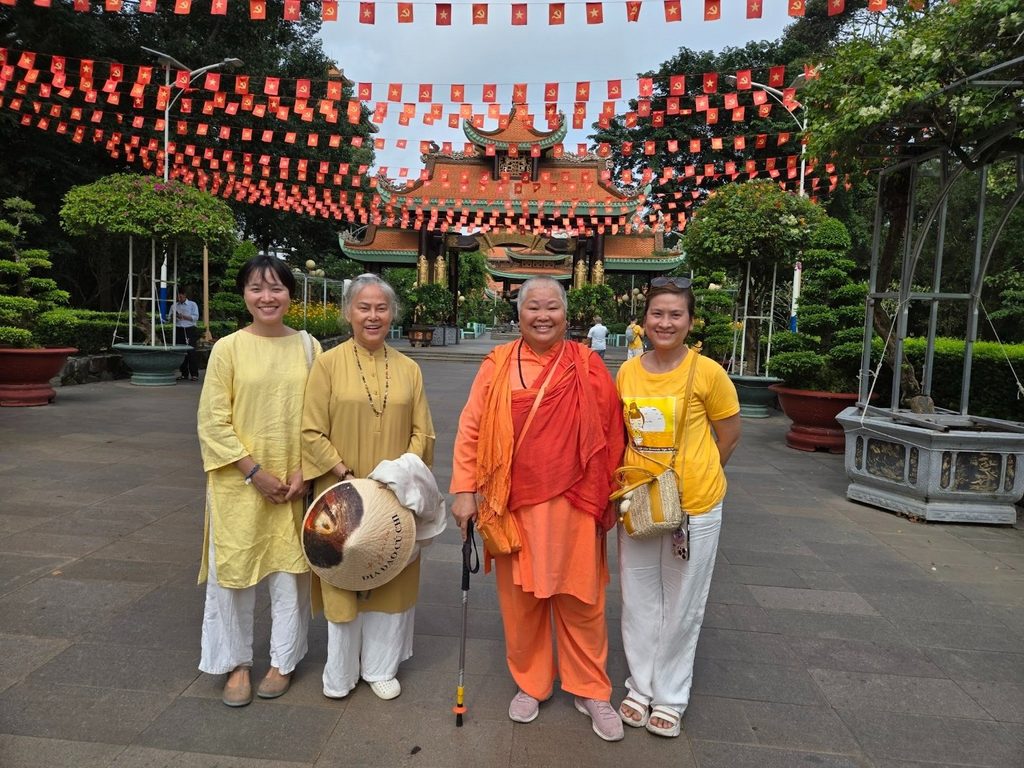
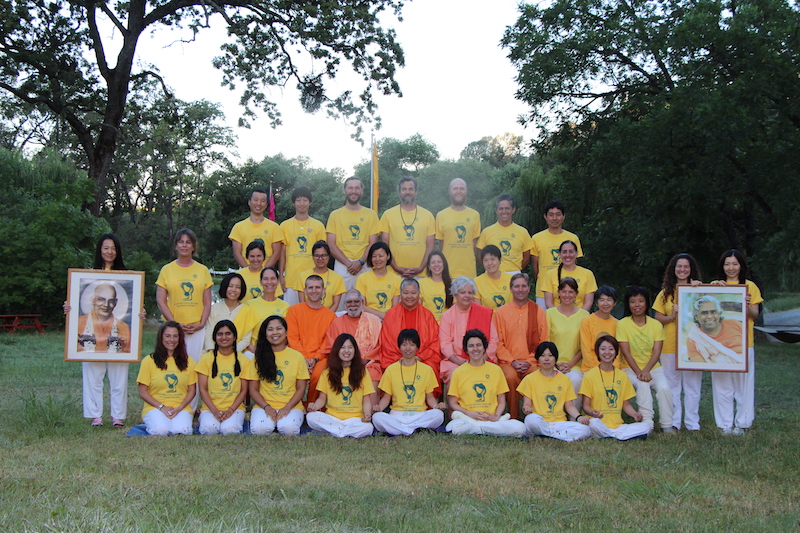
At 6:00 a.m., I set out for Củ Chi with 35 Vietnamese friends, traveling in two small vehicles and one large bus. Our first stop was the Bến Dược Military Memorial Temple, which honors approximately 45,000 people who sacrificed their lives for the country.
Returning to the “Land of Steel and Bronze”
Củ Chi was once known as the “Land of Steel and Bronze.” During the war, it endured such intense bombardment that it was at one point called a “white zone”—an area devastated and stripped of life. Countless lives were lost, and profound suffering remains deeply imprinted in the memories of many generations.
I have had a special connection with Củ Chi for many years. From 2010 to 2014, I taught yoga teacher training courses there. At the time, I felt that I was teaching yoga and yoga philosophy not only to those present in the classroom, but also to many souls in the surrounding area who were listening.
On the final day of one course, the sky was clear when a powerful wind suddenly arose. The atmosphere became joyful and mystical, as though many unseen beings were happily bidding us farewell. When we later reviewed the photographs, hundreds of white spots—commonly called “orbs”—appeared in them. Above my head was a very large circle of light that resembled a halo. It was a profound experience that has always remained with me, leading me to remember Củ Chi as a place in need of remembrance, love, and healing.
Today, as I conduct peace programs in many places, I carry with me a heartfelt intention: to help heal what happened in the past but still lingers in the human subconscious. Painful memories need to be acknowledged with compassion so that they may gradually be released.
We intentionally use the word inner peace, because peace begins within. Peace may refer to external circumstances or cessation of war, but inner peace is something each person can cultivate through a yogic life. Through the practice of asana, pranayama, and meditation, we connect with the peace that already exists within us. When we understand ourselves and live in harmony with ourselves, we can understand others, bring harmony into our relationships, and help create peace in our communities and throughout the world.
Remembrance at Bến Dược Memorial Temple
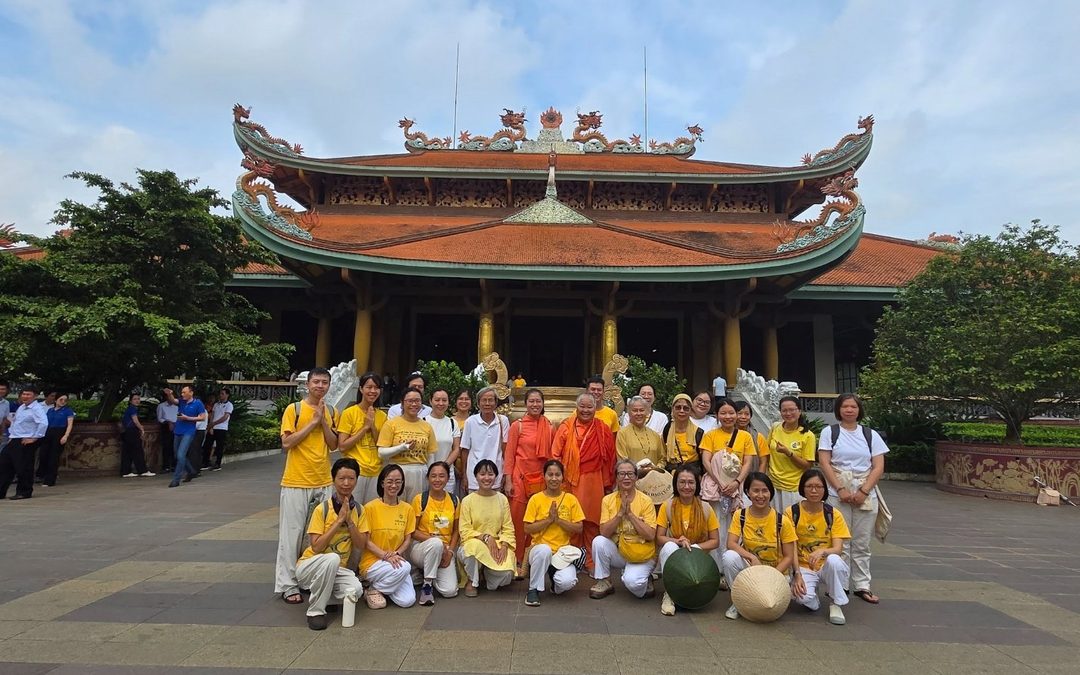
Before passing through the main gate of Bến Dược Memorial Temple, I asked everyone to remain solemn, refrain from talking, and silently repeat two mantras: Om Namo Narayanaya, a prayer for peace; and Om Tryambakam Yajamahe, a mantra praying for the liberation of those who have passed away and for peace for those who are still living.
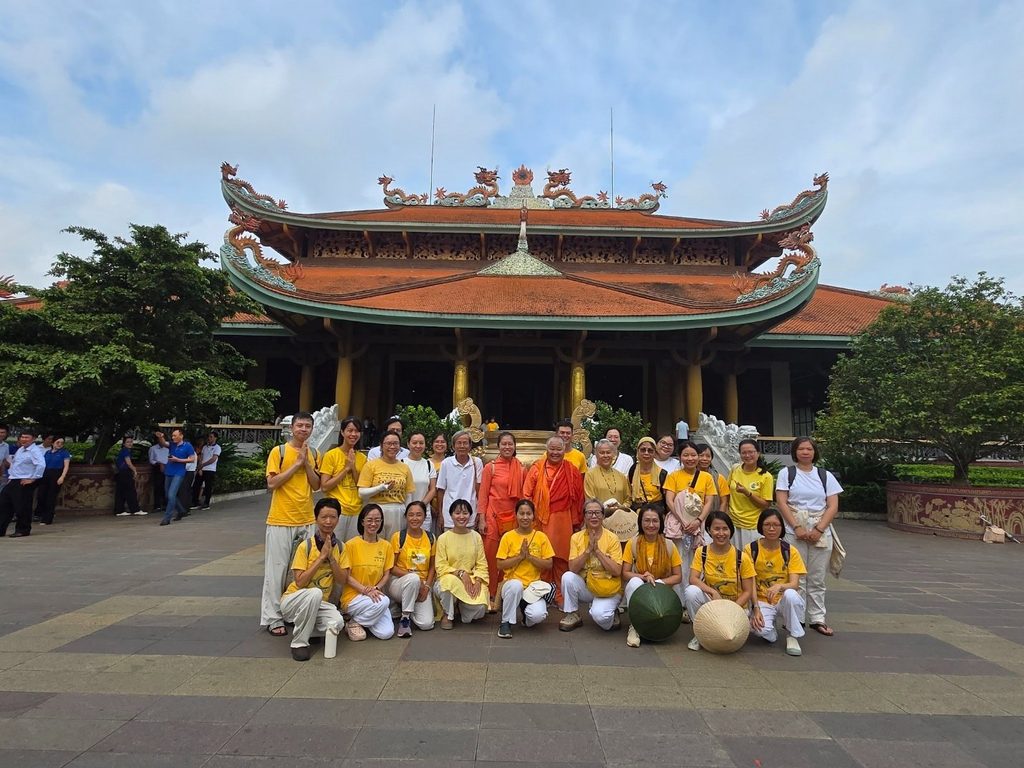
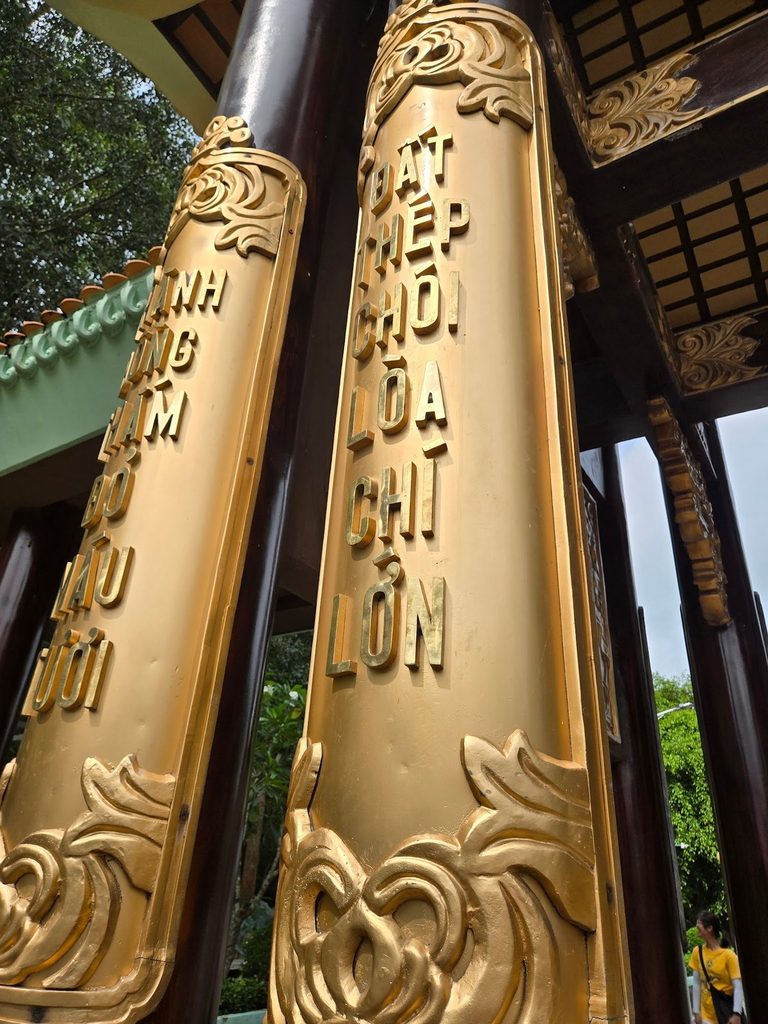
After taking a group photograph in front of the gate, we slowly entered while chanting the mantras. In the middle of the broad pathway stood a majestic incense burner. The entire memorial complex was beautifully maintained, with tall rows of trees, flowers, greenery, and solemn architecture resembling that of a temple. Many leaders and generals have planted commemorative trees there.
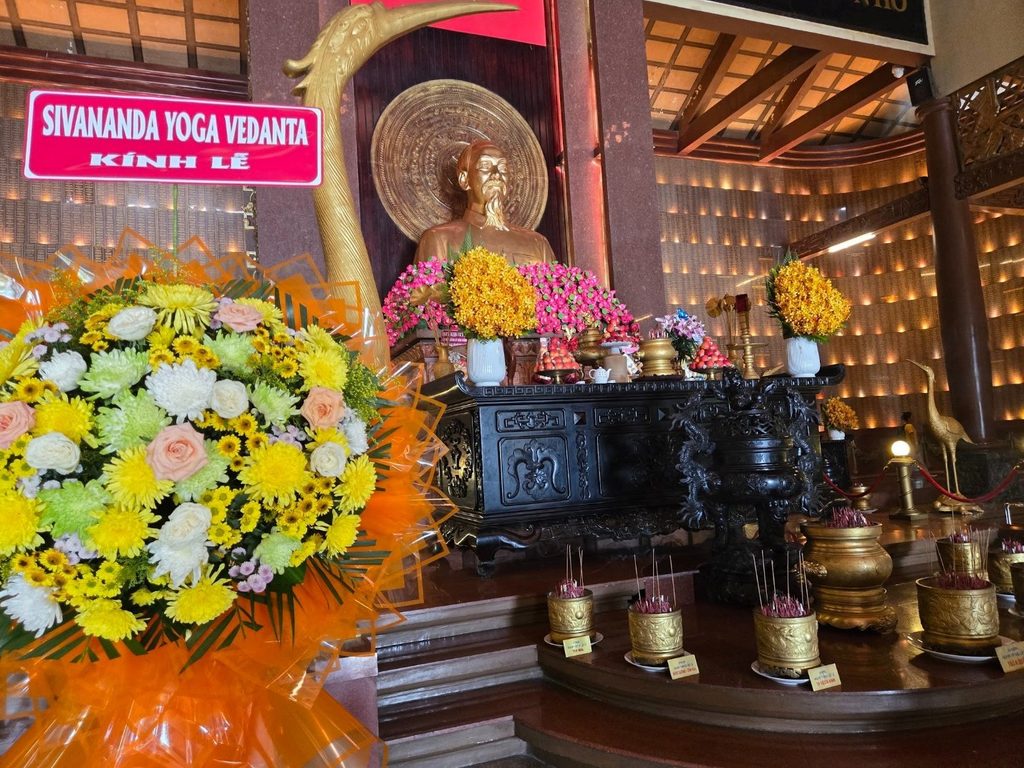
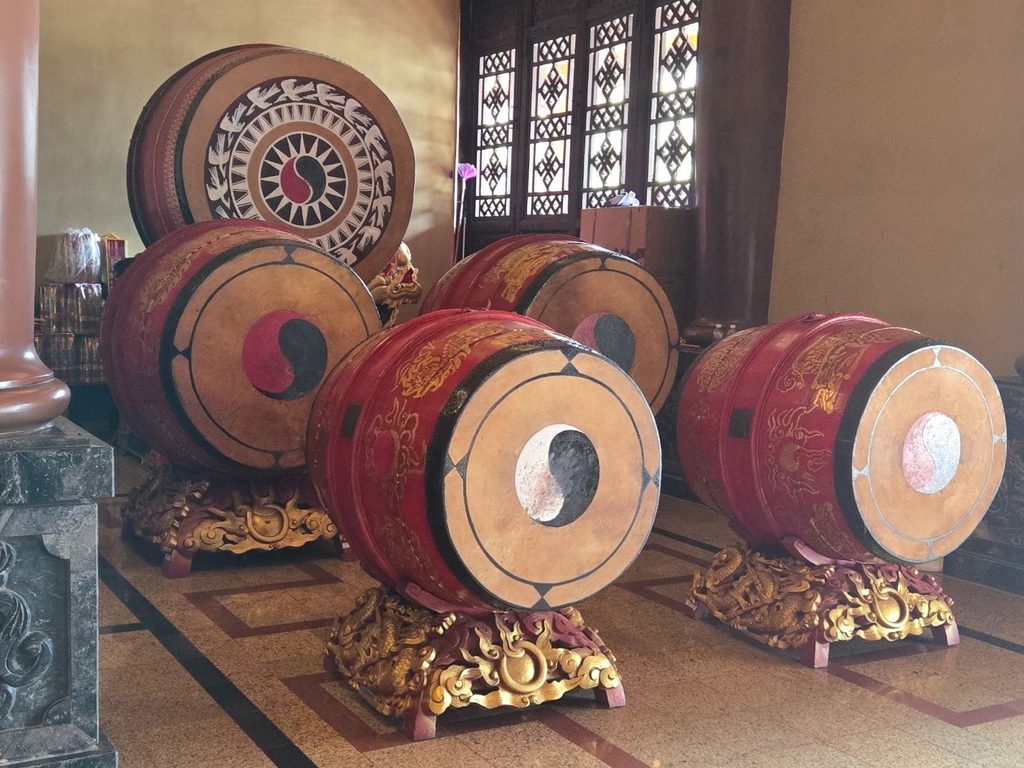
Upon entering the main sanctuary, we observed one minute of silence. The resounding great bell, the drums, and the sacred music deeply moved many people. Two floral wreaths bearing the name Sivananda Yoga were placed respectfully before the altar.
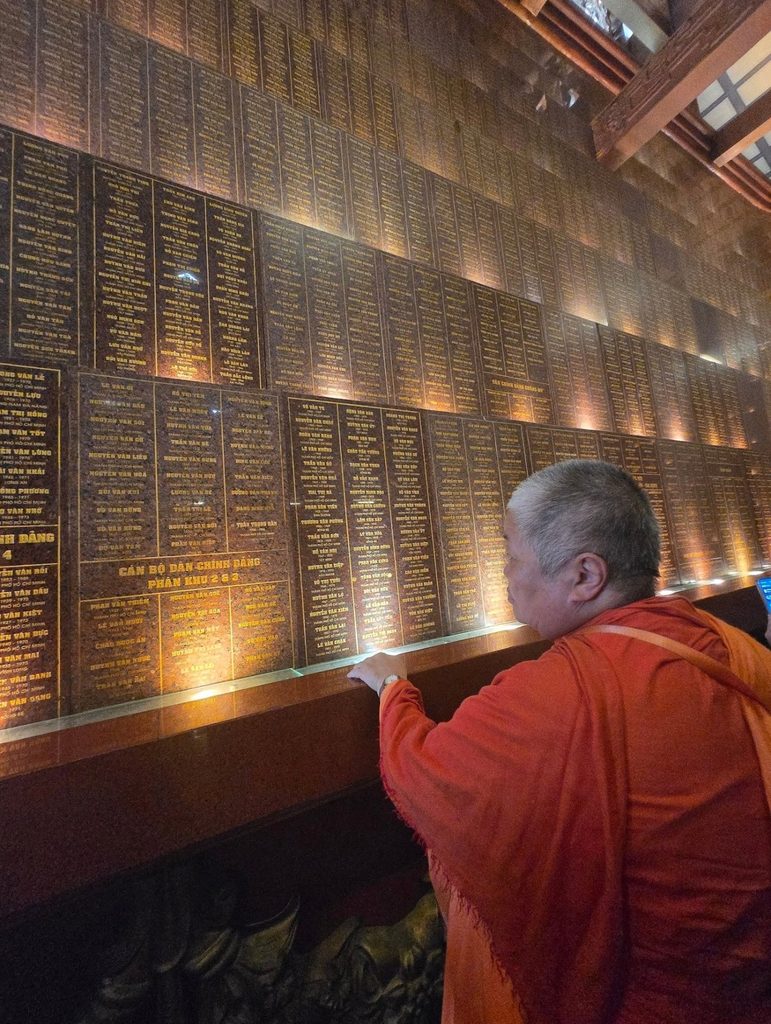
At the center stood a statue of President Hồ Chí Minh. Along the three surrounding walls were bronze plaques engraved with the names of the fallen soldiers, together with their places of birth and the years of their birth and death. Most of them were very young—only 18, 20, 22, or 23 years old—when they sacrificed their lives for their homeland.
Everyone walked around quietly, reading the names one by one. One member of our group, Ms. Mỹ, found the name of her older brother, a fallen soldier who had been missing, and requested an official confirmation. Tarini was also deeply moved when she asked for help locating her maternal grandfather’s name. Among the tens of thousands of names, history was no longer something abstract; each name represented a life, a family, and a story that continues to be remembered.
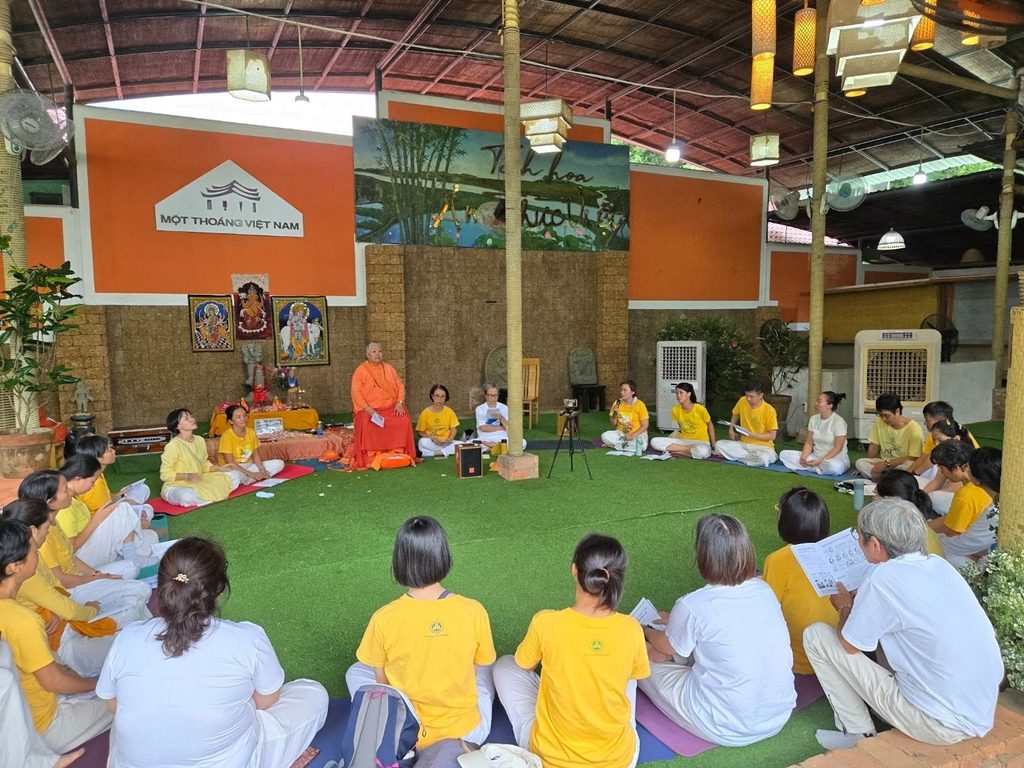
Behind the temple, we sat together in a Peace Circle and chanted Jaya Ganesha. When other groups of visitors arrived, we lowered our voices and continued chanting softly. Many people shared that the energy of this place felt very pure, gentle, and sacred. Perhaps, through so many years of remembrance, prayer, and sincere offerings, those who passed away have found peace.
Each day, ceremonial tables at the temple are carefully prepared with Vietnamese food as offerings to the fallen soldiers. The enduring care and gratitude of the living seem to have transformed a land once filled with suffering into a place of serenity and sacred beauty.
Một Thoáng Việt Nam: Transforming Bomb Craters into a Place That Preserves Vietnamese Culture
Leaving Bến Dược Memorial Temple, we traveled to the Một Thoáng Việt Nam cultural and traditional craft village. Ms. Trần Thị Tuyết Nga, its founder and General Director, warmly and formally welcomed our group. As a war veteran, she has devoted herself wholeheartedly to preserving and sharing the values of traditional Vietnamese culture with both Vietnamese people and international visitors.
The site preserves many historical artifacts, statues, altars, and teachings of distinguished Vietnamese figures, military leaders, and poets. I was especially drawn to the memorial plaque honoring Trần Quốc Tuấn, also known as Hưng Đạo Đại Vương, who three times led the soldiers and people of Đại Việt in resisting the Mongol–Yuan invasions. Wooden stakes evoke the victory at Bạch Đằng and the wisdom of our ancestors, who harnessed the tides to defend their homeland.
At the center of the traditional house stood the Altar of the Nation and the Land, built with sacred soil gathered from all 63 provinces and municipalities, symbolizing the unity of the Vietnamese people. It is also a place where Vietnamese people can return to their roots and honor the ancestors of the nation’s many family lineages, from the earliest days of settling the land and founding the country.
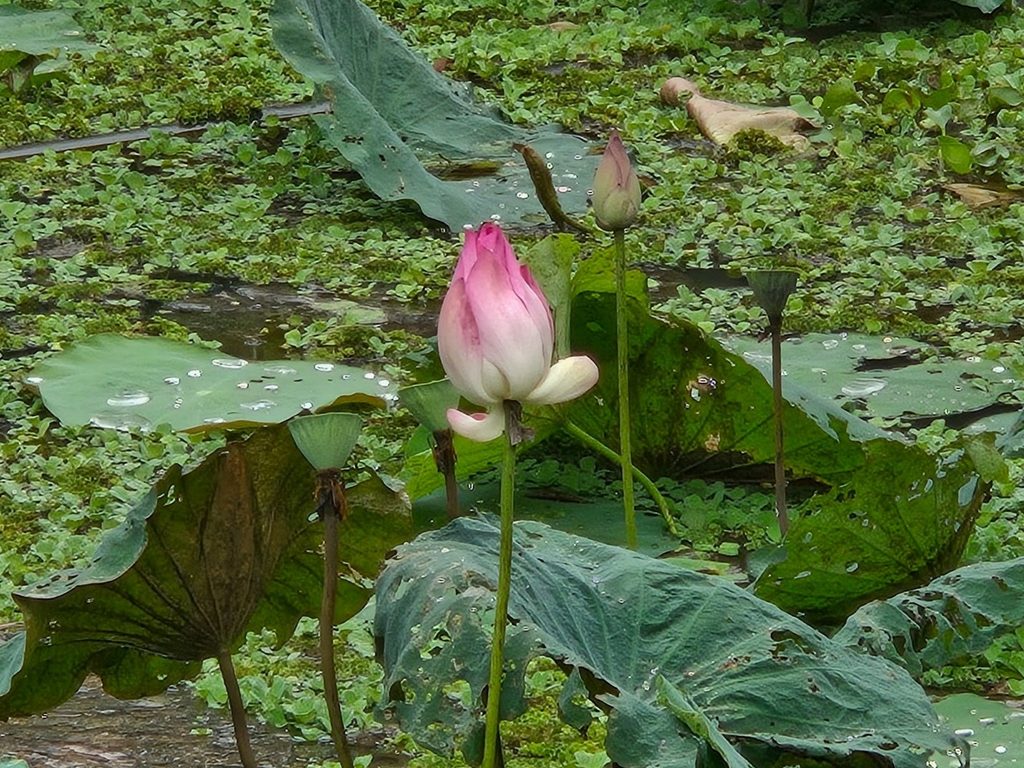
Ms. Nga explained that this land was once a muddy bomb crater. She overcame many difficulties and used nearly one million cubic meters of soil to fill it, transforming a scar of war into a lush cultural sanctuary with brick pathways, rows of bamboo, climbing vines, flowers, greenery, and lotus ponds. It is a deeply meaningful image of transformation: from destruction to life, and from memories of war to beauty and culture.
Puja for Universal Peace
After offering incense at the ancestral altar, we performed a traditional Indian puja to pray for universal peace. Ms. Nga shared that while deeply honoring Vietnamese culture and our homeland, we should also open our hearts and pray for all humanity.
At the center of the puja was a large stone Shiva Lingam from the Cham culture. Its lower part represents feminine energy, while its upper part represents masculine energy. The Shiva Lingam symbolizes the harmony of yin and yang and the union of cosmic consciousness with cosmic energy—the two aspects that bring this world into being.
Beside the Shiva Lingam, we placed a statue of Ganesha and images of the spiritual masters of the Sivananda tradition. The presence of the masters helps us understand the deeper meaning of worship, so that ritual does not become superstition but remains a path of understanding and spiritual connection.
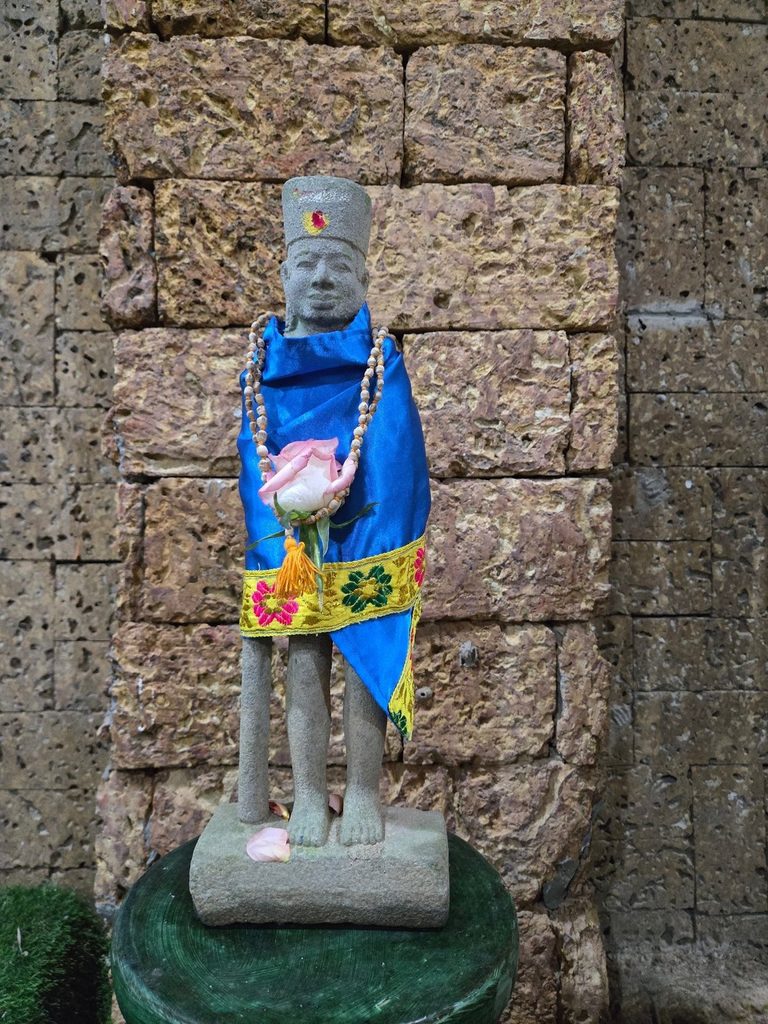
The altar also held a small statue of Vishnu, believed to be approximately one thousand years old. Although only about 20 centimeters tall, it radiated a powerful vitality and possessed a uniquely captivating beauty. Vishnu symbolizes preservation, inner peace, and peace throughout the world.
Ms. Nga shared that, in preparation for this day of prayer, she had visited the Cát Tiên Sanctuary—where traces of Shiva Lingam worship remain—and the Cao Đài Holy See in Tây Ninh to seek blessings and pray for the ceremony’s successful completion.
One by one, each member of the group came forward to offer milk, water, and flowers to the Shiva Lingam while we chanted the 108 names of Lord Shiva together. The solemn ceremony served as a bridge connecting Vietnamese culture, Cham culture, and the spiritual traditions of India in a shared prayer for peace.
Afterward, everyone enjoyed a generous vegetarian meal beside the lotus pond. The dishes were light and wholesome, beautifully presented, and given meaningful names.
A Peace Circle in the Rain
After the meal, the group gathered in a Peace Circle. I gave each person a topic to reflect upon and share. Rather than speaking in general terms, each participant looked deeply within and spoke from personal experience. A flower and a microphone were passed from one person to the next. As everyone began to open their hearts, heavy rain started to fall.
The topics shared by all are centered on restoring inner peace: ahimsa—nonviolence; satya and satyagraha—truthfulness and the power of truth; selflessness and service; courage; forgiveness; grief and loss; yoga and meditation; self-mastery; and conscious action.
Some remembered the soldiers who had sacrificed their lives in service to their country. Others expressed regret for having lost their temper or behaved harshly toward their children. Some admitted that forgiveness was very difficult, yet they remained committed to trying. One person spoke of losing a close friend and wept for a beloved cat who had been a companion for 17 years. Through grief, there is inner realization how important it is to keep the heart open.
One person shared that she needed to become gentler and more feminine in the way she treated others. Another said that living truthfully had led her through a divorce, but had also helped her rediscover peace within herself and with her children. Someone who had previously been very afraid to visit Củ Chi and Bến Dược Memorial Temple felt happy afterward for having made the journey, connected with others, and gained a deeper understanding. Another person sincerely apologized to the younger generation for words spoken in the past that may have caused them pain.
One participant read a poem written at the vegetarian restaurant:
“Live without anger, resentment, or blame.
Live with a smile through trials and hardships.
Live by rising toward the morning light.
Live in harmony with all living beings.
Life is movement, yet the heart remains still.
Live with love, but without attachment.
Live in peace and joy, untouched by fame or gain.
Keep the mind unchanging amid life’s countless changes.”
These verses embody much of the spirit of yoga. To live without anger, resentment, or blame is to avoid identifying with our emotions. To smile in the face of hardship is to maintain a positive outlook. To rise toward the morning light is to continually seek light and wisdom. To live in harmony is to cultivate peace in our relationships.
“Life is movement, yet the heart remains still” recalls the teaching of the Bhagavad Gita about seeing inaction in action. “Live with love, but without attachment” expresses the spirit of non-attachment in Jnana Yoga. Regarding fame and material gain lightly reflects the virtue of aparigraha—non-possessiveness. And “Keep the mind unchanging amid life’s countless changes” reminds us of the Atman, our true Self, which is eternal and unchanging even as the outer world is constantly changing.
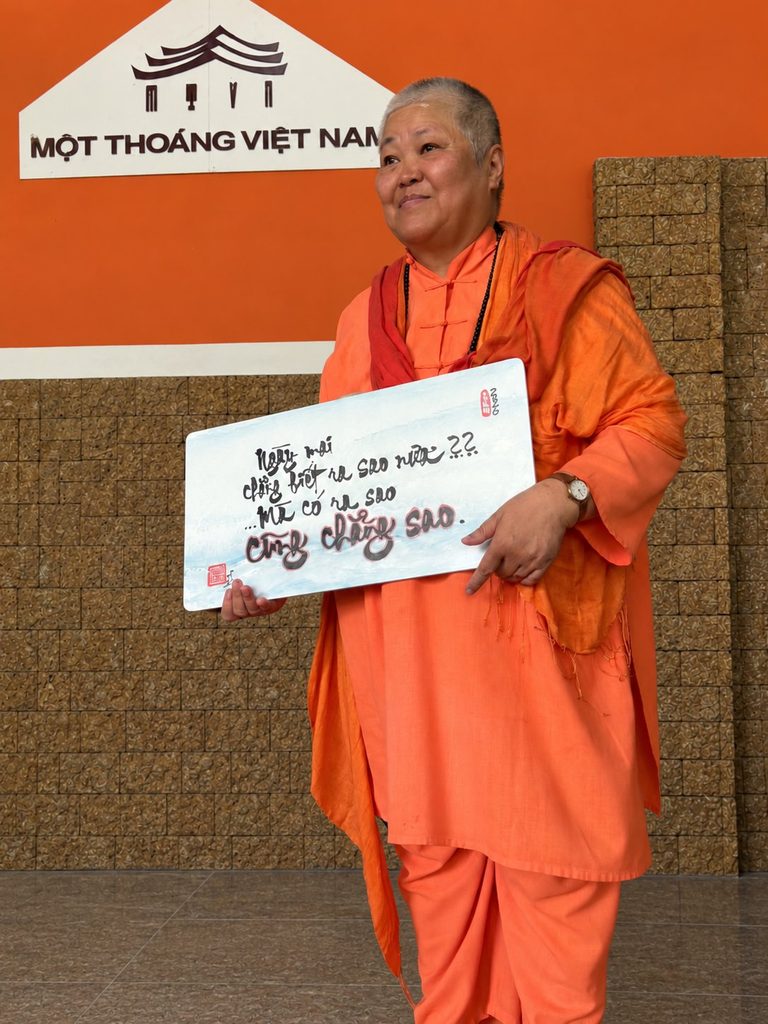
Another piece of calligraphy displayed these words by Master Thanh Sơn:
“We do not know what tomorrow may bring,
but whatever it brings, it is all right.”
It is a simple reminder to let go and trust in the face of the unknown.
Asana for Peace and the Closing of the Circle
After the Peace Circle, we practiced an asana class for peace. Through the breath, gentle movements, and relaxation, everyone brought the message of the day deeply into their own body and mind.
At the end of the day, we gathered once more in a closing circle. Many participants felt deeply moved and grateful to have been there. Some had initially decided not to come because they were tired or busy, yet after spending the day together, they felt renewed and full of energy, with their fatigue gone. Many shared their stories through tears.
One person recalled the story of a poor elderly woman who ran a small roadside food stall. When someone felt sorry for her and remarked that her life must be very difficult, she replied that she was not suffering at all, but felt deeply blessed. During the war, whenever she heard a sound, she had to jump into a shelter. Now she could live in peace without hiding from bombs and gunfire—and to her, that alone was an immense happiness.
One person compared the atmosphere at the Ba Chúc Memorial, where approximately 3,000 people were killed—a place that still feels heavy—with that of Bến Dược Memorial Temple, which commemorates approximately 45,000 fallen soldiers. Through many years of continual remembrance, offerings, and reverence, Bến Dược today feels serene and carries a profoundly uplifting energy. The sincere remembrance of the living has the power to heal the past.
Some realized that they now understood their parents more deeply. Their parents had lived through the war, and some of the difficulties in their personalities and lives may bear the imprint of those years of fear and uncertainty. This understanding opened the heart to compassion rather than judgment.
Many people said they now better understood the difference between external peace and inner peace: external peace is generally understood in relation to outer circumstances, while inner peace begins within. One participant expressed gratitude and felt a deeper connection with her own father after the pilgrimage. Everyone wished to bring peace into their daily lives, rather than experience it only on one special day.
Through these heartfelt reflections, everyone developed greater empathy for those seated with them in the circle. From that shared understanding, each person felt strengthened to live in peace and spread peace to others.
As the pilgrimage came to an end, everyone boarded the vehicles, said their farewells, and returned home. But what we carried with us was more than the memory of a journey. It was the understanding that inner peace is not a distant ideal. It is created through every breath, every word, and every conscious action—through forgiveness, gratitude, remembrance, and our willingness to open our hearts to our own suffering and that of others.
When a person finds inner peace, they can bring peace into their family. When families live in harmony, communities can begin to heal. And from such small circles of truthfulness, empathy, and love, peace can spread throughout the world.
The topic of today is an important topic, a philosophical topic. It is the topic of detachment. Those who study Vedanta in the TTC, you know that it is part of the practice of Vedanta to learn to detach so that your mind and heart are not so involved in everything that is temporary. You remain yourself.
The word detachment is called vairagya in Sanskrit. It is an important skill to be able to learn so that you do not lose yourself. The drama is when you get involved in life and you lose yourself. Like when you drive the car on the road and you forget and are unable to direct the car. You don’t know anymore where you go and you lose your mastership of the car.
Vairagya or detachment is a faculty to learn through practice. You need to practice, practice, practice. Some people are better than others. Some people are very passionate so they cannot detach. Detachment or dispassion is the same thing. You need to step back to be able to see the bigger picture and not be too involved. Your mind and emotions get involved and you lose yourself. You need to learn how to do this, to step back, to detach.
Detachment as opposed to attachment
In order for you to step back, you are afraid, which is why you attach. Why are we so attached? Because we are afraid. We are afraid that if we detach we will let go of that holding and then we will fall into the nothingness. Then we would lose ourselves. That’s a problem. That is why in order for you to learn to detach you must be very anchored and you have to remember your true nature which is Satchitananda Atman. The moment you remember yourself, you remember that if you are attached you lose yourself, but if you are detached you remember yourself.
Especially for those who have a passionate nature with lots of emotion, it is easier for you to feel alive when you are attached. It is more difficult for you to be detached because you feel that you are not alive. It is not true that you are not alive but you have to learn to feel a different kind of feeling, which is a feeling of peace, of inner joy. It is not a feeling of emotional excitement or emotional fulfillment. It is higher, more refined, the quality of detachment. Detachment does not mean that you are not loving. It just means that you are loving in a more profound manner.
Self as Satchitananda
Now you need to remember the self as Satchitananada. Sat means always existing. You in reality are always existing – not coming, not going, not changing, not being born, not dying. That means beyond this life in this body you have an existence, something that is always there: your spirit, your soul. You need to remember the truth that is untouched and is always there behind the whole drama – when you remember, you are not afraid. People are afraid of dying and afraid things will change. You have to practice to withdraw so you can remember the self that is not changing.
Gold is the essential nature of different ornaments: the ring, the bracelet, the crown is made of gold. It has different shape, form, name, and usage, but gold is the most important thing. You need to be detached from the name, form, and usage to see the essential nature of that thing is gold. You need to be detached from your name and form, your occupation or your relationship so that you remember your essential nature, your true self, is spirit. When you are able to detach you remember your spirit.
You need to develop a spiritual approach to life. You live your life from a larger perspective. We need to know the purpose of our life and who we are. You know the purpose of your life is to realize more and more your immortal spirit. Who we are is the Atman, is the Self. Then you can really detach because you know that you detach, but you find everything, you are not losing anything.
In the beginning, you have to go through the fear of detachment. You don not want to detach even though when you attach you have a lot of trouble, a lot of problems. Because you prefer to be attached you are not able to detach. You prefer to continue that same habit of attachment.
Ocean of Samsara
When you are not detached then you identify also with actions, what you do. You are attached to action and what you do. You get involved in everything and everything is a big drama. You are immersed in the battle of life. Life becomes very real: you battle and struggle and you lose your own true self in the battle of life. Some people are so involved, fearful, angry, and desperate and sometimes they kill themselves. They kill their instrument of realization, which is the body. This does not solve the problem. According to Vedanta philosophy, you have to live life, but with detachment. This is the teaching of karma yoga.
If you are immersed in life sometimes you win and sometimes you lose; something good happens – you are happy; sometimes you’re in a difficult situation – it’s a big drama. You are all the time losing yourself in up and down, up and down. We call this the ocean of samsara. Ocean of samsara means that whole ocean with so many waves and you are drowning in it. Up and down. Sometimes you can breathe and sometimes you are down, sometimes you can breathe and sometimes you are down. Like right now the whole world is in the pandemic and everyone is very anxious.
Detachment from what is changing
(add image from Swami Sitas Vairagya satsang slide with same header – woman in front of mirror)
You have to learn this faculty called detachment. Detachment from what is changing – like this lady looking in the mirror seeing that she has this white hair. Everything is changing. Your body is changing. Your appearance is changing. What is changing is not called truth.
In Vietnamese there is a word, Vô thường, which means impermanence. In the Buddhist teaching a very important teaching is what is permanent and what is impermanent. You learn to develop that faculty to know that something is impermanent, which means that the nature of it is not to exist forever. Then you need to detach from it.
Truth eternal
The nature of the body is when you are born you have a certain number of years to live and a certain number of breaths and then it is finished. It is not forever. The Self is truth existing forever. Consciousness exists forever. The Truth exists forever. Everything else is changing. Everything else is asat – meaning not true.
The name, you can work and build up a name, some people are very famous – and they die. Nobody remembers them. Circumstances of life are changing: sometimes we live with people, sometimes we live alone and things are changing. Sometimes you go to work. Now you are not going to work, you are at home. Things are never the same so better that you live in the present as much as you can and you do not worry about the past or the future all the time. Locations change. Emotions change. Emotion is always changing.
Detachment from that which is external
We also attached from that which is external. You have to learn that which is internal and that which is external. Internal is your consciousness, your feeling, your awareness, your idea that “I know”, “I am” – that is internal. Anything else is external. You detach from the external because the external is made of your senses and your senses are not really representing the truth.
The internal, your feeling inside, this is what you need to be more aware and more developed. As you have your feeling inside, your awareness, your consciousness, your sense of “I know”, you need to feel secure in that. Our eyes are all the time looking for something external and we grasp for the external, we attach to the external.
Meditation
When you learn to meditate, you find that consciousness, you see. When you learn to meditate, you close your eyes, you close your senses, you do not remember anything, you are in that space. When you open your eyes, you live in this world and you are a little bit more detached. That is why meditation is a very good tool to train you in detachment. The more that you are able to meditate the more strong you become because you are more secure in yourself instead of losing yourself in the external.
Everyone needs to meditate every day. The more that you are able to do the better. If you want to be strong, you need to be withdrawing in the meditation then you start to realize there is something there that is strong, that is unchanged. You also can help yourself with renunciation. Instead of desiring and grasping for one thing, you say “No” I do not need it. I am fine. You live a simple life.
Purification
Purification means you do asana and pranayama. Purify your energy. Purify your nadis, your energy. Purify your mind so that you do not have certain thoughts. Automatically it is easier for you to go inward because you are not blocked. When your mind is blocked by impurities, by wrong habit of thinking, then you cannot go inside. When the mind is blocked, it is always projecting some external distortion. When your mind is pure, you can go more inside, deeper. You will become more contented, more peaceful. You do not project, constantly projecting different distorted ideas about life.
Happiness Is Within
The knowledge that comes from detachment is a spiritual knowledge not an interactional knowledge. The answer lies within. If you feel worry, concern, you do not know what will happen, then you look inside. The answer lies within.
Sometimes you ask yourself the question, “When will this pandemic finish? When do I not have to wear a mask anymore? When can I travel like before? When can I meet with family and friends?” That means you have to sit in restlessness. You attach this present situation and you do not feel comfortable with it. Then you ask yourself all the different questions.
Then you need to remember that the answer lies within. You see what that means. At that time you detach from the external you go in the meditation, you go inward. When you go inward, you feel fine. You do not need to meet with anybody, you do not need to travel anywhere, you do not need to eat anything fancy, you do not need to go to coffee shop, and you do not need to do any kind of activity. Even your livelihood you become detached from also because you know that it will be provided somehow because you are more creative and you are not panicking. The answer lies within.
It is not as if you are running away from your responsibility and you do not care, but this is a philosophical answer to the difficulties of life. You need to find fulfillment and say that you already have what you are looking for. You look for always something outside, but it never really fulfills you so you look for peace. If you are going to detach you look for peace and peace will be there and you feel content, you feel ok. Stop looking at the wrong place.
Sometimes you meditate, you do yoga and you feel like it is pointless, that it does not do anything that there is no result, but that is wrong thinking. When you do yoga and meditation the main thing is you become more detached. You might not be aware of it, but life is different because you are not running after the external. When your mind is active, then it starts to say, “Oh yoga and meditation doesn’t give me what I want”, but that is a mistake of thinking. When you practice yoga and meditation, you are more content. You are fulfilled. You do not need anything and that is a great feeling.
Illusion of the Senses
A woman looks for the needle she dropped in the house outside because there is light outside. We always look for our happiness in the world of the senses, but it is an illusion. It does not last long and it can change. You need to develop this sense of contentment, of peace, from within.
In the ashram in Vietnam there is a beautiful place that you can sit and look at the sunrise and you feel very happy from inside because it is not so much the sun that you look at, but the phenomenon of the sun rising. You are witnessing the miracle of life, the miracle of god and that is how you become happy.
Illusion of the Mind
There is another story, a person walking in the desert found a tree, but they look away and there is always water: we call it a mirage. It is an illusion. That person decides to leave the shade to go look for the water saying to himself, “I will come back to my shade if I don’t find water”.
The same in life – we all the time have that illusion in our mind, this different desire in our mind. If I am going to get this promotion then I will be happy. If I am going to buy this car then I will be happy. If I am going to get married then I will be happy. If I am going to get divorced, I will be happy. If I am going to travel, I will be happy. Always the “if” for you to be happy, but it is an illusion because you will never be happy because there is an “if” there.
You need to stand in one place and look within. The person needs to stand under the tree and dig underneath and water is there. You need to be fulfilled now, be happy, contented now.
There is only one self – there is no other
The Vedanta philosophy teaches you the illusion of relationship. There’s only one Self. There is no other, what that means is there is the Self that is reflecting in other people around you. Always one. One is all. There is that one Self that is in all.
When you have relationships, oftentimes there is the problem of attachment in relationship. You need to remember, you need to see the Self in others. The Self included yourself. If you forget yourself and you only see the other then that is attachment happening. If you remember yourself, and you remember the Self in others than you are fine.
All knowledge is within, so try to be calm. Have the conviction that the Self is there. Calm your mind down. Have self-confidence.
Find your sattva nature by the practice of the five points: asana, pranayama, relaxation, positive thinking, and meditation. Then you are calm. When you are calm then you can see yourself. Be quiet. Those who are in lockdown it is a very good opportunity to do this. Be quiet. Be silent.
Do not worry. Try to convert your negative emotions. If you have negative emotions or any kind of emotion, the mind is wavy. When the mid is wavy then you lose yourself. You get involved so you lose yourself.
If you think, “I am this then I will not know that” – what does that mean? It means that the mind is always in duality. It gets involved in this and it gets separated from that.
Think, “I am you then I know you”. It is better that you do not compare yourself with other people from the external point of view as that will bring the attraction, repulsion, disturbance in the mind. If you think, “I am that person” then you feel more compassionate or you feel that you are that person. You can be that person itself. You know the person. Then you do not have conflict with people and you are more at peace.
Detach-attach-detach
Detachment is not easy because that is the nature of your life. When you are born you are attached. You try to detach and you get attached again, you try to detach and you get attached again.
This is the story of a tiger walking in the forest of leaves and the leaves just fell so they have some sap. The leaves get stuck to his feet so he sits down in order to remove the leaves from his feet. Because he sat down the leaves get attached to his butt. He wants to remove the leaves from his butt so he lies down. Now the leaves attach to his back. He wants to remove the leaves from his back and he rolls around and the leaves get attached to his belly. The leaves are all over. He want to be detached and now they are all over him. This is a nice story I hope you remember. The story of us.
Attachment brings suffering
Oftentimes, we want to be detached, but then we get attached more. You want to be detached – let’s say free from your work. You find two jobs in order for you to make more money in order to retire from work. And you get attached more.
If you want to detach from your relationship and then you get attached to beer and alcohol or to sleeping pills because you have difficulty. Then you want to be detached from the drugs and alcohol. Then you get attached to the cigarettes. Then if you don’t want to get attached to the cigarettes you get attached to food. You get detached from this person and you get attached to another person immediately. Constantly like this, our lives like that. Attach, detach, attach, detach.
Sometimes you feel yourself so attached, like in prison. You cannot do anything. Always you think of the boss, you think of your family, you think of your household, you think of your life like a prison. You feel like you are a slave to everything. You cry and you blame. Attachment brings suffering. At that time you have to sit down again and meditate. Don’t move. It is like the more that you move the more you try to find solutions to your problem the more you sink. Like quicksand, you can sink the more you move. Calm down. Relax.
Detachment from suffering
Remember your Ananda nature. Remember unconditional love. Happiness is also absolute, unconditional. Remember that your mistake is that you are looking for the happiness externally. You need to remember that you are happy by nature.
By withdrawing yourself and by being content you recognize this contentment within, but by using your mind you always experience pain and pleasure. Detach from the mind and the emotions.
Your true nature is Satchitananda. The mind cannot reflect that true nature. The mind is conditioned. It looks outside. It depends on the senses. It is imperfect. It is full of desires. It is swinging between likes and dislikes, governed by the ego sense, competitive, ambitious, and passionate. The mind includes the personality, emotion, desire. It changes constantly. If you attach to your personality, to your mind, to your way of seeing things then you will not have peace because you are looking outside of yourself. What you need is to look through the mind disregarding what the mind projects and clearing out the mind.
4 ways of detachment
There are four ways of detachment: karma yoga detachment, bhakti yoga detachment, raja yoga detachment, and jnana yoga detachment. Whatever way, it is ok. Each person is different. The truth is one. The paths are many.
Karma yoga – detachment in selfless service
In karma yoga do the best you can, but let go of the result. Detach from the result. Offer your efforts unconditionally.
Bhakti yoga, yoga of devotion – detachment in emotion
In the yoga of devotion, you detach from whatever you feel and think and you completely attach to the divine. You trust and have faith in the divine will and then you detach. You relax. You practice humility. You surrender.
Right now, you don’t know when Covid will finish. You have to surrender. You have to accept. We do not know when. It is the will of God. Relax.
Attachment to the highest truth brings detachment from everything else. You attach to find the truth. From everything else you detach. Remember our nature is very emotional. We identify different emotions. When you learn devotion, you attach to God or to the Divine or to Mother Nature and you detach from everything else.
Raja yoga – detachment in meditation
In meditation you also detach, but also detach from thoughts and distractions. You concentrate on the highest ideal by the name of the mantra. You focus on the mantra and you detach from everything else. You roll your japa mala beads.
Meditation is uninterrupted flow of consciousness. When you are completely detached then that bliss of the Self is there all the time. In the beginning, you need to detach by concentration.
You need to detach from past and future. Don’t think of the past. Don’t think of the future. The past is gone. You cannot make a better past. Let it go. Detach from your own story of the past. The future is not there, only a projection of your mind. Do not worry. Do not be attached to an imaginary future. Do not worry. Live in the present. The present is eternal. When the mind is concentrated it is easier for it to be in the present.
Jnana yoga – detachment from the unreal
The unreal is anything that is changing. Here is a baby monkey. The baby monkey is clinging to the mother monkey. Attachment to the truth here, and detach from everything else. It is the path of wisdom. You know what is transient, what is permanent, what is not permanent. You attach to the permanent. You remember the Self that is permanent and from everything else, you detach. You ask yourself the question, “Who am I?” and you say “Neti, neti”. You detach from the not self, the not real, the not permanent.
You can also be detached from name and fame. This is an Olympic champion with his gold medal. Nothing lasts forever. Name and fame are illusory. Detach from name, fame, and ego. Do what is right. Let go of criticism and praises. Bear insult, bear injury – highest yoga. You need to go inward and detach from name and fame.
Detach from sensual desires. Desire comes from Rajas, from the sense of lack. Desires are insatiable. If you eat one ice cream, you want more, you want more, but then you have a stomachache. One desire will fan another desire.
You can switch it to the desire for liberation. Calm the mind by detachment from desire. Realize the complete, the already fulfilled self. You do not need anything.
Detach from losses. Ultimately, loss is the loss of the body. However, you can also lose your relationships. Nothing in reality belong to us. The persons around us, we attach to them, but they belong to the universe. From our point of view you say, “It’s mine. My relationship”. In the bigger picture, it is the universe. We are custodians; we are caretakers of our relationship. We have the karma yoga attitude. Love is forever. You might lose a loved one, but love remains. Love is forever. We might lose objects and possessions, but more will be there. We are taken care of, don’t worry. It is a difficult topic, detachment from losses.
Detachment is the way out of samsara
Samsara is the ocean of suffering, never ending, the wheel of life and birth and life and death. Eventually detachment helps you get to moksha, liberation. Attachment is the reason why you are born. It is the root cause of all karma. Detachment is the way of exit out of the cycle of suffering, the cycle of birth and death. The ultimate detachment is moksha, freedom from the cycle of reincarnation and karma.
Start with day-to-day detachment. It is a big topic so think about this. It is not like you can do it right away. Every day you have to practice the detachment and you replace it with the truth about yourself. You detach, you have difficulty, but if you can remember the Self, remember that everything is there for you, that you are everything, then it is easier for you to detach.
The first level of knowledge is when you become a sadhaka, a seeker, a seeker after Truth. Somehow, you already know that you don’t know—that’s already significant. You are seeking for the Truth, seeking to know. But what are you seeking? There is sometimes darkness and sometimes light, and often, confusion when we embark on the inner seeking journey. It’s not a seeking outside. And you don’t need to come to the Ashram and do a Training Course if you can follow this guideline.
We are used to seeking outside for pleasures and happiness that are in the sensual world and that are temporary. If something does not happen the way we want, we are disappointed; we blame something or somebody. The reason for our disappointment is always external to us, in the external world.
Light in the darkness
But the seeker, or sadhaka, is a person of discrimination. This is the first qualification of a seeker according to Vedanta teachings. The second qualification is to have dispassion or detachment; the third is acquiring the six mental qualifications, and the fourth is having mumukshutva, a strong desire to know.
Since those present have completed the Yoga teachers training course and many have been on the path for a very long time, I believe that you all are quite serious. So, you are a seeker. Otherwise, you would not have gone through TTC, wanting to have more discipline in your life, learning meditation and yoga in a systematic, serious manner. That’s called mumukshutva, the desire to know. You have to know, more or less, what you are seeking. Otherwise, what are you seeking? If I’m looking for my glasses, I grasp everything around, asking, “Are these my glasses?” “No.” “Oh, maybe these are my glasses?” “No.” “Oh, these are my glasses!” “No.”
Why I am grasping? Because I don’t quite know. I’m putting each thing down, because I know that it’s not them. These are not my glasses. Why am I so certain that they are not my glasses? I can put the object down and reject it. Because I know, right? Because I know my glasses. And when I touch them, I have no uncertainty, no doubt. Why? Because I know them. The same in Vedanta, you are seeking something that you know.
Ask the right question
And yet, there is something in your mind that is so illusory, that causes you to look for something somewhere else and mistake something for what it is not. You have a pattern of seeking in the wrong place and you do not quite know what you are seeking. That’s a big problem. Thankfully, there are guidelines. In Vedanta philosophy, it is said that you have to qualify yourself in order for you to see or for you to find. Normally we seek outside, then say, “Oh, this, maybe it’s in the landscape?”
Or maybe, “It’s in the company?” Or maybe, “It’s in the weather?” Maybe: “Yeah, I want to be near the beach. And here it is too dry.” You are always looking for something—for happiness, in truth—but you fall back on the very bad habit of looking for it externally.
Happiness slips away
We try to change this with yoga self-discipline, to look in the right place. Eventually, you have to have the discrimination; you have to know what you’re seeking. Next, you have to be detached, be dispassionate, about things that you have mistaken to be “it”, to be what you are looking for. And still, you continue to do it again and again. You say you know that these are not your glasses, and yet, out of habit, you still go down the same road. You know that ice cream, sensual pleasure, etc. are our habitual ways to seek happiness—in the senses, in the emotions, in sex, in name and fame and the ego—in the external world.
The external world means the world of the senses. You are here, but you are looking around: “Oh, I’d like to be at the beach.” And then you have that dream in your mind: “Yeah, I’d like to be at the beach in a five-star hotel. I’d like to have my piña colada…” “Oh, that is happiness!” You have had this impression in the mind for a very long time—it’s very deep. And, perhaps you have been living with disappointment for a very long time, too. You build up some kind of desire, and then you get the desired object, but you don’t get the happiness you expected. It slips through your fingers. It’s gone.
Again, you feel empty and longing—hankering after something, and yet not able to satisfy yourself and find peace of mind. Still, the mind keeps going in the same, deep groove. It takes a long time to change. That’s why you need to be qualified. In reality, the happiness you seek is right here and now. It is within you; it is always surrounding you. It is right in front of you. It is not outside. And yet, we have been mistaken all this time.
The long journey
Again, the first qualification of a seeker is discrimination. This faculty of intelligence in the mind is able to recognize that the Truth you’re looking for, the happiness you’re looking for, is not in this changing world—not in the senses, not in your habits, not in your emotions, not in this changing world. You begin looking for it in a different manner. You need to go within to find the unchanging, the permanent, the Truth, the sat—in a word, satchidanandaatman—the Self that is full awareness, consciousness, and that is full of bliss. That is what you are looking for. You have sought it in many elusive forms, but this is the essence. Discrimination is the inner faculty that allows you to go beyond the illusions of the mind.
You are not new on this path. You have practiced before. You have been a seeker before, before this life. Maybe you have been seeking a long, long time for that Truth. But your discriminative intelligence is not yet sharp enough to discern where you go wrong, to recognize when you go backward and you’re in your old habit again. The habit leads you again to emptiness, to disillusion; it will not get you where you want. The discriminative faculty is that intuitive intelligence that comes from the wisdom within. It has been sharpened over lifetimes. It makes you feel that something is wrong. In fact, it makes you know, makes you decide, that something is wrong.
The dilemma of the oak trees
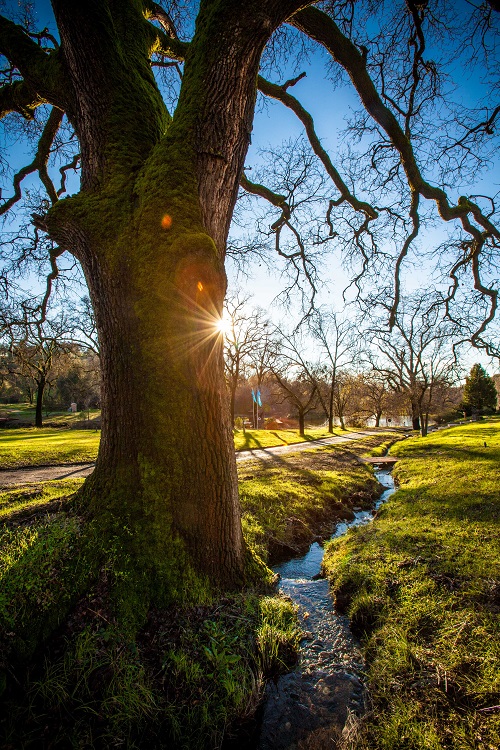
I will give some examples. About 25 years ago, Swami Vishnudevanandaji sent me here, to the Yoga Farm Ashram. I was not happy about it for many reasons. At that time, the Ashram was very small. There was an old farmhouse with grass growing tall and there was nobody here. It was not developed. That’s not what concerned me. I had a dream in my mind, an attachment to a certain thought, or samskara, that the ideal place for me would be in the mountains. Not in the valley. I like pine trees because, in my childhood, I lived on a hill of pine trees. And now I would be in a valley with oak trees and different weather.
Pine trees grow in a cool climate. But here I am in an area with oak trees and it’s hot. I have been sent by the Guru to be here. My mind complained, “No, I don’t like it.” Then I said, “Why would Swamiji open an Ashram in a valley like this? Just a few miles up the highway, there are pine trees on a hillside and nice weather. That would be perfect. Why isn’t the Ashram there? The Ashram here is not what I wanted.” So, then my mind is thinking, “I can go a few miles and get the ideal that is in my mind. Or I can come to this place, which is not my ideal at all.
But—what do I get? I get the teaching. I get the connection to the Guru, and I get to serve the Guru’s mission. I get to follow the schedule decided by the Guru. That is how the teaching is transmitted—through the schedule and through daily life. I get all this. But my mind is attached to my idea of what the ideal place for me is, what will bring me happiness. Thank God, my discriminative mind kicked in. It said, “Oh, okay. I have to choose between the weather, the landscape, the everything—and the teaching, and the connection to the guru that will lead me to go inside myself, lead me to the right place.”
So what do I choose? I chose the teaching, sacrificing my idea of an external reality that could give me happiness. I chose the connection, the austerity, the tapas, the opportunity to do practices. And that’s how I stayed here for 25 years. It wasn’t easy. These days, there are not many people here because of the Covid pandemic. Twenty-five years ago when I started, there was only half a staff. That was me; I split my time between the San Francisco Center and the Yoga Farm.
Now we have a dozen staff; it’s a big difference. My point is that your mind needs to start thinking differently about your choices in life. Illusion in our mind always brings us on the same route, leading us to the same disillusion. We go round and round and round and waste a lot of time. Meanwhile, you get old and you lose all opportunity for discipline, for meditation. You waste your life running after illusions. Time passes so quickly.
A lesson in Paris
Here’s another story of discrimination and dispassion. Once upon a time, I was not a Swami. I was like you, working. I had some money and time—and a vacation. I didn’t have a mission in life, nothing to dedicate myself to. I had no spiritual ideal, nothing. So I went to Paris. What do you do in Paris? You go sightseeing a little bit… and then what? You go shopping. What is Paris famous for? Fashion! So that’s what I did. I had money. I had nothing else to do with my life. So I went shopping for fashion, things that I would not normally buy. Back home, I tried the clothes on and said, “One day, I will wear this.”
But as I looked at myself in the mirror, it didn’t look like me at all. Why would I spend the money and wear such a thing? It was a very fashionable cape. So then, I just got rid of it. I wasted my money. I got rid of it after a day. Why? Because some amount of discrimination dawned. Your happiness doesn’t depend on your looks. If you wear fashionable clothing, you think that your look will give you success and happiness. If you have the look, you can be attractive. But will you have the happiness? No. I knew very quickly that it was an illusion.
When will it stop?
The first quality is discrimination—to think properly, to know what will lead you to the happiness you seek, avoiding your old groove or habit. The second quality is dispassion—detachment toward the habit, toward the karma, toward that strong desire and strong tendency. It builds up over a long period of time. It makes us go around in circles, go wrong, and not be able to stop. It was dispassion that made me give away the fashionable Parisian clothing and vow to myself that I would never indulge myself again. I had made a mistake, wasted my money, but I also realized that that was it, it was finished for me—finished forever and ever.
Temporary detachment
Detachment that comes with discrimination lasts, but detachment that comes from pain doesn’t. As an example, often a woman who gives birth finds it very painful. She may say, “That’s it, I will not have another child!” But then, after some time, she forgets. She goes on to have many children. That is a temporary dispassion or detachment. Another example is somebody suffering heartache from the disillusion of romantic love. Maybe their girlfriend ran away. Their heart aches and they run to the ashram.
I clearly remember one guy who arrived here in a red sports car. A sports car at the ashram! It represents rajas. He had just broken up with his girlfriend and he came here saying, “I will stay here forever.” He said he’d had enough of this girlfriend business! “I know now, I understand. I will stay here and do meditation. I will rebuild my life.” He sounded very sincere. We took him in. But this guy barely stayed a month. In one month, he forgot about the girlfriend. But do you think he got over the red sports car? He got another girlfriend!
Free yourself from the trap
What if you eat some ice cream, get a stomach ache and say, “Never again”? Is it going to last? No. Why? Because it’s not based on discrimination. In order to last, detachment must be based on discrimination. Otherwise, you will go back to the same thing when you feel a little bit under the weather, or when things are not going your way. Then you want to find happiness immediately—and the old samskaras, the old grooves, will kick in again. You will find yourself doing the same thing, again.
Use your intelligence to understand. Another example: you realize that ice cream is colored ice with sugar and a nice name. That’s it. Actually, the truth about ice cream is that it gives you a sugar high. Ahh, the coldness, and that name that sounds good—but then it gives you diarrhea. If you really think about it, then the detachment will be lasting. Then even if they come up with a new name for ice cream (or a new color, that’s how the industry works), you will not be tempted to buy it. You will not fall into that trap again. Now your dispassion is solid, based on understanding.
Be honest with yourself
So beware of anything that you find yourself doing again and again (and again and again) that gets you in trouble. Think of the moth that cannot resist flying into fire. It loses its wings. It becomes blind. Flying in and out, and back in again, blind, it literally kills itself. You can continue to do this yourself, but for how long? You lose all your prana and get sick. You cannot be young forever. This disillusion—this heart ache, sadness or depression—comes when your desire is unfulfilled.
Anger and resentment tax your system. You waste your time; you waste your life. So stop and think. That’s why satsanga, or company of the wise, is important. They don’t try to sell you ice cream or easy happiness. What do they tell you? You have to be disciplined; you have to look within. You have to cease your habit of attachment, your habit of telling yourself stories. They tell you the Truth. When you are in satsanga, it keeps you safe and sane. It keeps you on the right path.
The drama of not seeing
Another level of dispassion is detachment toward the difficulty of our karma. Life is not always pleasant. This morning is was nice at the Ashram, but then in the afternoon, some smoke blew in. That’s karma, the collective karma of California wildfires. Climate change is the collective karma of Planet Earth. It creates some difficulty for us. When we don’t understand, when things are negative, we collapse. Why? We believe it to be true. We forget our immortal Self and we lose our energy. The drama replays. We can’t see the happiness and find ourselves again. We fall back into the old grooves; we go back to old addictions, the old way of finding temporary happiness. We become blind again.
Attachment or detachment?
Forbearance allows you to detach from the ups and downs of karma, to have the resilience not to believe in it, but to remain in your Self. Discrimination lets us know that whatever is happening is temporary, it’s not the Truth. The Truth of your life is not the landscape or the weather or the people. It is not the company or the food you eat. It is your capacity to see yourself—your True Self—which is real, here and now. Separate from your mind, which is always coming up with new thoughts, new ideas and new desires to pull you away from meditation. Discrimination allows you to detach from the thoughts.
When you meditate, stick to the peace, even when thoughts come. Usually your most favorite thought will pop up during meditation to disturb you. You run with it and forget about meditation. The same in life, we constantly run after our desires, our ideas about this and that. We forget. We lose concentration, get distracted and find ourselves in the loop again. Discrimination is called viveka. Detachment is called vairagya. Detachment from the results of your actions is called Karma Yoga.
Detachment from thoughts is meditation. You are attached to things because of your emotions. To detach from emotions, you have to practice Bhakti Yoga. Cling to your mantra, to your way of connecting to the Divine in order to resist attachment. Attachment is not going to bring you happiness. It will ruin your life. You lose your way.
False identification
Detach from the results of your actions. Detach from this life, which is simply the result of your actions in the past. Detach from your feelings, your emotions. The moment we have a feeling, an emotion, we fall right away. We don’t have any discrimination, resistance, detachment—nothing. The feelings just pull us by the nose and we fall. We get ourselves completely confused. Detachment regarding the emotions is Bhakti Yoga. Detachment toward the mind and the thoughts themselves is called Raja Yoga and meditation—detachment toward the ego, the false sense of self, false identification. You know your ego: I’m the best cook, I’m the best teacher, I’m the best everything. What am I doing here? I need to do this, do that. We need to be detached from all these ideas about our identity as well.
Be curious to know
We must cultivate the six virtues and mumukshutva, the desire to know. In the process, you might have a glimpse of knowing that you don’t know and that you are seeking. But then you forget. The mumukshutva must be continuously nurtured. You must constantly know that you don’t know—and constantly be interested in knowing.
One thing I find very strange in my 40 years of teaching is that people are not curious about themselves. They know everything about the external world—they know how to shop, which company is good, what price, what car, what brand. They’re educated about politics and who said what. But about themselves, they don’t care. They think they know. The ego tells them plenty, and they’ve believed it for a long time. The society, the environment, their families have also been telling them. But that’s not who they are. Unless you ask yourself questions, you don’t know.
But people don’t ask questions. I’ve taught thousands of people. At the end of each TTC, I always say, “If you have a question, I am available. I promise to answer your questions.” And how many questions do I get? Very few. For a person to ask a question and come back with more questions is very rare. Most people don’t. It’s called mumukshutva—continuously cultivating your desire to know.
Hari Om Tat Sat. Thank you.
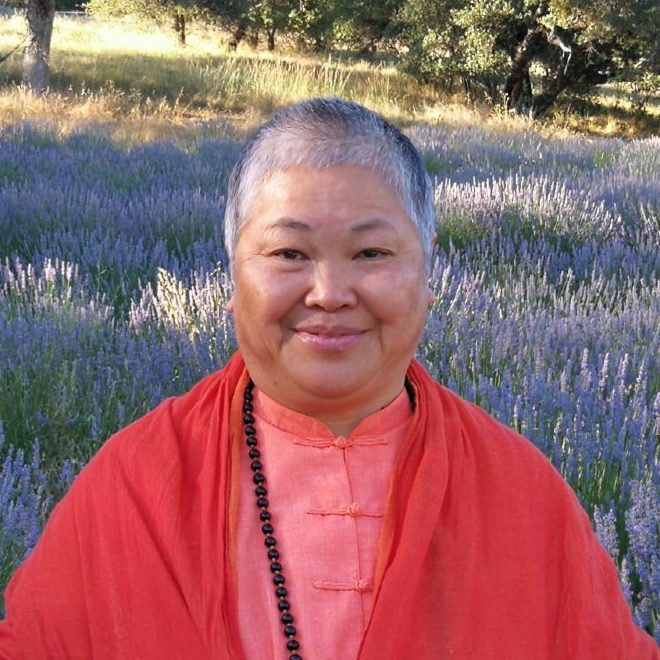
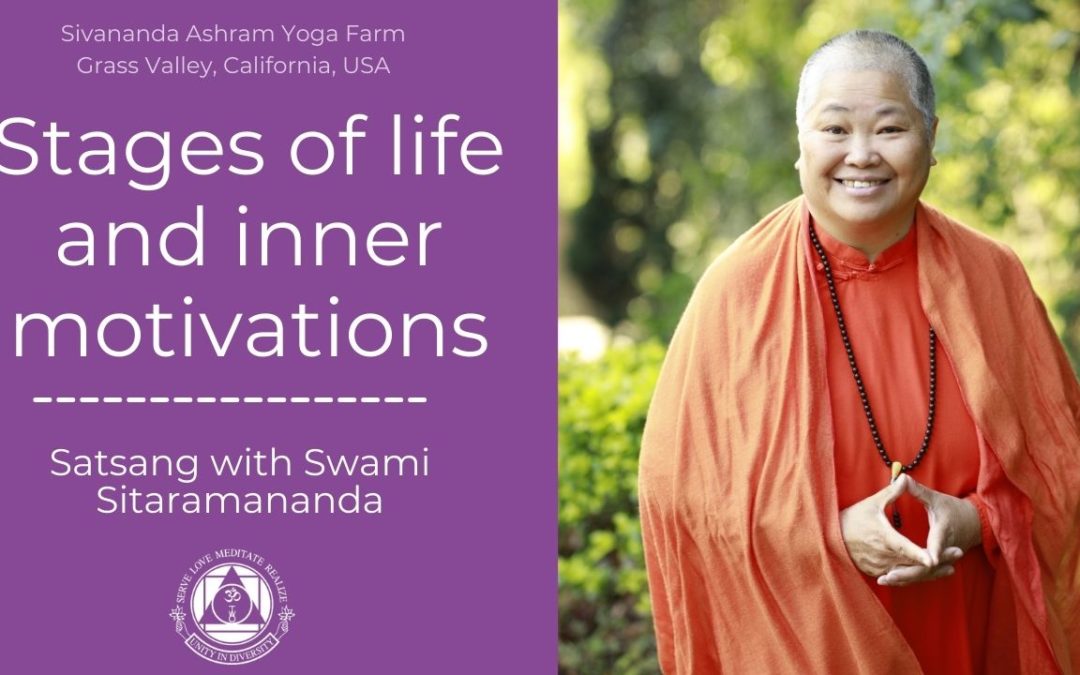
Swami Sitaramananda is a senior acharya of the International Sivananda Yoga Vedanta Centers and is director of the Sivananda Ashram Vedanta Yoga Farm, California and the Sivananda Yoga Resort and Training Center, Vietnam. She is acharya of China, Taiwan, and Japan as well. Swamiji is the organizer and teacher of the Sivananda Yoga Health Educator Training (SYHET) program, an 800-hour program on yoga therapy, accredited by the International Association of Yoga Therapists (IAYT).
Swami Sitaramananda is the author of “Essentials of Yoga Practice and Philosophy” (translated in Chinese, Japanese, Vietnamese, and Russian), “Positive Thinking Manual”, “Karma Yoga Manual”, “Meditation Manual”, “Swamiji Said, a collection of teachings by Swami Vishnu” in His Own Words. She is responsible for the Vietnamese translation of “Completed Illustrated Book of Yoga” (CIBY) and “Meditation & Mantras” by Swami Vishnu. Many of her video & audio lectures on Yoga life, philosophy, and psychology as well as articles and webinars can be found on this website.
Swami Sita is an ardent supporter of the integration of the Vedic sciences such as Vastu, Jyotish, Ayurveda, Yoga and Vedanta. She is an international teacher of the Sivananda Yoga Teachers’ Training Courses and Advanced Yoga teachers’ Training courses, as well as Meditation and Vedanta & Silence Courses both in Sivananda Ashrams in Vietnam and in Grass Valley, CA.
It’s very nice to have you all here. And today is the full moon, and also Guru Poornima, which is a very special and auspicious day on the full moon that is traditionally offered to the Guru. You have Mother’s Day, Father’s Day, Secretary’s day and Valentine’s Day, and in Vietnam they have a Teacher’s Day. I’m not sure if you have Teacher’s Day here, but in Vietnam it is very important. However, in India the teacher is called not only a teacher but rather a Guru. The day is called Guru Poornima, which means the full moon. So today, it happened to be the Guru Poornima, the Full Moon celebration of the Guru.
You can have a dance teacher, you can have a computer teacher, you can have a cooking teacher. Oftentimes people use this word Guru for this, you know, my cooking Guru, my dancing Guru, my music Guru, like this. But for us here the word Guru means a spiritual teacher, the person that teaches you the highest kind of knowledge that gives you liberation from suffering, liberation from bondage. That’s called a Guru. He / she is the one that removes your darkness and gives you some light. Tomorrow evening we have a puja, a special celebration, Puja, to dedicate to Guru Poornima.
The topic of the upcoming four days retreat at the ashram here is called the “Yoga of Transition.” And at the same time, we welcome the TTC graduates in this “TTC refresher,” that means knowledge being refreshed. Because if you know something and you don’t think about it, it gets dusty, it gets rusty, so you have to renew from time to time.
VEDIC GUIDANCE ON LIFE TRANSITIONS:
Life is continuously flowing. You are always in movement from one state to another, because that’s how you feel alive. If your life is not moving, then you feel that you are stuck, stagnant and somehow you’re not moving forward. Everyone wants to move forward in life. Sometimes you get confused because you don’t know where you are now, what you are doing, where you are going, and what is the right thing, because sometimes you receive pressure from all around, your parents, your friends and yourself. You say, “Life is pulling me in different directions and I am confused.”
The ancient teaching of the Vedas have given you some guidance. And of course, you need to have a teacher who knows you very well, who can tell you (more or less) where you are at, and what are the different steps that you need to take. Today I’m going to present to you a little bit of these different ideas to guide you.
Number one, you need to keep in mind all the time that you are an entity: body, mind, spirit. You are not just a body. Our bad habit is that we think of ourselves as only a body. If somebody asks you who you are, and you present yourself to somebody, you always say: “I’m 30 years old” or “I’m 20 years old.” You define yourself as the age of the body, as the physical body. But in fact you are more than that. And you need to keep that in mind.
First, the physical body, as you know, is born and then it grows, and the cells are growing and then decaying. So the state of your body depends upon your age, and your age will change a lot of things. So first remember the body.
Second, you need to consider the astral body, which in general means your mind, your energy. This energy comes also from the maturity of your mind, it depends on the quality of what you think. The thought that you have in mind sometimes gives a lot of prana and certain thoughts that you have in mind block your flow prana and make you feel very small and weak. So, the astral body is very important: your prana level, your mind, your subconscious mind, your emotions, the way you think, and your idea of yourself, all these are influencing the way you conduct yourself in life and the way you move in life.
Third, there is the core body which is called the causal body. The causal body is the seed body. This means that there is a reason that you’re born in this particular body and circumstances. According to Yoga philosophy, you are born to pay certain karmic debts and learn certain lessons. That’s why each person has different kinds of circumstances in life.
Somebody is born healthy, in a very rich family, and is loved, and somebody is born in a poor family, in a physically challenged body and is rejected and becomes an orphan. Why? There are different circumstances, different lessons that we need to learn. In the same manner, if you plant an orange seed in the ground, then what you expect is an orange tree. You cannot plant an orange seed and expect a banana tree. The law of cause and effect works very precisely.
Depending on the seed thought (the cause) that you have in mind, you will be born in the body of a male or a female in certain circumstances of your life, your father, your mother, your culture and all these things. There is something that governs your life in the core and that is your reason to be born. This is a karmic lesson to be learned at a deeper level.
Then beyond all this there is the Atman. Atman is your Self. It is your freedom, your Sat Chit Ananda, your bliss, your ultimate goal, what you truly want. Whatever you want in life is to know the truth, to not have any difficulties and to be aware, to be awake and not to be ignorant, and also to be happy and blissful. In general, we say that your purpose is to find your true Self, and that’s the purpose of all the yoga meditation practices and all Vedanta study. So you use the three bodies as your vehicles to navigate through life.
This knowledge comes from the Vedas or the Vedic culture. They give different sign posts that will help you to navigate this life. Vedic culture includes Yoga, Vedanta, Ayurveda, Jyotisha and Vastu. In Vedic culture the Guru, the spiritual teacher, is important. The Guru will guide you through.
SELF DEVELOPMENT AND THE GUNAS
The other important idea that you need to keep in mind in order to understand yourself, is the idea of the three gunas. The idea is that in life you are evolving from Tamas to Rajas to Sattva. So if you ask yourself: “Am I evolving? Where am I going?” Then the answer has to be: “I am moving from darkness (tamas, inertia, darkness) to rajas (movement, restlessness, egoism) to sattva ( purity, clarity, wisdom).
In tamas, the veil over your consciousness in the beginning is very thick, so you cannot see the oneness, you only see a big difference between you and me. In rajas, there is a little bit less thick veil, but you can only see partially, as you are self-centered and you only see from your point of view and you cannot see other people’s point of view, because you don’t have wisdom. In Sattva, everything is clear, light is coming in, and you see the whole big picture.
Your evolution from ignorance to wisdom corresponds with your age and stage in life. At a young age, there is tamas, ignorance. Then you grow up a little bit and then you care about yourself. Your ego becomes big and you only focus only on your needs. During that time, you still don’t see the picture of your relationship with other people, your relationship with the world. And then eventually, you become more enlightened, you become more sattvic, you become more wise and at that time your vision opens up. And then you start to situate yourself in a more correct manner, in relation to the world and in relation to other people. You see the big picture about life. And you also see the goal of life, which is to attain wisdom, to pay your karmic debt and to be free.
Your maturity comes with age, your biology dictates a certain psychology, a certain maturity. However, to note exceptions to the norm: Some people are very young and they are very mature. I met a boy who was six years old and he talked like an old man. He didn’t want to play, he was very serious with meditation and yoga. And I have met people 60-70-80 years old, and they are like kids. So, it depends on the individual.
FOUR VEDIC TRADITIONNAL STAGES OF LIFE:
The brahmacharya stage, a student’s stage (6-25 years old)
The grihastha householder stage is from 25 to 50.
Vanaprastha, retirement stage (50-60)
Sannyasa, renunciation stage
In brahmacharya you are studying the basics about life and your separate self, you learn asanas, pranayama and keep brahmacharya. Your duty is to your parents and your teachers.
Grihastha is when you get married, you have children and you participate in the society. Your duty is to your children, your family and also to your parents.
Vanaprastha stage is when you retire to the forest. Retirement here is not just like when you don’t have a job and you retire from the production line, the economical point of view. Retirement in spiritual culture means that you have done your duty, you have done your duty to family and society and now you’re going back to yourself. You might live a secluded life in an ashram (oftentimes in a secluded forest) and the only thing you do here is spiritual practices, yoga, meditation and so on. You don’t worry about politics. You don’t worry about what’s happening in the world. It is a certain state of consciousness where you withdraw within yourself, you allow yourself to live your spiritual life. Before you had to take care of the family, the society, the children and the whole thing. The fourth stage of life is the sannyasa stage. At that time your goal, your purpose, is only renunciation and you take a vow of renunciation.
The evolution between these four stages of life is based on the idea that you are born with a certain karma, the body is changing, but also you have to pay your karmic debt and then you have to go back to your spiritual nature, that you don’t have time to waste.
The evolution between these four stages of life is based on the idea that you are born with a certain karma, the body is changing, you have to pay your karmic debt, and then go back to your spiritual nature, so you don’t have time to waste. Sometimes if you don’t have this understanding of your biological, psychological and spiritual development, you can waste your time and be mixed up.
Example: I have a student who is about 50 or more years old, almost
She came to class every day, she took all the courses and she was very, very happy. She was a grandma. And then one day, she didn’t come to class. I met her and I asked her, ”Why are you not coming to class?” And she cried and she said, “Oh, because I have to go to work and take care of my grandchildren.“
I asked her, ”Why are your children not taking care of your grandchildren?” She said, “Oh, my children take care of the grandchildren, but they don’t have enough income so I think that I have to go to work and I have to take care of my grandchildren.“ Then she cried again. Why this suffering? Because she went against her evolution. She came to vanaprastha stage and she went back to grihastha stage.
Normally, you have to go forward and you don’t go back. You can go as slow as you want, but you have to go forward in life. So, that’s the whole idea, to have guidance, to know where you are and where you are going. What speed you’re going is up to you, but you have to go in the right direction and not go round and round and also not go back.
EVOLUTION IN INNER MOTIVATIONS:
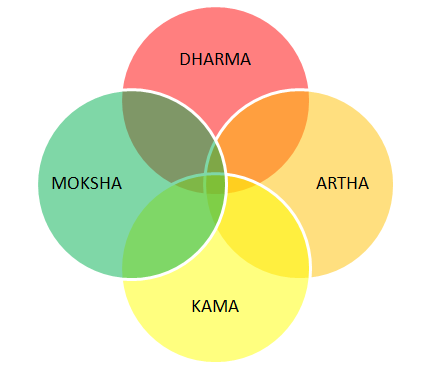
Motivation is called purushartha, it is about our inner motivation.
The scripture says that there are four motivations which everyone has. You need to recognize your inner motivation, what is the energy or the thoughts within you that push you to make certain decisions.
The first goal of life is called kama. (Kama is not karma, there is no ‘r’).
This clarification is helpful for the Vietnamese speakers because they have a problem with words using “R” anywhere other than at the beginning of a word. For English speakers it seems not necessary and a bit disruptive to me. I would leave it out.
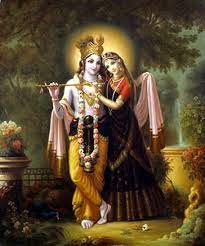
Kama means enjoyment, enjoyment of the senses, enjoyment of the emotions, enjoyment of life. So the first goal when you are alive is to enjoy life.
The goal when you first come into this existence is to enjoy life.
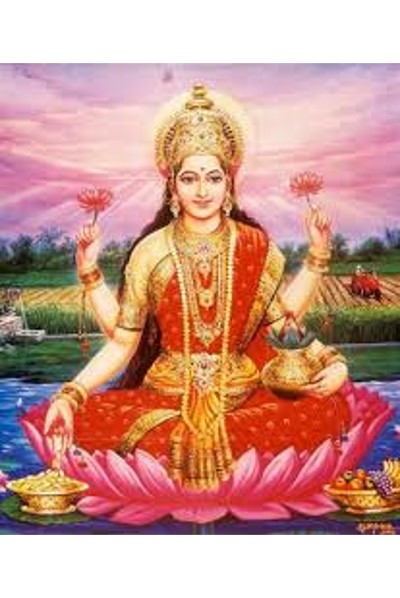
2. The next goal is called artha. Artha means having material wealth, in order for you to do what you need to do. It is a goal of wealth and everyone has this goal.
3. So the next one is called dharma. Dharma can be translated as righteousness, learning your position in life, in society. Dharma also means duty, and acting according to that duty.
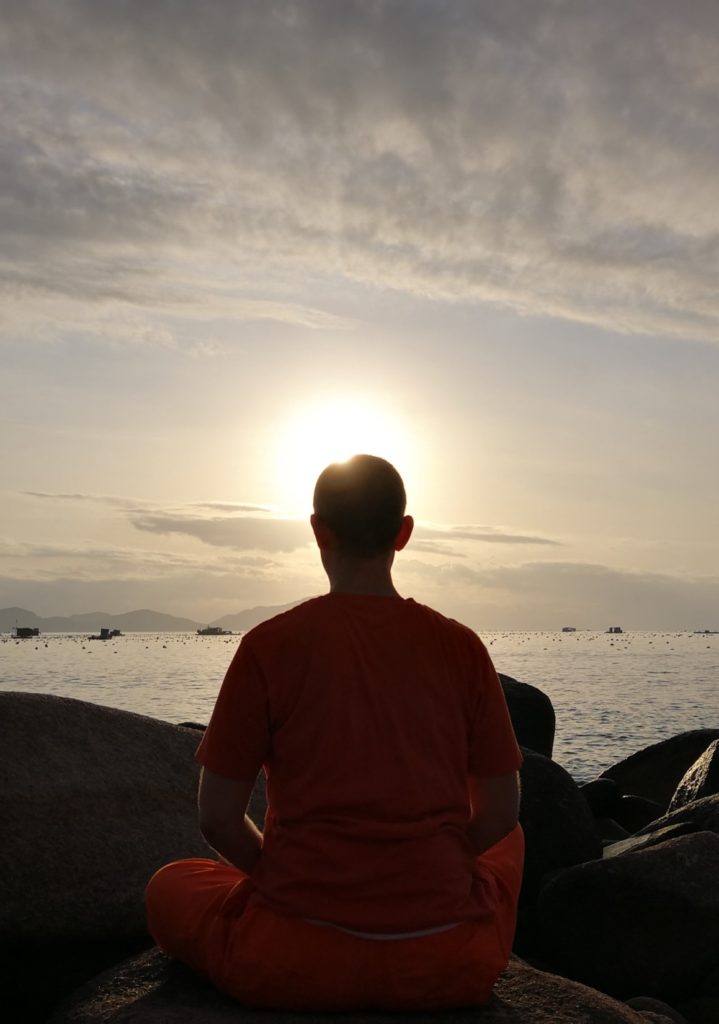
4. And the last is moksha. Moksha is the goal of liberation, of spiritual knowledge.
According to Vedic knowledge, when you were born, you did not just start your life. You have started your life way, way before in many past lifetimes. And then in each life when you’re born in the body there are only one lesson, two lessons or a few lessons to be learned, and if you are not finished with your learning, you will reincarnate in different circumstances, a different body, in order for you to continue to learn.
CORRESPONDENCE BETWEEN GUNAS, STAGE OF LIFE AND MOTIVATION:
Motivation of Kama in a Young Student’s life (Brahmacharya stage): The quality of tamas is dominant. When you have the goal
of enjoyment of the senses, enjoyment in life, then you are in tamas. You don’t have spiritual knowledge and you do not know the purpose of your life. You are spiritually ignorant. You think you are born with the five senses to enjoy.
In the beginning when you are young, (brahmacharya stage), you are in tamas and you don’t have the moksha goal. You have the kama goal. You want to play. Children just want to play and that’s it. They don’t worry about what is life and what is liberation from suffering. They don’t even know. They are suffering because they miss something, and they cry, and then they maybe take it from others.
People like Swami Sivananda, even when he was young, he shared whatever he had with other kids. But not necessarily every kid is like this. We are quite selfish. When we are kids, sometimes we can torture animals and if we don’t have something, we can go and steal from other people because we don’t know these rules of conduct. We are selfish. Tamas is strong, ignorance is strong.
Motivation of Artha in the householder’s life (grihastha stage): The quality of rajas is dominant. During this stage, you want to make money in order for you to enjoy your senses. You are more rajasic.
Rajas means you are dominated by self-motivated action. In this stage, if you see people suffering from lack of wealth or from limitation, you don’t move from your position because you need to have your money and your life and your desire fulfilled.
Motivation of Dharma in Retirement to the Forest phase ( vanaprastha stage) – The quality is sattva.
As you mature, Sattva, which is the quality of purity, of knowledge, of wisdom, starts to dawn. You start to think of the purpose of life, “who am I? What is the purpose of all this?” Then you move to dharma. I have seen business people who made a lot of money and gave it all to charity. For example, they share the company’s profit with the employees, who they consider to be their own family. They buy houses for the employees, and share the profit in the company. So there are business people who do not have the goal of making money for their own enjoyment only. They start to have a lot of sattva in their mind, or purity and they want to do the right thing. They want to do charity, they want to share, they don’t think that this is my money, this is my company, so they are not rajasic, they start to become sattvic as their motivation and behavior change.
In terms of time, the same thing can happen. Normally we say time is money. We think, ”Okay, my time, I’m going to take care of myself, it is my time, I want to live my life”. But eventually when sattwa dawns, you realize that this is not your energy, your energy is actually God-given energy and you are only a custodian. You are the one who is keeping the energy and then sharing the energy as an instrument, for a higher purpose that you do not control. Then you don’t think that it is my time, my energy, in order to get more wealth and more enjoyment. In sattwa, your thinking about your life changes. You think about a bigger picture, other people. You become more aware. In ecology, you start to think: “Oh my God, we are destroying the planet,” the climate changes and you start to spend a lot of time helping society, or helping to alleviate the climate change.
I’m just giving this as an example, that you are not just only only leading your life in a selfish manner, but you start to give out your energy and your time and you’re starting to think of a bigger picture, the society, the environment, the world and other people. At that time the goal of dharma becomes more important. We move from darkness to light. It is good to recognize the transition, although sometimes it gets very confusing. Sometimes you feel inner conflicts. You think,”My parents say that I have to go find a job, get married, make money and so on. But I feel a very strong desire inside to help the world and to serve the world. I don’t think that I can live my life just thinking of, you know, two, three people in my family, and that will be sufficient for me. I feel that I need to be responsible for the world. I’m a citizen of the world. I am a member of the world family. And I want to give my time and my energy and care for the world’s family and try to live a dharmic life.”
Motivation of Moksha in the renunciation stage (sannyasa) as sattva becomes dominant.
At this time, your motivation might change again into the fourth goal of life called moksha. You start to practice yoga, and you start to practice meditation and you find a certain peace. Then you want more of this peace and more of that expansion of consciousness. When you expand your consciousness, you start to have the moksha goal. Now, you want to take more time to go to the ashram, to do retreats, and do karma yoga.
Swami Sita’s example of evolution in motivations :
“When I just arrived in Canada, I was 18. I was studying in university, and I have to find some money to send money back tosupport my family, but also to take care of my livelihood. I was 18. At that time, what kind of job? I don’t know society, I do not know anything. So I went to find out in the newspaper, and I found a job in an entertainment ground, an amusement park. In this entertainment ground, the girls I worked with were very young, they were my age and they enjoyed themselves, flirting, drinking… through their KAMA goal , right? And one person that was the most miserable in that whole entertainment ground was me. I was so out of sorts. It was not at my place, loud music, entertainment, amusement…it was an amusement park. And I was so unhappy. Why? Because I did not fit in this KAMA goal.
Even though I was just 18 and I could have played, I was not meant to be entertaining myself and entertaining people. That’s why I was so unhappy.“
“So I changed. And, you know, in order for you to change, you have to have some self confidence that you can do something else. I did not speak the language well and I was very young, in that country
Here I do not understand what you mean by “in that country”. You could say “in a foreign country” or “in a country with a very different culture”, etc.
and so on. But I changed. I learned how to become a secretary. It means I worked in an office, and then I had to go to learn how to type, and that was 50 years ago. Anyway, I had to go to learn how to do type writing on the electric typewriter, because at that time there was no computer. And then I changed my job. So eventuallyI finished school. And then I worked, and later moved to the ashram. Normally people’s salaries just come higher. And for me, the salaries have come slowly down. Because I kept choosing new motivation. I’m just sharing with you the journey. My journey was quite fast. My change was very fast. But for you the change is happening also. And you have to do soul searching all the time: what you do, what you want, and so on. It might be slower. But you are in movement as much as I am in movement. There are different voices within all of us that are talking all the time”.
“At that time I had a job. I had a very good job, a professional job. I had a great salary, and could travel as I liked. At that time, I traveled as I liked and bought a car and bought this and that. I went to Paris and bought fashion clothing and things like this. It did not last long. I can buy this fashion clothing and I wear it. But then I wear it one time and let go. Why? It was not according to me, to my motivation. It was not my motivation. I could have made money. I’m good at making money. I can do business and make money, but I do business for my family and I give them business advice, but I could not continue to do business, the ARTHA GOAL did not fit me and it did not work.”
“So, when I became a social worker, I did more things for society. Actually, I was working taking care of my family, but also doing social work at night. That means as a volunteer person. So, then I volunteered full time, I worked full time and took care of my family full time. But the dharma goal became very important. I cared so much about society that I suffered when society suffered. When there was something that happened, something unjust thathappened to society, I was motivated to help. So I was in the street protesting things and I became a militant activist about different causes for children, women, poor people, the environment, social justice and so on. The DHARMA GOAL has become very important. And I was very happy to do that.”
“I went to the ashram when I was 28. I was already working for society a long time before that time. Because of karma, my family stayed in Vietnam so I went to Canada by myself to study. So all of a sudden, I did not have any family to take care of, so I took care of my society. Which at that time was Canadian and different people that lived in the city. They were all kinds of people and all kinds of cultures. At that time I did not think that these people were foreigners. I worked with Haitian people, Italian people, English speaking people, French speaking people, all kinds of groups, all kinds of classes. I was a social community organizer, social worker. At that time, I thought of these people as my family. The whole city was my family, and I wanted to take care of them. My DHARMA GOAL started early.”
“And then one day, the motivation changed again. I was burned out from doing action, social services, and then I realized the ego that was there, I realized a certain ego that wanted things to change the way I wanted it, the way I thought. So, the sattva started to come in a little bit more at that time, I felt, “Oh, now I understand God’s Will.” The words “God’s Will” are not easy to come by. Before I thought this was me, but now I started to realize, “Oh my God, there is something that is higher than me, higher than politics and everything. There is a Will that isdetermining what happens in this world, the way it works and that makes things happen. And that Will is God’s Will”.
“I was not born with the idea of God. But then, at that time, somehow it came to my mind. There is something that you need to tune into. And then you have to become an instrument of that Will. And there is nothing about you. So these words “God’s Will” came naturally. My motivation changed from DHARMA to MOKSHA, which is called liberation . Then I became a yogi, I became a sanyasi. I’m very happy now. That was my journey.”
GUNAS AND CASTES
According to guna and karma, you find yourself in a certain caste (or group) as follows: Sudra means when the tamas is strong and you are doing a service job, like my job at the entertainment ground and in a secretarial position before. At that time, you don’t ask spiritual questions. I believe the girls the same age as me at the entertainment ground did not ask existential questions. For myself at that time I already had a lot of questions, therefore I did not fit for long in the sudra group.
Here you can say: I did not fit in the sudra group. I did not last for a long time in that group. OR I did not last for a long time in the sudra group.
I briefly became a Vaishya, when I started doing business for my parents and I was more rajasic, but it did not last long. Then I became a kshatriya when I started to think of others, became an activist, and had a dharma goal. Kshatrya is a mix of rajas and sattva. Then the
last caste is brahmin when sattva is dominant, this is when I became a Yoga and meditation teacher and a sannyasi renunciate.
COMBINATION GUNA, SAGE OF LIFE, MOTIVATION, CASTE:
Tamas, rajas, sattva change. The biology, maturity and psychology change, the motivation, inner motivation, what you really want changes, and then the manifestation of the inner motivation, your occupation and your job changes. In Jyotish, there is a way you can see the motivations. For example, on a total of nine points (depending on where the planets in the birthchart lie), you can see a person’s motivation: If a person has Moksha goal 4, Dharma goal zero, Artha goal 4, Kama goal 1, then this life picture doesn’t make sense. The person wants to liberate himself from suffering but will not make an effort to live righteously, or to seek to know the laws of Nature, the big dharmic picture. Therefore he goes on accumulating wealth and at the same time wants to be free, and yet cannot be at peace with himself.
The advice is, “You need to do more selfless service, you need to increase the Dharma goal. You need to do more selfless service, and you need to give your money a little bit more in charity.“ So now the profile of the motivations changes: Moksha 4, Dharma 2, Artha 2, Kama 1. In this scenario, the Moksha goal is still there, given high value, but then you won’t feel conflicted. Before, you wanted to make money and at the same time you wanted to do yoga, and you wanted liberation, you wanted self-knowledge, and you didn’t do any service for society. When you run these two goals together and it doesn’t fit, then you have some inner conflict.
What you need to do is to put a little bit more time, a little bit more money into charity, a little bit more time into charity, thinking about other people, how you can help. And then don’t just sit at home, study and meditate. I’m sorry to say that. It’s not like I don’t promote meditation. But also in order for you to grow you need to do karma yoga. I mean, you need to serve other people, and it’s a way of meditation. Then it will smooth everything out. And then you will feel better.
Kama goal and Moksha goal: Let’s say you have some desire for self-knowledge. But you have a very strong habit, a desire for enjoyment of the senses. So how does it work? It doesn’t work. So you have to practice more yoga, but focusing on withdrawing the senses, in order for you to see a world that is beyond the sensual world. That is the spiritual world, when you start to meditate more and withdraw more, not running around shopping so much. Be content, be more within.
During the COVID pandemic time you have to stay home more. I think that it is a good thing that you stay home and you don’t go shopping or to coffee shops, sitting and drinking coffee and chit chatting with your friends. You cannot do this now. Vietnam is completely locked down, and here in America last year it was completely locked down. People complained and they were unhappy, but actually it was a very good thing. It forced them to move into another space where they had to be looking inside, working on themselves and not going into the outer enjoyment. The KAMA goal will be less, and the ARTHA goal also.
Sometimes we are forced in the time of COVID. We have to close our businesses and slow down. Before, the goal of making money was very important. But now the artha goal will be less, kama goal will be less, DHARMA goal will be higher, and the MOKSHA goal, the knowledge goal will be higher.
MANAGEMENT OF INNER MOTIVATIONS FOR GROWTH:
I hope that it helps you to think about your life and think about your priority. Of course, you can change your life quickly, but usually it takes time. At least you have to be conscious of your motivation and try to go forward and not go backwards. You need to become less selfish, and not more selfish. If your choice is more selfish, you are going backward. If your choice shows that you are less selfish, you are going forward. If you are more ego-oriented, then you are going backward but if you are more God-oriented then you are going forward. If you are able to surrender your personal will to God’s Will, then you are going forward. If you fight with God’s Will, and you want to impose your will, then you’re going backward.
Conclusion:
You have to think of what motivates you inside. And then you have to have a very clear picture of your inner goal, and then you accept it.
The idea is we don’t usually know where we are. Sometimes, the inner motivation to grow is present but you are conflicted as you struggle with the pressure of what other people say and your own outer, louder voice of the lower mind and habits which pull you in a different direction. So then you’re all confused. This is why you need to meditate daily, be quiet, think about the purpose of your life and who you are and what you want.
The advice is “don’t jump too fast”, do not try to jump life stages and motivations too fast. Because if you jump too fast, you will miss something. For example, if you are young and you need to enjoy your life, that is perfectly okay. Then you need to have time for your enjoyment and at the same time, try to turn it into some sattvic enjoyment like seeing a nice sattvic movie, eating popcorn. It’s all okay. You have to manage these different inner motivations, avoid inner conflicts, accept your current situation and move on. Your inner motivations will evolve at their own speed.
Om Tat Sat
Swami Sitaramananda is a senior acharya of the International Sivananda Yoga Vedanta Centers and is director of the Sivananda Ashram Vedanta Yoga Farm, California and the Sivananda Yoga Resort and Training Center, Vietnam. She is acharya of China, Taiwan, and Japan as well. Swamiji is the organizer and teacher of the Sivananda Yoga Health Educator Training (SYHET) program, an 800-hour program on yoga therapy, accredited by the International Association of Yoga Therapists (IAYT).
Swami Sitaramananda is the author of “Essentials of Yoga Practice and Philosophy” (translated in Chinese, Japanese, Vietnamese, and Russian), “Positive Thinking Manual”, “Karma Yoga Manual”, “Meditation Manual”, “Swamiji Said, a collection of teachings by Swami Vishnu” in His Own Words. She is responsible for the Vietnamese translation of “Completed Illustrated Book of Yoga” (CIBY) and “Meditation & Mantras” by Swami Vishnu. Many of her video & audio lectures on Yoga life, philosophy, and psychology as well as articles and webinars can be found on this website.
Swami Sita is an ardent supporter of the integration of the Vedic sciences such as Vastu, Jyotish, Ayurveda, Yoga and Vedanta. She is an international teacher of the Sivananda Yoga Teachers’ Training Courses and Advanced Yoga teachers’ Training courses, as well as Meditation and Vedanta & Silence Courses both in Sivananda Ashrams in Vietnam and in Grass Valley, CA.
We have said how discrimination is the most important qualification to have, i.e., to know the difference between the Self and not-Self. The problem is that we get confused between the Self and the not-Self. In fact, the association of the Atman (the true Self) with the mind makes us think that we are the mind. Whatever the mind thinks, you think you are. This is a big problem, the biggest problem. That is why discrimination is the most important qualification.
You need to observe or detach from what you are thinking. In fact, your past thoughts are the origin of your current life. This life, what you experience today, is the karmic result of what you were thinking in the past. Detachment from your thoughts is how you begin to work your way out of samsara, to not repeat the same mistake, the same pattern of thinking that brought you here in the first place, that brought you suffering. That is why these are the qualifications for liberation—liberation from suffering. In other words, these qualifications create the conditions for you to realize that state of happiness and fullness that you already are.
Number one, you have to discriminate. This is my mind and this is the Self. It is extremely difficult to do this, because for years and years, lifetimes and lifetimes, you have thought that you are the mind. You need to accumulate a lot of sattva, purity, for this realization to dawn in you, “Oh, it’s my mind”. Consequently, you have been observing the patterns of your mind for a long time. You have to disassociate from the mind. That is part of the meditation practice when you detach from the mind.
This talk is about Shad-sampat: the sixfold virtues, the six qualifications of the mind that you can acquire.
The idea is that you are already the Self, Satchitananda, nature. In fact, you cannot get the happiness that you seek from outside. You cannot improve yourself from outside. The mind cannot improve itself by itself. In reality, it’s about making the mind more sattvic for it to reflect the Self. The journey is about cleansing the mind, taking care of the mind, so that you can see the Self that is already there.
You will be endowed with these six qualities when you practice yoga. Yoga is the technique to help you to get these qualities for your mind to see the Self.
1. SAMA – tranquility
Sama means tranquility, tranquility of the mind. It is the first virtue that you should get. As a yoga teacher, you encounter students who are very, very restless, changing up and down. What then, does the yoga teacher or Yoga Health Educator tell these people to do? If a person comes to you and he/she is very much up and down, what do you tell them to do? Meditation and self-enquiry? These are very high goals. They need to do something before that. The answer is they need to do asana and pranayama. That’s all it is. Why? When they do asana, they slow down. Everything slows down. They coordinate the body, the breath, and everything slows down. With pranayama, it is the same. They slow down. They purify the nadis and the prana becomes more balanced. Already that allows them to have some insight, to have some vision, some kind of knowledge about the workings of their own mind. This brings them a little bit of peace, a little bit of serenity. Moreover, the classical bhakti yoga teaching gives them techniques for controlling the emotions. The mind is stirred up and made unsteady by the emotions. That’s why controlling the emotions, sublimating the emotions, is necessary to calm the mind down.
When they do asana, they slow down. Everything slows down.
Our actions are based on our thinking, but our thinking is being motivated by the emotions. Our reasoning is employed to simply justify the emotions. Swami Sivananda said the emotions are predominant in this era. The practice of pranayama helps to calm the emotions and number two, you need to chant to express the Divine Love. Practicing love in bhakti yoga means to practice unconditional love and not to practice attachment. When you practice unconditional love, you calm down, the mind calms down. That’s all it is. When the mind calms down, you are able to see your Self. Bhakti yoga practice helps you to do that. Because we are here separated from our source, separated from ourselves, separated from our true nature, we feel lonely, we feel abandoned and in the dark, separated from Divine Mother and separated from Divine Father; we feel separated from everything, and we have to live with people that we don’t understand. Therefore, it is very difficult to love them. So then, practice tranquility, peace of mind. Some people look like they are calm, but inside they are like a tornado. However, when you practice tranquility, the mind is truly quiet. The churning of the mind needs to settle for you to rest in peace.
Patanjali Maharishi says very clearly in the Raja Yoga sutras, it’s impossible for a mind to understand a mind; it is impossible for the mind to understand itself. No matter how many thoughts you churn in the mind, it is not going to solve the problem that you have in mind. It is literally impossible for you to use your mind to comprehend somebody else’s mind. In Vietnamese there is an expression, “One talks duck, one talks chicken”. Ducks and chickens talking to each other. It’s not possible to understand each other. That’s why we have so much interpersonal conflict because the mind is already so difficult for you to understand. Then you use that mind to understand somebody else’s mind and it’s impossible. That’s why you need to turn inward to understand your own mind. By calming your own mind and by bringing light to your own mind, you will be able to see another person’s mind. This seeing is not because you are able to see another person’s mind from your mind. It is the light of the Atman shining in your mind that allows you to see the Atman in the other person’s mind.
You have to first work on your own peace. Without that, there is no way you can see the Self, no way you can be happy, truly happy. Swamiji said, “Instead of peace of mind, we have pieces of mind”. This means, you project the conditions for you to be happy, you get the conditions fulfilled and you have a little glimpse of peace. You work very hard to get those conditions fulfilled to have another little piece of peace. And then again, you carry on, work out another contract, fulfill that, and earn another little piece of peace. In this way, we have pieces of mind, but we don’t have peace of mind. Because peace of mind has to come with wisdom, with a certain level of freedom, a certain level of unconditional comfort within yourself and in all situations.
That’s why we have so much interpersonal conflict because the mind is already so difficult for you to understand.
If you watch your life all the time, seeing if it fits your pre-set conditions, always being on the defensive, you will not have peace of mind. That is the unfortunate situation for most of us. It’s very difficult to let down our guard and very difficult for us to be open because we have been hurt for a long time. And you know, we wrongly attribute our hurt to someone else. We have been doing this for a very long time, wrongly attributing our hurt to someone else, therefore, carrying that memory and hoping to be free from hurt. But it’s not possible. In the same manner, in the Vedantic analogy of the “rope and snake,” you constantly see the ‘snake’ because the snake is in your mind, you are constantly projecting the idea of the hurtful snake outside, superimposing the snake on a piece of ‘rope’ and say, “Oh, that snake is going to bite me!” Yes, you run away, but you see the snake again. Because it’s in your mind. That’s why you constantly repeat your patterns of unhappiness. So, even though “sama” is the first virtue, it takes a long, long time to get the peace.
2. DAMA: Control of the Senses
Dama means to control the senses. The Vedantic teacher Adi Shankaracharya spelled it out clearly. He says that if you are very disturbed by the senses then you do not have peace of mind. It is something that you can work on. If you have any kind of addiction, any kind of uncontrolled sensual desire, then you are not qualified. That is why you have to go and work very hard on the control of the senses. Why is control of the senses so important? If we have discrimination, we cannot carry on with this idea that life is about sensual enjoyment. We cannot carry on with this idea that whatever we see outside is real. We cannot carry on with the idea that this life of the five senses is the only life, because yoga and Vedanta say “no”, there is an inner life. There is an inner life that we need to explore.
Yes, this life is a projection of your mind and it’s there to distract you. This life of the senses is there to distract you. So, if you can control the senses, you will have fewer distractions, you will be able to turn inward and you will be able to realize your Self.
3. UPARATI: Satiety
Uparati is the goal of turning inward. That means you are able to lead an inner life and you are able to see your Self. You would have to sort yourself out from within, as all answers are from within. If you constantly hanker for something external, you will not be able to turn within. Uparati is resolutely turning away from the external, so you can sort yourself out from within. It is the control of the senses; it goes with withdrawing of the senses. In yoga, we call it Pratyahara which is the phase before meditation. Basically, you won’t have any success in meditation if you are not able to turn inward.
When you do asanas and pranayama, what happens? You are starting to turn inward. That’s how it works. Because asanas regulate your prana and make you less subject to prana imbalances or subject to the pull of the emotions and the senses. When you start to practice you start to have a glimpse of the Self because you are turning inward. You turn inward when you practice savasana. Now you have a glimpse of this kind of inner peace.
4. TITIKSHA: Endurance
Titiksha is endurance or forbearance. This is very important because you can turn inward and practice meditation or yoga, but you may not see the happiness that is being promised.
On the contrary, you might have back pain, neck pain, or you feel very bored. You don’t know what you’re doing when you start to meditate. That’s why endurance and forbearance is required. You need to stick to the practice at all costs. That’s what the yogi tries to practice in the beginning. Of course, if you have back pain you will have to move a little bit, you don’t torture your body. There must be some moderation, but if you run away from your practice out of any kind of discomfort then you will not have the necessary qualification for you to sort through your mind and to realize your Self. That is why you need to endure the difficulties brought by your own body, your own mind, and emotions.
Scripture says there are different kinds of suffering. Suffering can come from external elements (fires, floods), from the mind and its interaction with other people, and from your own existence in the body which is constantly changing. Pain and discomfort can be moving all the time. Ayurveda says that vata aggravation creates pain. Western medicine cannot understand this because they treat symptoms. Western medicine cannot understand why pain shows up in different places. Someone with this kind of pain most likely has a tendency to worry, and the more he or she worries, the more they create anxiety that leads to more moving pain. They will not have the necessary peace to turn inward.
There must be some moderation, but if you run away from your practice out of any kind of discomfort then you will not have the necessary qualification for you to sort through your mind and to realize your Self.
You would need to build up your strength and endurance and to “bear insult, bear injury”. Pain can be mental. Someone saying the wrong thing about you is pain; hearing people talk nonsense is pain; eating food that you cannot digest in the body and the mind is painful. Everything can be painful.
Why does the seeker need to learn to endure? The seeker after Truth wants to be free from suffering altogether. The seeker knows the mind’s tendency to go up and down and its condition to react to external things. So, the seeker would endure. To endure means to remember the Self amidst the ups and downs of the mind. The pain is there, but the pains are not new. Therefore, you endure when you have pain, and you remember, “I am the Self”.
People in the pandemic, when their whole cities and country are in lockdown, are having much pain and difficulty these days. Yet, when I talk to them about Self-remembrance, they thank me for my talk and are not rejecting it as unrealistic. To some level, there is wisdom within them even though they suffer from pain. But to hear someone say, “The pains are not real. You are real. Your immortal Self is real. You are blissful in reality.” They are thankful. Therefore, we have to constantly repeat to ourselves the truth, even though our minds scream the untruth. Forbearance means to remember the truth so that you can bear the karma.
5. SHRADDHA: Faith
We need to cultivate faith. When we lose faith, we feed ourselves with doubts. Some people do not have any faith at all. Most people suffer a lot because they have no faith. For people in difficult situations that have faith, somehow they have a better quality of life, while people who don’t have any faith think that logic can explain everything. When their logic cannot explain things, they think everything is collapsing. In some way, it’s very good that everything is collapsing. This helps you to realize that the intellect is incapable of seeing the big picture.
How do we nurture faith? When we don’t have the answer and you say, “God knows,” you can also say, “I surrender to the wisdom of the universe, there must be a reason why things are like that.” Or you can say, “I have faith that it will work itself out.”
3 Types of Faith
1. Faith in one’s own Self Self-reliance, or faith in one’s Self, means we rely on our own inner strength, dwelling within us, as opposed to relying on an ego self. Fear exists when we don’t know the Truth about the Self (the Atman). Until we have such knowledge of the Self from our own direct experience, we must rely on faith in order to progress in our life. Ultimately faith is replaced by direct experience of the Self. Truth or Knowledge can be glimpsed intuitively, even if we do not have a name for it. SO CALM DOWN AND TRUST YOURSELF. One student approached me very worried because she had a cough and had just travelled back from England and wondered if she should go to the hospital and be tested. I told her, “Look within, ask yourself the question, “Am I going to die soon? Am I healthy?” To which she nodded. She regained confidence and overcame her fears by being asked to find the answer from within.
Until we have such knowledge of the Self from our own direct experience, we must rely on faith in order to progress in our life.
The Truth that sets us free from all fears, resides inside of us. It is a long, hard journey to find it. We must start on that journey with humility and sincerity. We lack experience in the beginning, as we do not really have a clue where to look when trying to look within. Faith keeps us going on that journey.
2. Faith in Nature and the Supreme Intelligence Meditate, shift consciousness from the past to the present. Try to see a bigger picture and channel your emotions into devotion; have the courage to face your illusions. Faith in the Supreme springs from an inner feeling that there is something greater than you, a Supreme being that indwells one’s essential spirit. When one is enriched with abiding faith, one recognizes Grace operating in all things. We are on a journey of Self-discovery to uncover the truth of who we are, a journey guided by faith. We can think of faith as the bridge that carries us from one experience of Grace to the next.
3. Faith in the teachings and the practices The sacred teachings say that you are like the Shining Sun untouched by fear and diseases. There are days when clouds fill the sky and we cannot see the sun. You know the sun is there. To regain that vision of the inner sun, we must learn to clear away the impurities of the mind by observing the Niyamas (purity, contentment, austerity, Self-study, Self-surrender). Self-surrender means accepting what is; letting go and letting the Divine will prevail. Let it be. Bear the consequences of past actions arising in the present. Have faith that eventually everything will pass. We must also practice endurance and know that the journey is not going to happen overnight. The challenge of enduring past karma is learning not to react or retaliate. Forgive and forget.
To qualify yourself, you need to gather these three conditions: 1) faith in your own true Self that will guide you toward wisdom; 2) faith in Nature and the Supreme Intelligence; 3) and faith in the teachings and the practices. Then keep practicing. If you don’t have complete faith in the teacher, fine, keep practicing and you will get there. Because it is very difficult to understand who the teacher is, but you can practice what you understand from the teaching and eventually you will understand the relationship.
In case you have doubt, there are many things you can do to lift the doubt. Continue to practice of course, but the easiest thing to do is to keep company (satsanga) with those who have no doubt.
In the beginning, 40 years ago, I had a lot of doubts, because I had a lot of questions. I did not have peace. I had my intellect, my questions, my mind. My mind was constantly churning, so I always came up with a long list of questions. I had a glimpse of peace when I met Swami Vishnudevananda, so when my mind went into that mode again, I wrote down my list of questions, or I had the list in my mind, and I went to see him. I just arrived at the gate of his residence and all my questions were gone. Yet, I was not even in Swamiji’s wise company.
When my mind went into that mode again, I wrote down my list of questions, or I had the list in my mind, and I went to see him. I just arrived at the gate of his residence and all my questions were gone.
I was uplifted without words and all my questions were gone. The high energy was radiating, so I found some peace. What I learned is that just by being near that high energy, I will find some answer. I didn’t even know what answer it was, because it was not a logical answer, it was not some intellectual answer. The fact is only that I have peace. So, I decided I would try to get karma yoga around Swamiji’s house. I always found some excuse to do karma yoga there. I volunteered to sweep the courtyard, do things around the house, and I didn’t even see Swamiji, I didn’t even have any conversation or ask any kind of question. But I had some calmness, some kind of peace because my mind, my questioning mind calmed down.
How can we dispel doubt? Keep company with those who have no doubt, because they radiate a different kind of energy. As the Atman in you and the Atman in those wise ones are the same, when you enter into the company of those that have realized that they are the Atman, you then have a glimpse of your own Atman. That’s how peace comes to you. That’s all it is.
Sometimes we think the teacher has to do something for you. The teacher is not doing anything for you. The teacher is being themselves. They live their life. They enjoy themselves. They are not a babysitter and they’re not helping anything. They are just being their happy Self. And when you are in their company and they are themselves, you see your Self.
You think that the teacher has to do something? Of course, the teacher also has to work, teach and uplift, and the teaching comes through depending on how ready the students are. I just want to make a point that the transmission of spiritual knowledge depends primarily on the readiness of the student. The comprehension of the greatness of the teacher depends on the greatness of the students. The greatness of the students depends on the greatness of the teacher who was able to help the students to realize him/herself.
The transmission of spiritual knowledge depends primarily on the readiness of the student.
Swami Sivananda was a medical doctor. Then he became a seeker and a wandering monk, a sadhu. He met with a Sanyasi teacher who gave him initiation into Sannyas. He practiced serious meditation for seven years in his little meditation kutir. He went out to get alms and came back to meditation. At the same time, he healed people as a doctor but now he healed them not only physically but also mentally and spiritually. People started to come to him. When more people started to come to him he opened the ashram. Swami Sivananda was very much one of the exceptional disciples because he already had this knowledge. He met with the teacher and met with Vedanta. He realized very quickly, so didn’t stay with his teacher for a long time and became a teacher himself very quickly. We call this type of student a “gunpowder student”.
Swami Vishnudevananda met Swami Sivananda at a young age, stayed with him for 10 years in India before being sent to the West, and carried on working under the name of Swami Sivananda for the rest of his life. I myself am the same. I did not come into contact with any other teacher. I have stayed in the same teaching the whole time. Of course, there was the temptation to check out other teachings in the beginning. There is always some idea that some other teaching is better than what you are practicing because what you are practicing becomes boring. So, your mind starts to wander, finding fault with the teacher, thinking that what you are doing is not giving any result. So, in case you have a doubt about the teacher, you need to continue practicing until the doubts are cleared out.
6. SAMADHANA: Balance with attention.
One of my favorite translations of this word is “balance with attention”. The story is that you practice so you become balanced in order to realize the big Self. If you are imbalanced, it means you are extreme in some way. Then you will fall. Why isn’t good to be extreme? To be extreme in something will have an opposite effect. You will fall where you were strong. Balance means you are good in everything and are keeping an eye on the goal of Self Realization all the time. Sometimes you might fall a little bit, go sidesways a little, get a little angry, get a little sad, get a little attached. But you never lose yourself completely, you do not lose your path. One needs to cultivate the virtue of balance, of equanimity, of detachment from the ups and downs, from the liking and the disliking. In this way, your attention is always on the goal. It is similar to keeping yourself balanced on one foot in the tree pose. Your eyes have to look at one point far away to balance in the tree pose. If someone praises you, you might lose it. If someone criticizes you, you might lose it. You have to keep your eye on the goal and not lose it in praise or censure, in good or bad conditions, you are all the time focused. That’s called “balance with attention,” or “concentration on the goal,” or the practice of “equanimity”.
SUMMARY
In order for us to qualify for Self-Realization, we need to gather the 6 qualities: 1) Sama, tranquility, control of the emotions to become peaceful. 2) Dama, control of the senses. Don’t let any sense pull you away, a little bit here a little bit there, but do not give yourself to anything that will pull you away from your center. 3) Uparati, turning resolutely inwards. That means you have to be at the point where you say to yourself, “Enough is enough is enough”. Enough of the external life, enough of seeking for pleasures in the wrong places, enough of these wanderings around, enough is enough is enough! At that time, you say, “I am turning inwards, I’m going to find my peace in the right place”.
4) Titiksha, endurance, forbearing the difficulties of the path, difficulties created by your own mind and the environment. Titiksha is to bear it, not losing it and not dropping it. 5) Shraddha, having faith in your own capacity for realization, faith in the teacher and faith in the teaching.
6) Samadhana, keeping the goal of Self-realization in view; to keep experiencing the “I am” and a little bit of “I am this and that,” and always coming back to yourself, never losing your balance.
By acquiring the 6 virtues (Shad-Sampat), you cultivate the desire to know, Mumukshutva, is the 4th qualification after Viveka, Vairagya, and the 6 virtues. Mumukshutva means you never drop the goal o Self Realization.
Om shanti
Swami Sitaramananda is a senior acharya of the International Sivananda Yoga Vedanta Centers and is director of the Sivananda Ashram Vedanta Yoga Farm, California and the Sivananda Yoga Resort and Training Center, Vietnam. She is acharya of China, Taiwan, and Japan as well. Swamiji is the organizer and teacher of the Sivananda Yoga Health Educator Training (SYHET) program, an 800-hour program on yoga therapy, accredited by the International Association of Yoga Therapists (IAYT).
Swami Sitaramananda is the author of “Essentials of Yoga Practice and Philosophy” (translated in Chinese, Japanese, Vietnamese, and Russian), “Positive Thinking Manual”, “Karma Yoga Manual”, “Meditation Manual”, “Swamiji Said, a collection of teachings by Swami Vishnu” in His Own Words. She is responsible for the Vietnamese translation of “Completed Illustrated Book of Yoga” (CIBY) and “Meditation & Mantras” by Swami Vishnu. Many of her video & audio lectures on Yoga life, philosophy, and psychology as well as articles and webinars can be found on this website.
Swami Sita is an ardent supporter of the integration of the Vedic sciences such as Vastu, Jyotish, Ayurveda, Yoga and Vedanta. She is an international teacher of the Sivananda Yoga Teachers’ Training Courses and Advanced Yoga teachers’ Training courses, as well as Meditation and Vedanta & Silence Courses both in Sivananda Ashrams in Vietnam and in Grass Valley, CA.
The topic of this week end is about five tools to renew our life.
Prana: To renew our life we have to change our Prana level. So, we need to know how to increase prana, how to conserve prana and how to check your prana.
positive thinking: To renew our life, we need to resolve all the negative emotions within us and we have to sort it all out and keep positive thinking.
adaptability: to renew our life, to refresh our life, we have to be ready to be flexible, to adapt to new conditions, and to work with our ego. We need to understand where we are now, at this moment, and we can change accordingly so we stay in the present and not be pulled down by the subconscious mind, by the past.
Meditation in daily life: learn to have another awareness about your daily life activities.
Detachment: In order for you to renew yourself, you need to be detached, because if you’re not detached, then you are bound. Bound means you are not free. You are pulled down by your attachment. The teaching today is about how to be detached.
The more that you’ll be able to be detached, the more you are free, the more you can renew yourself and be in the present and be happy. The more that you are attached, the more difficult it is for you to renew yourself and to find yourself.
THE NATURE OF THE TRUE SELF:
To understand what detachment means, you need to know about the nature of the Self first, your true nature. Your true nature is sat chit ananda. Sat means all the time there, it is not coming and going. It’s not true that when you are born, you start to exist, and when you die, you are finished. In fact, your spiritual nature or your spirit is always there, your consciousness or your true self is always there. To understand this, we need to develop a spiritual approach to life. It means that you need to live your life with a bigger perspective, with a bigger idea of what life is, you need to know the purpose of life, and who you are. Then in this context, we can talk about detachment. If you do not know who you are, then we can’t talk about detachment because for you, everything in life is just action, everything is just attachment, everything is about involvement, everything is drama. You are in what we call the Battle of life, you lost your own true Self in the Battle of life. Sometimes you win, sometimes you lost. Something good happens and you are happy, and sometimes you have a difficult situation, then it is a big drama. For example, in a pandemic situation you must close the business, stop everything, and things are disturbed, and you are disturbed.
So, we talk about detachment only if you know what you need to be detached from and what you need not to be attached to.
These are two words Swami Sivananda said before he left his body. These are two very important words. He said: “Detach, attach”. It means detach about everything else and attach to God. Detach about everything that you think that is true, real and important and attach to the knowledge of God, of Truth, of the Self. That’s all that is.
The Self is Sat Chit Ananda — three words.
WHAT MEANS SAT?
Sat means it’s always there. It doesn’t come, it doesn’t go, it was not born and it will never die. If you are attached, then everything comes, everything is born, comes about and everything dies. But if you are detached, then you understand that it’s only an appearance. It’s what you feel right now that’s what it is, but it’s not. There’s another level that is not like this and you need to discover that level, that something that is not coming and going and changing and is impermanent. Buddhism talks about the truth of impermanence and of everything that is changing. In order for you to know that which is not changing, you have to be detached. That is Sat. The Self is truth, absolute, eternal.
WHAT MEANS CHIT?
Chit means consciousness or knowledge, absolute. It means it is only a temporary condition that you are veiled that you don’t know and you are ignorant.
But the true condition is you are consciousness. How do I know? I know because I am that itself. If I think that I am this, then I don’t know that. But if I think that I am you, my true self is you then I know you. So that is difficult to understand. But you see, inside of us always is a desire for knowledge.
We want to know. Some people just finished studying and then they don’t know what to do with their life. So they study another branch. And then they study another two, all the time they study. But they study, many people study, study, study. And they still feel that they don’t know. Because they study things externally, but they don’t have the knowledge of the Self. So yoga, Vedanta have different methods for you to know the self. You have to control the mind, control the emotions, you have to make your life sattvic, calm and pure, you have to meditate, be quiet, be silent and don’t worry, don’t have negative emotions, meditate, don’t be disturbed by anything then the clarity will come to you about everything because there is only one Self, one truth, one consciousness.
WHAT MEANS ANANDA?
Ananda is something that you relate to more. Maybe Knowledge, Consciousness you don’t know but happiness you know. You know your desire for happiness. All the time you are seeking for bliss or for happiness or for fulfillment — and Ananda. Actually, when you are seeking for happiness, basically you are seeking for the Self. You are seeking for happiness in somebody or in something because the Self is happy by nature and it projects that happiness on something external. You project that happiness on something outside and you seek for it, you want to be one with it. The true nature of the Self is happiness absolute. It means it doesn’t need anything to be happy. It is in itself happiness, unconditional happiness. The true nature of everything is happiness. Your mind gets attached to different conditions and attributes happiness or unhappiness to different things. But, if you look within, then your true nature is Ananda or Bliss.
DETACHMENT FROM THE MIND ACTIVITY helps you to access Satchitananda.
First, you need to know the true nature of the Self — Sat Chit Ananda.
Second, you need to know that your mind is not really reflecting that happiness or that true nature. The nature of the mind is conditioned, it is looking outside, it depends on the senses, it is imperfect, it is full of desires, it is swinging between what you like and what you don’t like. It has egoistic ambition, it thinks all the time about something that is unreal, it’s always building up a story. So let’s say you think that you want to become the richest person in the world, the first person that will go and live on the Moon, the first person that will go and live on Mars. So there is a race like this: who will be the first person that will live on the Moon or Mars, or the richest person. So you have a different idea that is egoistic. It is based on your idea to compete with somebody or to be the best. These are called ego ideas. The mind is full of this. When we say the word ‘mind’ it includes your emotions, your ego, your desires. So I say in general ‘the mind’. It comes, it goes, it has a nature of veiling the truth.
And if you attach yourself to it then you don’t have peace. Maybe it gives you the motivation to become the best in the world, the richest person or the fastest person, or the most powerful person, it gives you the motivation to do things, to work hard, but you are looking for that outside of the Self. Really what you’re looking for is the peace Sat Chit Ananda, your true Self, but you’re looking outside of yourself. What you need is looking through your mind, disregarding what is being projected by the mind and clearing out the mind.
THE ANSWER LIES WITHIN: we have what we are looking for
The teaching says you need to look at the right place. The answer lies within. What you are looking for you have, that’s the teaching of Vedanta. Really, you already have it and you waste a lot of energy looking for it.
So you need to calm down, relax, detach, then you’ll find.
STORY: a lady losing a needle, she goes outside the house looking for her needle. People say: where did you lose your needle?
She said “I lost it inside the house”.
“So why do you go outside?”
“Because outside there is light”
You are looking in the wrong place, like this lady.
Looking inside means trying to realize your own Self. Looking outside means constantly running externally and believing that the sensual world that we live in is true. Believing that the world is created by our senses, our mind, the internet is true, therefore, we have no time to look within.
In fact, what you are seeking for, you already have. Let’s assume, the lady would look for her needle inside the house, even though it’s very dark. Let’s assume she would look for it with the tip of her finger, because she can’t see when there is no light. But she will find it. So if you continue yoga, meditation you would feel better, even though it seems pointless, that there is no result.
ANOTHER STORY:
The deer is running looking for the smell called the musk that comes from his sweat. The sweat of the animal has that smell. And the deer is running looking for that smell coming from his own body, yet, he looks for it somewhere else. Sometimes, I wear my glasses and I was looking, where’s my glass? Where’s my glass? But it’s on me.
So we have what we are looking for. And we have to wake up from that running and looking for it somewhere else.
DETACH- ATTACH : IT IS NOT EASY TO BE DETACHED:
There’s a story about a lion, a tiger walking in the forest. I like this story. And he walked in the forest and the leaves of the trees fell down. The leaves still had this sap sticky thing. So when we walked in the forest on the leaves, the leaves stuck to his feet. He wanted to remove the leaves and sat down. When he sat down, the leaves stuck to his butt. So he wanted to remove the leaves on his butt and lied down to remove the leaves on his butt. When he lied down, the leaves are attached to his back. So he rolled around. And soon he had leaves all over his body.
What the story says, sometimes we want to be detached from something. Let’s say you want to be detached from your boyfriend. Yeah, because you get attached to the boyfriend and then you become obsessed and the boyfriend is liking somebody else and then you suffer. Or it can be about the girlfriend and you want to be detached from her. People suffer a lot out of this attachment, out of this kind of drama in their mind. And they want to forget. For them detachment means to forget. So what do they do, they drink alcohol to be detached from a boyfriend or girlfriend, from emotional drama and then what happened they will be attached to alcohol or to sleeping pills. Then when they want to detach from sleeping pills or alcohol, they will attach themselves to cigarettes. And when they want to detach from cigarettes, then they would attach to food, they want to detach from food then they would attach themselves to work. So constantly we keep attaching ourselves to different things and it doesn’t solve our problem.
All what everyone wants is to be free. You say I’m going to work so that I can be free and I have enough money to do what I like. And then the work gets attached to you and you get attached to the work.
You can go on and give different kinds of examples. It’s not that easy to be free. One attachment leads to another, then another leads to another, you are just piling them up and you feel like you are in prison. Sometimes you feel like you are a slave to everything. You turn around and the family wants you to do something. You turn around and the boss wants you to do something. You look at yourself and your insights: Oh, I need a promotion and I need a different job so I can be happy. And then you go outside and then the newspaper says you know you need to buy this thing then you’ll be happy. And then you go talk to your friend and your friend says this is a new fashion you know you need to do this, do this and that and then your whole life you’re trying to find happiness and freedom and you feel like you’re sinking like the tiger in the example above. He tried to free himself and he has his body completely with the leaves.
Attachment brings suffering
Sometimes it can be very dramatic. People suicides, they attack their own life because they feel that they cannot get out of the situation. And some people fall sick because it’s a form of slow dying when you’re sick or when you are depressed. Depression is also self destruction because you feel bound, you feel heavy. The drama of your life is occupying your mind and you have no clue that you are in fact — Sat Chit Ananda. It seems this statement is completely up in the air, not real, not feasible, not accessible.
I described here the condition of our attachment. Feel free to give me more examples. But you can look around. Look in the news. Look in the story of people. There is a lot of suffering, attachment brings suffering. If you attach to your beauty, because now you’re young and beautiful, what will happen? When people praise you: Oh, you’re so pretty, you’re so beautiful, your hair is so beautiful, then what happens? When you attach to your skin and your hair, and then your beauty and if something happened to that beauty, then you feel very miserable. And if you get old, you feel very miserable. Because you lose that name, that aura. If you are attached to being intelligent, then you meet people more intelligent than you. And you meet a situation that you feel very stupid because you don’t understand anything.
If you are attached to being strong. I always give that example. It’s a very good example. It is an example of superman. Christopher Reeves is the actor of Superman has been chosen to be Superman. I mean, he has a strong, gorgeous, powerful body. And then Superman makes a lot of money. Yeah, he’s a famous actor on top of the world. And one day by karma, he fell off his horse, he broke his spine or something, he became paralyzed, he had to sit in the wheelchair. So he lost the Superman aura, he is no longer Superman, he lost his job, lost everything. So if he is attached to his image of Superman, attached to his body, he would not be able to accept this condition to sit on the wheelchair.
Actually in an interview, he said that in the beginning, he wanted to commit suicide. He was very lucky because he had a very good wife and children who accepted him and took care of him. And he turned around and detached from his name and fame and image and body and found his spirit that is not affected by the body condition. He found his perfect spirit inside and then he worked for this organization to take care of the rights and privileges of handicapped people. Through this huge accident he was forced to detach from the external and found himself inside.
There are 4 ways of detachment:
Karma Yoga detachment: Karma Yoga taught that wherever you live and whatever you do, try to be detached from results. Be detached from results means to be detached from the idea that you are doing something and you want something out of life.
Whatever you do, either you are a mother, or when you have a job or whatever you do in life, do the best, do your duty, and let go of the result. Be detached from the result. – it can be any kind of job, a high paying job or just a servant job, People praise you fine, people criticize you fine, you do a good job, fine, you don’t do a good job, fine, you’re fired from the job, you have to find another job, or you don’t have any job, fine. Be detached from that.
What does detachment mean in this context? It means don’t identify yourself with what you do. Identify yourself with the immortal Self that is already here.
That’s Karma Yoga’s teaching about detachment. This practice of detachment in daily life saves you a lot of headaches. Bhagavad Gita says your right is to work only. But not with the result. You have to work, try to do the best you can, and try to contribute. But it’s not about you. So be detached from what you do.
Bhakti Yoga detachment:
The second way how you practice detachment is detachment in Bhakti yoga. In fact, Bhakti yoga detachment means the yoga of devotion. You need to be detached from your emotions. So you transform your emotions into the highest, purest kind of love, called devotion. Let’s say you are with somebody you don’t like and you’re attached to your emotions. I don’t like this person. I like that person more. And this person makes me angry. This person makes me happier. Your mind is always looking for the person that makes you happy and runs away from the person that makes you angry. This is how the emotions work. The emotions swing all the time: either you run towards something out of projection or pleasure, either you run away from something out of fear or out of pain. Emotions bring attachment, attachment to the past pleasure. You’re attached to the past when you ate the ice cream, you felt so happy. So you’re attached to the ice cream. Somebody said nice words to you so you felt very sweet, you felt very important for that person. So then you get attached to them.
Attachment is an emotion, and we are 95% emotional. We are very emotional by nature, that’s why we are full of attachments by nature. We are attached all the time. Bhakti yoga taught us to turn this attachment into something helpful by getting attached to God, but detached from anything else.
Bhakti Yoga helped an emotional person with lots of emotions and an attached tendency to be attached to God instead or to the highest goal, to the highest ideal.
Bhakti yoga people has difficulty to detach because they are emotional, so they have a lot of attachments. The only thing they need to do is to switch it into attachment to God, to the right thing while being detached from everything else. In fact, the Bhakti Yogi will not practice detachment, he/she just practice attachment, but attachment to the right thing.
it is important for you to know that attachment comes from your emotions. So if you are identifying with your emotions and then you have that attachment to the emotion that will bring about pain. The only thing you need to do is to attach the same emotion but towards God, towards something that is your ideal.
The reason of this switch is because when you attach to an external object, be it a person, or an object, then you lose yourself. However, when you attach the emotion to God, you regain yourself, because God is including you. But if you get attached to somebody else external to yourself, you lose yourself.
Raja Yoga detachment:
The third way of practicing detachment is Raja Yoga kind of detachment. Raja Yoga says detach from thoughts. Raja Yoga is a method of meditation. You sit quietly, you withdraw the senses and you meditate and you concentrate. At that time, your attachment is your concentration on a pure ideal, via the mental repetition of a sacred mantra. During meditation, if thoughts come in your mind, you become detached, you observe the thought and you let it go, you don’t get involved with the thoughts.
This is the main method of detachment of a meditator: you are detached from your own thoughts, you become the observer of your thoughts and you keep yourself concentrated. Here, there is attachment in the form of concentration on a mantra. Technically, your mind can think of only of one thing at a time so if you are attached to a mantra, you are detached from everything else. The sacred mantra induced sacred vibration and has the capacity to merge the meditator with the divine presence which is the essence of the mantra. This will happen when the concentration on it becomes one pointed.
Raja Yoga theory explains that if you concentrate on a mantra, then you’ll be detached from other thoughts, you will not be involved in other thoughts, because Raja Yoga says if your mind is completely one pointedly focused then it becomes meditative. It dissolves all the talks in the mind and then you become one with what is. If you allow a lot of thoughts and distractions in the mind then it takes all your energy it leads you here and there, and you get lost. When you have a lot of thoughts in the mind you are lost. So, when you think too much and you have a lot of thoughts you need to reduce the thoughts by keeping only a few thoughts that are important and detach from the rest.
Focus, reducing distraction, renouncing anything not important and try to follow through with the thoughts you retain. Keeps the mind very concentrated on one thought, detached from distractions, not worrying about anything else. This is Raja Yoga detachment. This is the Raja Yoga meditator’s way of detachment.
It takes detachment to be able to concentrate. When a person is not concentrated, when they are very distracted, whatever comes their way, they say: “Yeah, I like that” and they start to do it. And when somebody else says something else: “Yeah, it’s interesting. I like that too”. So they start to do everything and then get themselves involved in everything, spending a lot of money running around trying this and trying that and then not being able to stay still and not finding happiness. Consequently, practice detachment from all thoughts and repeat your mantra which is that pure idea, that neutral thought that is high in vibration, given to you by your teacher. You can repeat the mantra and let go of everything else.
Jnana Yoga detachment:
The fourth type of detachment practice is called Jnana yoga detachment. For Jnana yoga detachment you need to have discrimination. What does it mean? You need to know what is Truth and what is not Truth, what is Self and what is not Self, what is important and what is not important, what is essential and what is non essential. So, then you detach from the unreal, from the non essential and you get attached to that thing that is real, that is essential.
Jnana Yoga is not teaching you to get attached. It says to you that you need to know the difference between real and unreal. And you need to be detached from the unreal. And when you are detached from the unreal and then real will be there. That’s it. You don’t have to be attached. In Bhakti Yoga — yes. In Jnana Yoga — no.
What kind of detachment depends on your personality, however, Sivananda taught the synthesis of Yoga, a combination of the 4 types of Yoga.
You can say depending on your temperament, depending on your strengths and weaknesses, it would be easier for you to detach from this or that. Maybe it’s easy for you to detach from distractions, because you are a very focused personality, but it can be very difficult for you to be detached from emotions that is part of your being as a very emotional person. Then at that time, you need to apply also Bhakti Yoga, that means you need to attach to God so you have to work slowly on your detachment and your attachment.
I remember what Swami Vishnudevandaji said one time, almost 40 years go, when I just started my Yoga path, that “you will not be born, nobody will be born if they don’t have any form of attachment.”
So attachment is the reason why you’re born. Detachment is the way out of the cycle of birth and death, of the called “cycle of samsara” or cycle of suffering.
The Buddha practiced his discrimination, he used his buddhi, his intelligence, he knew what is real and what is not real, what is permanent, what is impermanent, what is true and what is false and what is illusion. And what is the projection of his mind and what is his true essential nature and he meditates. He detached from everything else and he attained enlightenment. That means he becomes free, free from suffering. He has understood the true purpose of life.
In the same manner, we try to detach from our illusions, detach from things that are impermanent. You always have had experience of the impermanence, you get the desired object, and you know that it will be gone. You know that your mind has always been doing this, it fantasizes and it gets disillusioned. You need to wake up from this. The mind is always grasping things, and thinks it’s real. And then you get it and then the charm disappears, and the mind changes. And you’ll felt let down: “Oh, I thought it was so ideal. It was so good.!”
Kick it, before it kicks you. Future suffering should be avoided.
I want to share with you this sentence I came up with a long time ago: “kick it before it kicks you”, which means detach from it before it leaves you.
So if you know something is impermanent and is changing, don’t be attached to it. Because it will leave you, it will change and then you’ll suffer, it’s painful. It’s better that you take the decision to leave it because you understand the true nature of it is illusory. It promises you something yet you know, it’s just a matter of time that you will suffer from these illusions. Do you want to suffer?
If you don’t want to suffer then do something about it. If you enjoy suffering, and you say “okay, I can have a little bit of pleasure, a little bit of happiness, and if it leaves me, fine and good, I accept the price to pay. It will be painful, but it’s okay. It doesn’t matter.”
I give now some worldly example. Let’s say that’s you get romantically involved with somebody that is already married. While you are happy to have the company of the person, you know that at the end it will not work out. There’ll be big pain, separation, pain for you and for other people. So then stop it. I’m sorry, I would say: ” detach from it, detach from that temptation of pleasure”. This example is a kind of a big drama, but you know the story of painful forced detachment can be applied to everything else in life.
Jnana yoga meditation can be practiced only when you have an inner conviction, an inside knowing of what is good and what is not good, what is real and what is illusory, what is the truth and what is not. At that time, you detach from everything else that is not real, and what remains is the truth. If your true nature is peace and happiness and your mind is always projecting peace and happiness somewhere else then when you detach from everything else, and what remains is happiness. You get that? I should repeat. If your true nature is happiness already, but you don’t see it and you project the idea of happiness on something or somebody else, then if you detach from that something or somebody else, then what remains is happiness. Make sense?
“Sounds great!”. Diana, the student says : ” it sounds great!”
Yeah, you just have to detach, because you already have happiness. But you have the illusion that happiness is somewhere else. So be detached from the illusion and what remains is happiness. By not seeking happiness you will be happy. By chasing after happiness, you will be suffering. By being content and knowing yourself, then automatically you will be happy.
So, if you don’t kick things and things will kick you. If you do not detach, it will leave you and you will suffer. This happens also as a lesson, as a way to make you learn. Yes, you learn in suffering, in losing, in separation, in heartaches, and you’re forced to be detached.
So I learned another sentence from Swami Sivananda. He says: ”love little but love long”. It’s so nice. Because your tendency is you love something or somebody and you think if you love more, the more you love, the more you will have more love then you’ll be happy, you will have more happiness. Rajasic emotional nature thinks like this. This lovely thought “ love little but love long” means be detached from this illusion of passion, the illusion of emotions. In practice, If you feel that you love this too much, you get attached to this too much, then diminish it, love little and then it will last.
Summary and Conclusion:
Jnana yoga detachment is difficult because you have to be already discriminative and know what is real and what is not real. Raja Yoga detachment towards thoughts is easier. You can keep concentrating on the mantra, and then let go of all thoughts that come to mind and Meditate. In Bhakti Yoga meditation, just attach yourself to God, it is kind of easy but you can become fanatic.
And the last is Karma Yoga meditation, Karma Yoga detachment is working on the sense of non-doer-ship. Don’t get attached to your actions. Don’t get attached to your accomplishment. Do your duty and let go of the results.
Best is you practice all the paths, as they lead to the same place. But start one thing at a time, start with something the most concrete for you, be it Hatha Yoga when you have to detach from pain, from postures that you like and postures you do not like. You also at times, have to detach from routine even though you learn the discipline of a routine practice.
Receive weekly emails about the ashram programs and events.
This will close in 33 seconds
Like most websites, we use cookies for various features according to our policy. We hope that’s okay with you – if not, please feel free to disable cookies in your browser.