Yoga guidelines for thinking and feeling
You are what you think and you are not what you think
Introduction:
When I told this topic to people, people shook head, laughed, wheeled their fingers around by their temples showing signs that they are not understanding why you are what you think and you are not what you think.
During this webinar we will:
- Understand what thought is, and how it works
- Breathe and relax and Visualize Self
- The 3 levels of mind – how to move from lower mind to higher mind
- Practice of conversion of thoughts
- Practice of cultivating virtues and eradicating vices
How thought works?
When a thought wave arises in the mind, if you don’t feed into it, the wave falls back into the ocean of consciousness. The wave does not have a reality in itself. It only has reality as far as you keep feeding it. That is, we name the wave and give it meaning. Feed it, and the thought becomes more solid, and gains more power, and has reality.
We have a choice. We can make these thoughts (whatever they are) the reality, or we can make blissful thoughts reality. Yogis look at the thoughts to understand them, then don’t feed into the thought (give it energy), and let it go. They also can transform the thoughts from darkness to light.
Evolution of the mind
The mind has different levels and functions. The mind is not ourselves. Our thoughts and feelings are not ourselves. We have the tendency to repeat familiar thoughts and feelings and lose ourselves in the thoughts or emotions.
We need to learn to navigate our thoughts and emotions. If we know how to develop our own mind, we will know how to accelerate our process of spiritual evolution. Do we want to evolve? If we ask this question, most of us would say no because they do not know what evolution means. Evolution means coming closer to our core self, our blissful self, satisfying the purpose of our life, being closer to the truth, being truly happy… that happiness and fulfillment of our soul that last no matter what happens outside.
The Evolution of our mind is directly related to our connection with our blissful consciousness, our Atman.
What is the Atman? Who am I? what is consciousness?
The Self is called the Atman – the Truth about the Self is what we have been looking for all our life. It is our inner motivation. Each person will resonate with different idea about the Atman. You need to choose one word, one qualification and think about it. There are three practices 1. Listening to the scriptures 2. Contemplation, thinking deeply, 3. Realization by direct experience. Now we are listening and contemplating.
- Vedanta philosophy and quantum physics talked about consciousness as the ground of being.
- Brahman (or Atman) is absolute pure consciousness, it is satchitananda
- existence absolute-beyond ages of the body, beyond birth and death
- knowledge absolute-consciousness, awareness, not thinking automatically, not knowledge coming from the mind.
- and bliss absolute-complete fulfillment, no desire, no frustration, no complain, happiness without condition, feeling perfection, beyond emotions.
- Atman gives light and beauty to the universe – it is your own consciousness full of light and beauty that gives beauty to the appearances and the manifestations of nature and its beautiful forms or beings. If you change consciousness, that which was beautiful lost its beauty. Beauty is not depending on the attributes of the body. People have suffered a lot from disillusion from chasing after external beauty.
- Atman gives intelligence to the mind, shining through the intelligence that you attribute to people. In reality it is the atman that is intelligence shining through.
- It is unbroken awareness, unbroken sense of Self and of happiness, not functioning automatically out of habit
- neither inside nor outside, dwelling within, inside inner perception and outer perception of senses, everywhere. The meditator has half eye open, half closed. He or she is living in the world and out of the world in one consciousness only, beyond all conditioning. That is why a person practices to be the same inside and outside to be close to the atman. They would say what they feel, feel what they say and do what they say and feel. They are always the same, independent of where they are, and with who they are.
- beyond space-time, beyond the mind which is being conditioned by space and time. The more that you will be able to function the same way in all conditions, you come closer to the atman.
- non local, non material
- eternally present, it is the truth that is always there, either you are happy or unhappy. Reference to the book “The power of now” of Eckhard Tolle. What ever the problem that you have, just come back to the present, the problem will dissolve by itself. All problems can only come from the past that is also projected in the future. The more we live in the present, the more we come close to the atman.
- it is the subject, without who nothing exists, it is the master, the boss, the perceiver, not the object of perception. It is the consciousness awareness that sees
- The atman is not the object, not limited, indescribable, therefore can apply neti neti to refute the superimposed ideas of the mind, after which what remains is the Atman. By being not the object, the atman can not be dependent on something or somebody else. For example you feel valued when somebody praise you and you feel bad when somebody criticize you. At that time you need to come back to yourself and remember that you are the subject. Even when you are serving somebody and try to please somebody, you are aware that you are doing so, and not lose yourself. When you do karma yoga, you have to be conscious of what you are doing. For example you wash dishes but not aiming to finish the task of washing dishes. Instead, you are aware and awake while doing dishes. It is not what you do but the attitude in which you are doing that qualifies this action as liberating karma yoga. In this way the same action makes you a servant or a master.
- all pervading, everywhere. You can not feel lonely if you realize that.
- unbounded, free, unlimited, therefore you can not be confined to a place, a relationship, or a condition. In quarantine or lockdown, it will be helpful for people to remember that they are free in truth and not dependent. Sky is the limit when you feel consciousness expanded.
- unchanged, therefore no grief or surprise or disillusioned when things change (people’s mind and emotions, our own body, our habits, way of living) because it is not true
- unmoved, stable, giving sense of security
- Atman is all possibilities, all coming from Atman’s will, so no need to worry
- undefinable, ungraspable
- stainless, pure, perfect, not to be found in the relative world which is the mind’s creation and by nature is imperfect.
- perfect, perceivable through silence not through the mind or emotions
- beyond attributes,
- beyond the gunas- qualities, tamas (darkness), rajas (action), sattva (purity)
- beyond duality, split, here-there, in-out, this-that, high-low, white-black. No need to go anywhere just have to look within.
- eternal, not ephemeral
- having no equal, is one, nothing to compare to, to compete with. That is why do not compare yourself with others.
- transcendent, transcending the limitations of the mind
- supreme reality,
- supreme truth,
- self luminous, like the sun, does not need anything to give it light
- fully illumined, bright. If you are close to the atman you feel bright.
- fully enlightened,
- self existent, does not need anything to show that it exists, so not lonely
- undifferentiated, no quality
- without names and forms, beyond names and forms
- without parts, cannot be divided
- transcending appearances which come and go, so we need to see things through the eyes of the soul and avoid disillusion
- pure love, essence of love, behind all kinds of love, beyond more love or less love. It is 100% love and all the time.
- unity of consciousness, where all connect, beyond conflicts, beyond differences of wealth (have and have not), culture, gender, race, religion.
- oneness,
- beyond action, no need to do anything to find it or to perfect anything
- aware of ego, sense of separate “I” which manipulates and plays different games
- aware of mind and emotions, which are not the rulers. Atman is the inner ruler detecting all the changes in the emotions.
- the knower, it is the subject knowing everything
- the ruler, the boss
- the absolute
- It is compared to the Sun, giving light and life to all,
- Independent, not dependent on anything
- and it is the source of all pranas, source of all lives, source of consciousness. When you are closer to the Atman you have more prana, unlimited prana, when you are away from it you have less prana. If you don’t have prana you are far from the atman.
- Thoughts are waves that rise and fall in this infinite ocean of consciousness.
- Therefore, it is said you are not what you think.
- You are the observer, you are not the doer.
- the witness of your thoughts.
- You are not your thoughts.
- All meditators arrive to the same conclusion. They arrive to the experience that the meditator, the object of meditation and the act of meditation become one.
- The knower, the known and the knowing become one.
- To answer the question: is consciousness evolving? The answer is no. Consciousness is unchangeable. In fact, it is the veils of consciousness that are changing, being thinned out – as our mind evolves- and this gives us a glimpse of the Light which is Consciousness.
So how to train the mind and unveil the Self?
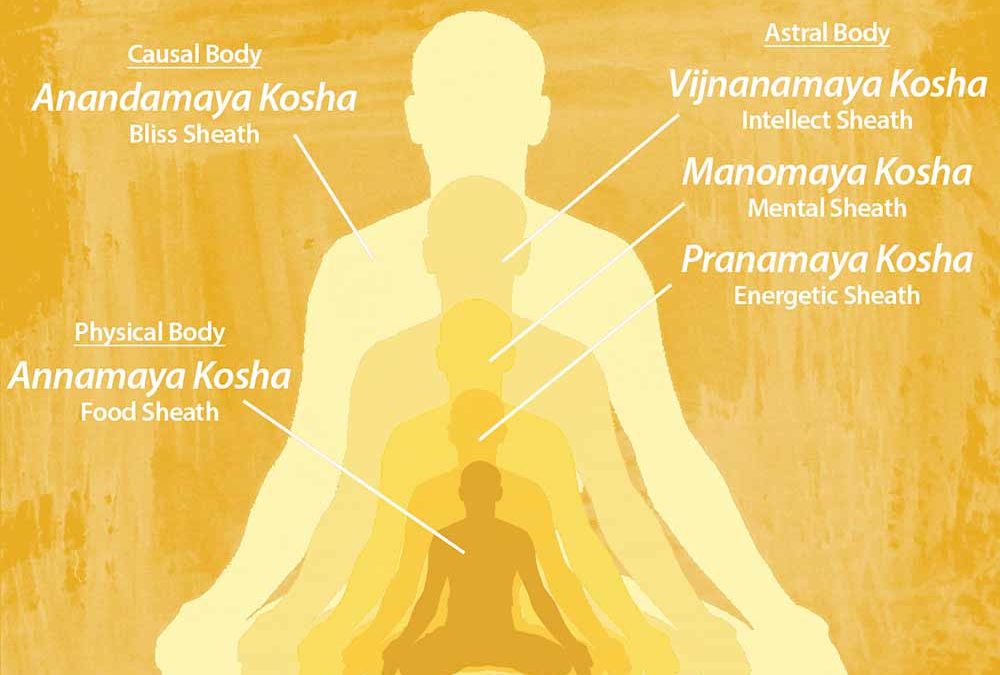
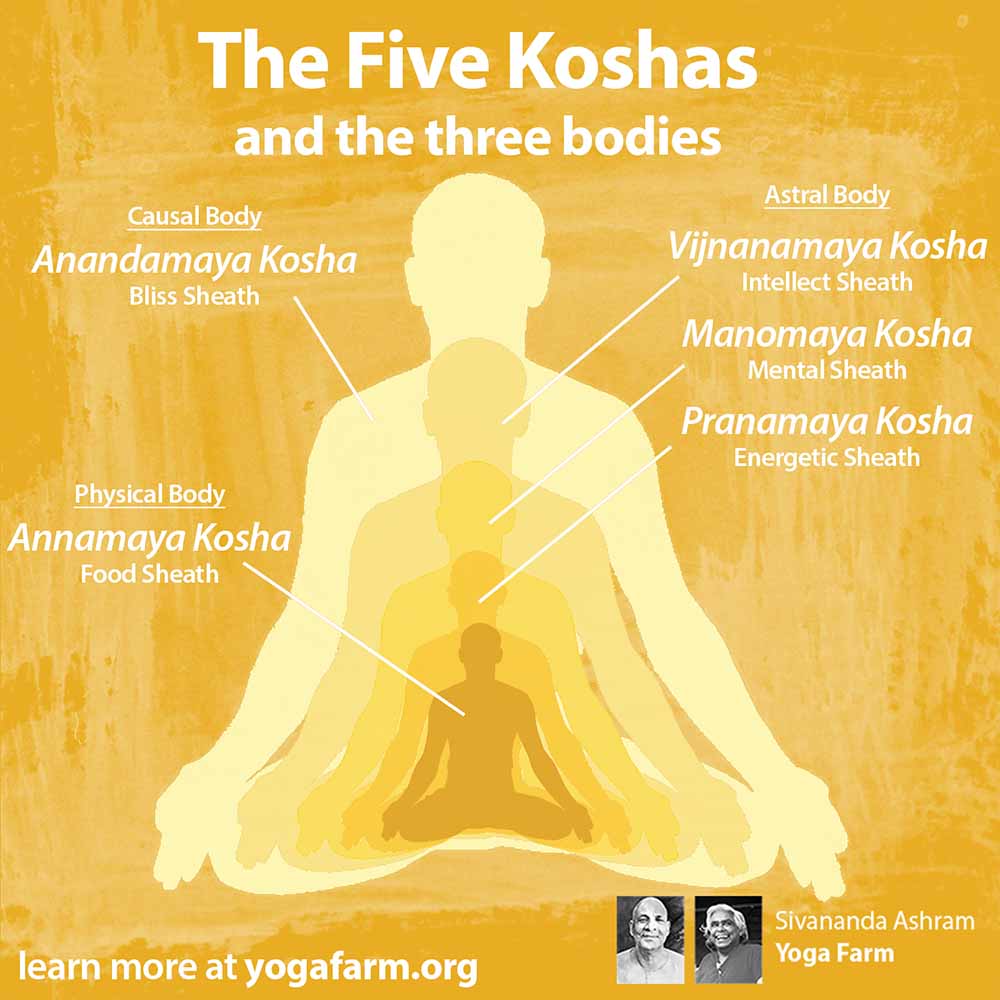
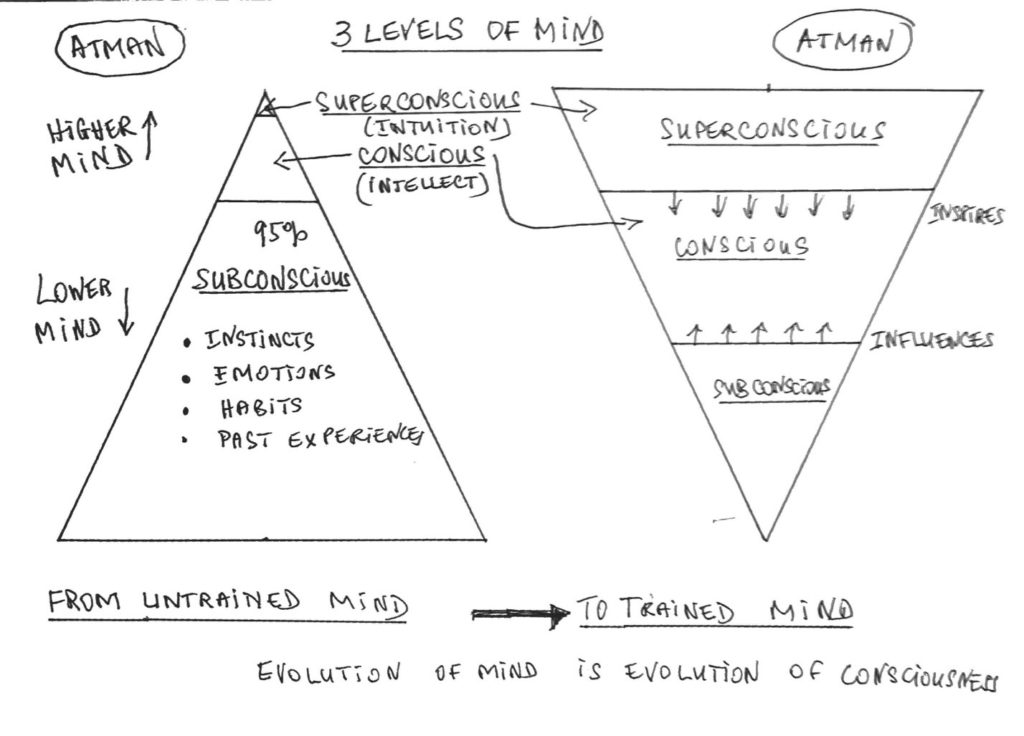
How to move the mind from lower to higher functioning and be closer to our bliss and truth? We will use the theory of the 3 levels of the mind in order for us to know how to navigate our minds.
1. The subconscious mind:
- the base of the triangle, the iceberg is the Subconscious Mind – lower mind
It is the first phase of the mind. It is the basic mind from which the conscious mind emerges. It is below the conscious mind; it is controllable by the Conscious Mind. - The subconscious mind consists of the unknown, thoughts
that are HIDDEN, SUBMERGED thoughts; - it is very POWERFUL and governs our life 95% of the time.
- The subconscious mind is the storehouse of PAST experiences
- and governs many of the AUTOMATIC functions of the body such as breathing, heartbeat, etc. It also stores the LEARNED EXPERIENCES such as locomotive skills, academic skills, social skills, memories of experiences. Like a car, you can press cruise control on the highway and be on autopilot. You can let go.
- The mind is made of karmic patterns, samskaras. Most of the time we are on AUTOPILOT, following the automatic commands of the subconscious mind. All the PATTERNS , HABITS of the mind are formed in the subconscious mind. We talked about KARMIC patterns, karmic tendencies. We can refer to the astrological vedic chart which shows the karmic tendencies through the disposition of the planets (Sun, moon, mars, mercury, Jupiter, Venus, Saturn, Rahu Ketu).
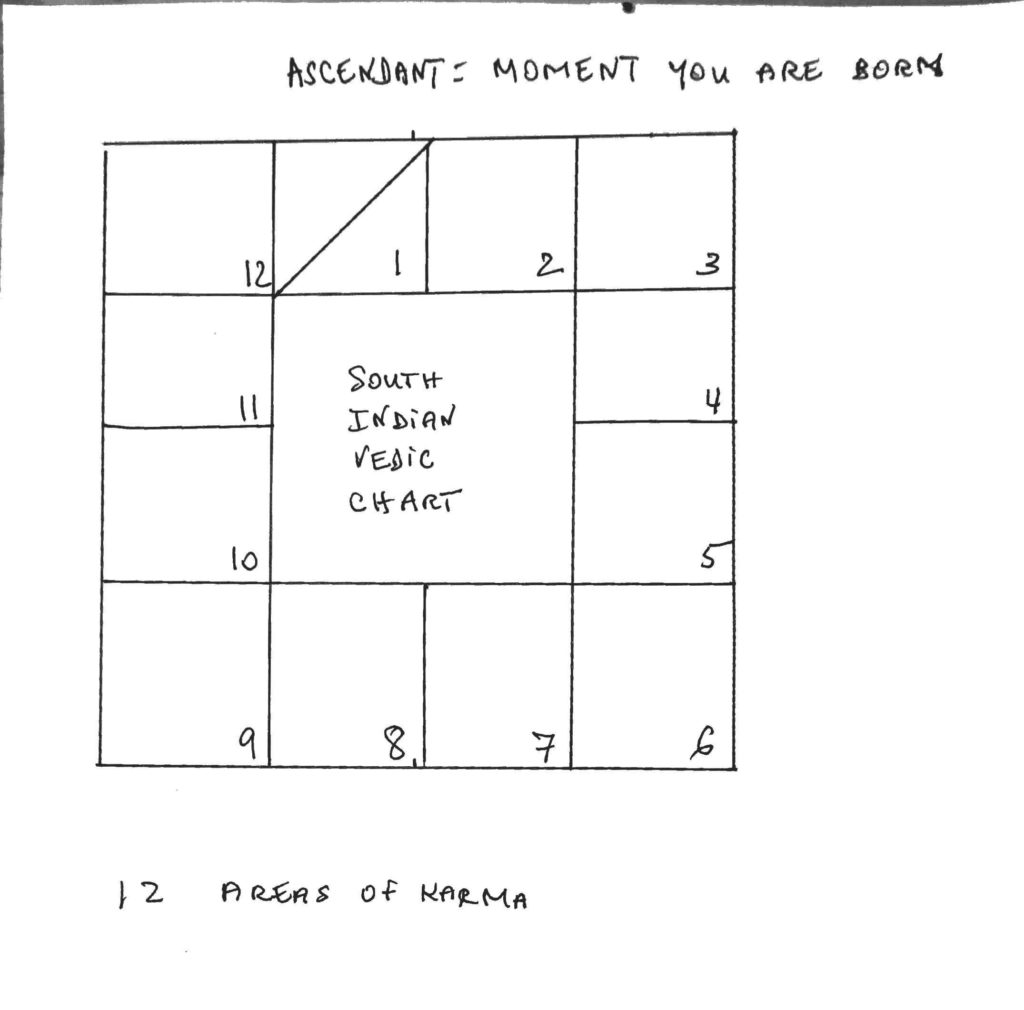
Moon in 1st (self concerned) moon in 2 h (concerned about money, food), moon in third house (concerned about public relations, arts), moon in 4th (likes to love), moon in fifth (likes to learn), moon in sixth (likes conflicts), moon in seventh (likes partner), moon in 8th (likes psychic world), moon in ninth (likes dharma, teacher), moon in ten house (likes to work), moon in 11th (likes gains), moon in twelve house (likes liberation). Other patterns: Moon alone (isolation, feeling lonely), moon mars (fast emotions, action oriented), moon Saturn (introvert), moon Jupiter (generous, broad vision) moon rahu (delusional), moon ketu (detached), moon sat mars (perfectionistic), moon hemmed (tense), full moon (empathetic), exalted moon (lots of emotions), moon debilitated (narrow mind, attached)
- The subconscious mind is instinctive. It is the seat of our ANIMAL INSTINCTS:
Instincts are fast, strong, powerful and irresistible.
Survival – sometimes you don’t understand how people survive, they live in certain conditions, it’s incredible, but you know that the instinct of survival is alive and strong. We will do what is necessary to survive. The way to transcend the survival instinct is to offer others food, transcending the impulse to feed yourself first according to your hunger.
Procreation – we find a mate to reproduce the body. The sexual (procreative) instinct is second after breathing. Think about this, it governs your life. Because it’s in the subconscious mind, it means that you are not aware of it, but it is governing your thoughts and actions. You want to dress in nice clothes, have nice hair, etc., all to find a mate.
Herd – follow the crowd. We don’t want to stick out. If the crowd says this is the way to behave, then you follow because you want to fit in. You may not know how to fit in, but you just want to fit in, i.e., you are vegetarian, others are not. Then you feel very strange, not at ease. Because our instinct is pulling us to be part of the group. We transcend the herd instinct with satsang, being in the company of the wise who seek the Truth of their own Self, not depending on others to feel safe and secure.
Territorial – we want to have our own kingdom, like the dog that marks his territory, this is my area, then they growl at us. Emotions associated with the territorial instinct include fear and jealousy. Animals that act out of their survival instinct compete with each other to find a mate; have a leader; 2 of them fight to establish who is in charge. Some animals learn how to cooperate. Human beings can move beyond the territorial instinct through cooperation and community.
- The subconscious is emotional
It is the seat of our LOWER EMOTIONS: anger, fear, greed, hatred, jealousy, envy, hatred, lust. These powerful emotions feel strong and lead us on the roller coaster. Emotional impulses are imperative to us and difficult to resist. To function in the conscious mind means we have to resist the emotions, the herding instinct, territorial instinct, procreative instinct, etc., resist our habits, to be strong in the present. - The subconscious is the seat of habits. Make use of good habits but do not be victim to habits
All thought patterns (habits) are lodged in the subconscious. Habits of waking up at a certain time, habit of walking, talking, meditation hours, eating hours. These are all habits that we can create in our subconscious mind. Create positive habits and you will not be victim to habits.
The conscious mind is in charge, able to adapt to changing circumstances as needed. We Learn by Trial and Error.Errors are stepping-stones to success. Awareness means to pay attention, to be conscious. Awareness means we make the effort to learn from our mistakes.
Examples: Learning how to drive; A baby learning how to walk; Learning headstand - Using autosuggestion: The subconscious mind is your 100 secretaries
Like a computer with hidden software programmed to run a certain way, the subconscious mind can be your servant, just like having one-hundred secretaries working for you. For example, you can use autosuggestion to wake up at a certain time. You need to remove the old software when it becomes obsolete, otherwise it can run against your will.
2. The Conscious Mind
- Conscious mind is our capacity to make choices.
- We make choices in the present.
- The conscious mind guides the subconscious mind; that is its role.
The conscious mind is more mature, closer to the truth. The conscious mind is higher than the emotions and the instincts. The subconscious needs to be guided by the conscious mind.
The subconscious mind needs to be guided by the conscious mind, like a child submitting his will to a more mature elder. The conscious mind’s decisions supersede the lower mind’s wants, being itself inspired by the super-conscious mind.
- Conscious mind uses intellect.The conscious mind is our reasoning power. The conscious mind makes decisions by analyzing the pros and cons of any given situation. One needs to develop one’s faculty of reasoning. If you do not use it, you lose it. We need to develop our discrimination and detachment.
- For the person not on their journey toward self-transformation, the conscious mind is not often used. We function automatically throughout the day and think very little.
- Intellect can make mistakes
Even though more reliable and superior to the emotional mind, the intellect is limited and can make mistakes. It cannot perceive the Truth and is limited by time, space and causation.
A finite instrument cannot perceive the Infinite.
- Self-awareness and ego
With the development of the conscious mind comes the faculty of self-awareness. Self-awareness is knowing one’s self as a separate ego – not to be mistaken as True Self Awareness which knows One’s Self as One in all apparent names and forms. A conscious mind that has not been purified can be egoistic.
- The conscious mind is pulled by the subconscious mind
The conscious mind can be usurped by the lower mind. The intellect can be colored by the wrapping of the emotions. This is how we make excuses and rationalize our decisions. - Self-enquiry is to use the intellect to discriminate between real and not real
That is why one needs to question one’s true motivation and remind oneself of one’s true purpose.
- The conscious mind helps us to own the present
To be aware is to feel empowered and alive in the present. The subconscious mind lives in the past. Dwelling in the past causes us to feel victimized and powerless.
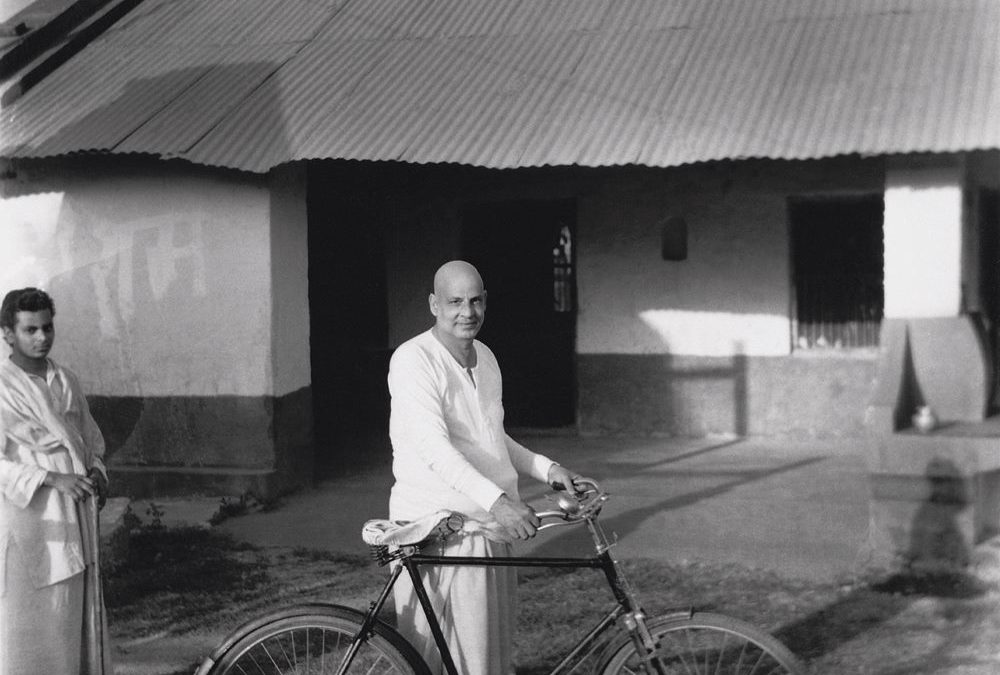
“The present is superior to the past”
Swami Sivananda
Albert Einstein
“No problem can be solved from the same level of consciousness from which it was created.”
Dwelling in the mental patterns of the past can never solve the problem. Only by coming to the present do we free ourselves from the past and open up to all possibilities, where the solutions to our problems lie.
- Live in the eternal present
The past feels secure.
The present feels difficult to grasp.
The future is uncertain.
In fact, the past is dead.
The present is Real.
The future does not have to be a replica of the past.
If you hold the present you hold the future.
If you hold the past you are victim to the future.
3. Super-conscious – intuitive higher mind
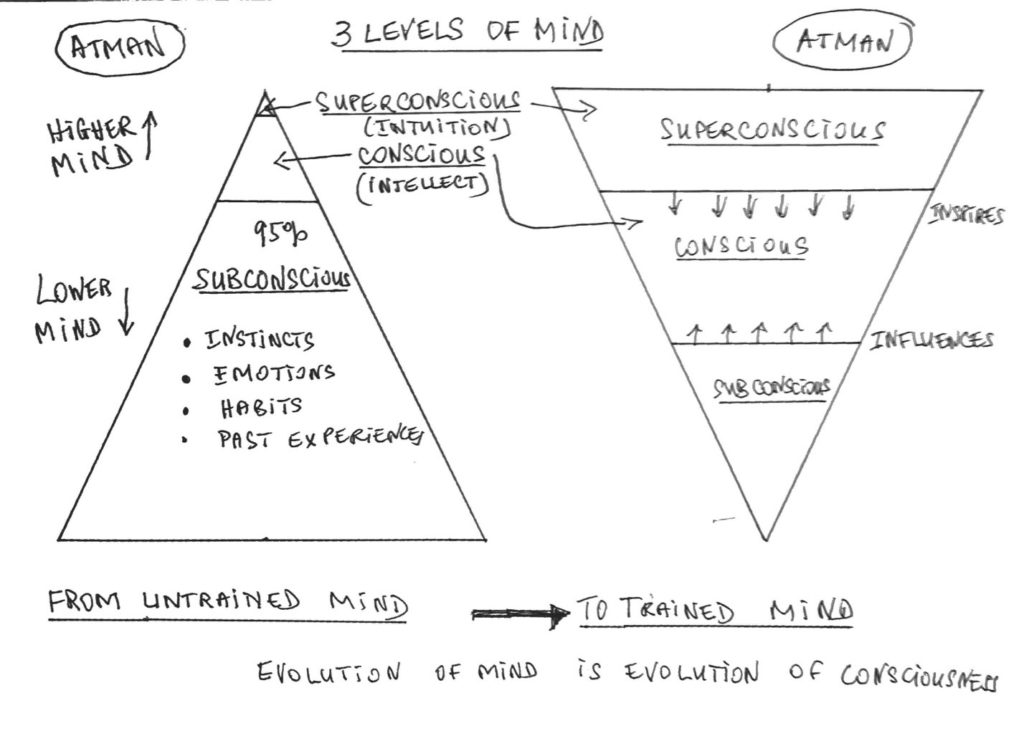
- The superconscious mind (sometimes called supramental) is the seat of intuition.
- Intuition allows us to know in a flash and does not make mistakes. Intuition comes from a sattvic mind and is not an impulse which comes from the emotional, lower mind – even though they look alike.
- The super conscious mind is warm, nice, immediate, powerful and will not make mistake, being closer to the truth. The conscious mind can be perceived as cold by the emotional mind which desires feelings of warmth. When the conscious mind works in cooperation with the super-conscious mind, it will gain approval, and the subconscious mind will calm down.
- The conscious mind takes time to think properly. The intuitive mind is immediate. However, we can make mistake and go to the subconscious mind instead which is powerful, fast, and instinctive. When we don’t have time, it is easier to go with the subconscious mind. Better to take time and think properly than to make things worse.
- The super-conscious, intuitive mind has feeling, higher feeling of pure love and unity. It is luminous, warm, it considers everything, transcends time and space, and is closer to the truth. To make a conscious decision, we need to consider all the facts. Intuitive thinking knows past, present and future; it knows right away.
- Intuitive feelings are different than emotional impulses even though they act alike, fast, feel strong, and we cannot resist. If we follow the emotional impulse, it will lead us down, we’ll be let down eventually. But intuitive thinking will lift us up, and we will not suffer from our decision.
- The subconscious mind tries to pull the conscious mind down to use for its advantage.
By contrast, the super-conscious mind inspires the conscious mind, pulling it up. Most of our efforts are to keep the inspiration going, to give us energy, prana, joy, to do good things, to keep the inspiration. - How do you get the inspiration if the subconscious mind is too loud? Through satsang, association with people who are inspired; or through scripture, to give us direction, a voice of the Truth.
- The super-conscious mind inspires the intellect upward. It is correct and warm at the same time. Pure love is correct and warm.
- Intuition is universal, connecting the mind to its source of wisdom. The lower mind will act selfishly to fulfill its desires. The intuition goes beyond all reasoning and yet is not crazy like unbridled emotions.
- The super-conscious is not the Absolute Truth even though it is higher and is more trustworthy than the intellect. It is our higher faculty to access knowledge that is to be developed.
4. Navigating the 3 minds – The Yogi’s Journey
The yogi’s journey is an inversion of the triangle. [Show inverted triangle picture.]
The yogi endeavors to become aware of the contents of the subconscious mind, to be guided by the intuition. The yogi keeps the automatic functions to a minimum and is no longer guided by instinct, emotions, past programming and likes and dislikes. Using the conscious mind, the yogi thins out the veils of the lower mind to see the Reality, the Truth.
Develop 3 levels of mind to accelerate the process of self development
In conclusion the aspirant . . .
- Develops awareness
- Exercises reasoning
- Surrender one’s will to a higher will
- Overcomes unconscious and base instincts
- Practices consciously Sadhana to accelerate the process of moving from darkness to light
5. What happens during meditation?
1. Subconscious imprints are cleaned up. Problems are resolved by themselves.
2. Conscious mind is activated and becomes clear.
3. Super-conscious can operate – intuition dawns.
6. Beyond the 3 Minds
Beyond the 3 minds is the Atman, the Absolute Consciousness, the ground of being, the pure, unborn and eternal.
Existence Absolute
Knowledge Absolute
Bliss Absolute
- Exercises of thought conversion (from lower mind to higher mind), and from negative to positive mind, from tamasic rajasic to sattvic pure mind. By thinking about something, you will become. However, you are not your thoughts so you can change your thoughts to the opposite. In general you need to counteract the tendency of the mind. The more you do this exercise, the more you will become expert in manipulation of your thoughts from negative to positive and eventually your sattvic mind will be able to reflect your true nature. Eventually all the angularities of your mind will become smooth. That is why we live in community so our mind will friction with each other and one day we will detach from the mind.
Positive words to think about
Thinking about these words can eventually lead you to the light: this is what you want your mind to be
Happy: not permanent happiness but general disposition of the mind.
Joyful: general disposition to be joyful will give you more prana
Healthy: do not think about disease but think about health
Loving: towards everybody, it is the quality of your heart
Compassionate:
Knowledge: to learn, to become curious about knowledge to get out of ignorance
Wise: in order to choose the right response when face with conflicts
Upwards: feeling to move upwards
Expanded: feeling to be big and great
Selfless: not egoistic
Disciplined: in a positive manner, i.e. do the right things at the right time
Uplifted: feeling light
Light: instead of heavy
Forgiving: not holding any grudge towards anybody
Wholesome: feeling together, feeling oneness
armonious:
Peaceful
Creative
Productive
United
Thoughtful: instead of being indifferent and insensitive
Sensitive
Empathy
Courageous: very important quality, it allows you to change
Flexible: adaptable
Flowing: floating with life instead of being stagnant
Growing: going upwards
Devotional: love for the highest in your heart
Faith: it will make you peaceful and secure, opposite of doubt
Focused: it helps you to be present
United: not separated towards anybody
Strong: just being yourself not abusive but anchored in your self
Calm:
Equanimity: evenness of mind, not up and down and high and low
Tranquil:
Serene:
Forbearing: be able to bear and keeping calm in difficulties
Honest
Content: not desirous, restless
Blissful:
Truthful
Independent: self-reliant
Surrendered: having faith, relaxed, no need to control everything
Forward: feeling of moving forward
Bright
Soft spoken: do say things but nicely
Non Violent: ahimsa
Respectful
Austere: not indulgent
Detached: opposite of attached
Vigilant:
Clear mind
Even mind
Adaptable
Beautiful: see beauty, feel beautiful
Connected: connected to Self, to the universe, connected to others to feel strong
Relaxed: not stressed
Moderate: not extreme
Balanced
Considerate
Dispassionate: detached while being fulfilled, does not mean being bored
Words to convert to opposite
Opposite of Unhappy— happy
Opposite of Depressed— joyful, energetic
Opposite of Unhealthy — healthy
Opposite of Hatred— loving. To completely avoid using word hatred.
Opposite of Judgmental, which is thinking out of ego— accepting, tolerant
Opposite of Chaotic— harmonious
Opposite of Undisciplined— disciplined
Opposite of Lazy: enthusiastic
Opposite of Slothful: caring
Opposite of Unrighteous: righteous
Opposite of Careless: caring
Opposite of Angry: being content, letting go of expectation
Opposite of Revengeful: forgiving
Opposite of Restless: peaceful
Opposite of Fearful: courageous
Opposite of Anxious: having faith
Opposite of Worried: having faith
Opposite of Shy: self-confident
Opposite of Doubtful: having faith
Opposite of being stuck: feeling flowing
Opposite of Stagnant: felling progress
Opposite of Irresponsible: responsible
Opposite of Jealous: accepting own karma, accepting self
Opposite of Envious: be more realistic about who you are, content
Opposite of Skeptical: having faith
Opposite of Proud: humble
Opposite of Abusive: respectful
Opposite of Frustrated: accepting
Opposite of Irritable: patient
Opposite of Arrogant: humble
Opposite of Selfish: selfless
Opposite of feeling Limited: feeling expanded, unlimited
Opposite of Rigid: being flowing, flexible, adaptable
Opposite of feeling Downward: feeling upwards
Opposite of Indulgent: disciplined
Opposite of being Addictive: being disciplined
Opposite of Crazy: orderly, grounded
Opposite of Self doubt: having faith in Self
Opposite of Self hatred: Self-love
Opposite of Spiteful: forgiving
Opposite of Dishonest: honest
Opposite of Manipulative: straightforward
Opposite of Lustful: pure
Opposite of Unstable: stable
Opposite of Attached: detached
Opposite of Possessive: generous, sharing
Opposite of Self righteous: self-surrendered
Opposite of Contempt: respect, humble
Opposite of Vicious: considerate, ethical
Opposite of Sinful: dharmic
Opposite of Perverted: pure, good
Opposite of Procrastinating: do it and surrender results
Opposite of Pessimistic: optimistic
Opposite of Feeling Lack: feeling fulfilled
Opposite of Naïve: realistic
Opposite of Inconsiderate: considerate
Opposite of Weak: strong
Opposite of Feeling Empty: feeling fulfilled
Opposite of Desirous: content
Opposite of Greed: generous
Opposite of Exaggerating: being truthful
Opposite of Imbalanced: balanced
Opposite of Inconsistent: consistent
Opposite of Wasteful: conservative
Opposite of being Mean: being generous
Opposite of Stingy: generous
Opposite of being Sensual: being austere, turning inwards
Opposite of Worldly: going inwards
8. Exercises of thought cultivation: eradicate vices and cultivation of virtues
Monday: detachment / attachment
Tuesday: courage/ fears, anxieties
Wednesday: compassion/ judgmental
Thursday: faith/ doubts
Friday: charity/ greed
Saturday: patience/ impatience
Sunday: forgiveness/ narrow-mindedness
January: austerity/ indulgence
February: generosity/ stinginess
March: vigilance/ slothfulness
April: pure love / lustful
May: creativity/ stagnant
June: forgiveness/ vengeful
July: equanimity/ bias
August: serenity/ disturbed
September: Straightforwardness/ hypocrisy
October: adaptability/ rigidity
November: self discipline/ distracted
December: charity, selflessness / egoism