On the occasion of Sivaratri, the festival of Lord Siva, celebrated by millions, this is an offering to help understand how contemplation on Lord Siva can guide us in our life.
Lord Siva is the Lord of Yoga, and represents what yoga and meditation practitioners are aspiring towards. He is the Adi Guru, first guru of yoga, and taught the science of Hatha Yoga.
Symbolism of Lord Siva
He is
often depicted with eyes half closed and half open. This represents an ideal
state of mind that yoga practitioners want to achieve, of being “in the world
and out of the world”, seeing the world of names and forms and changing
phenomena that we live in, and at the same time seeing the essence of it, as
opposed to seeing the manifested world as devoid of spirit and intelligence.
He also
is depicted with the third eye open. This means that we are encouraged to see
the world with our eye of intuition, or with a mind that has been purified of
its lower propensities such as anger, greed, lust, hatred, jealousy and envy.
Intuition is higher than intellect. Intuition can be developed only when we
transcend duality, or the left brain/right brain split. It includes
devotion, or pure love, while intellect might miss half of the picture if there
is no pure love in the thinking, or when the thinking is motivated by the
ego.
Lord Siva blessing Parvati, while Parvati worships Siva
Lord Siva sits on a tiger skin. This shows that to attain to an elevated state, or to be successful in our yoga and meditation endeavours, we need to control our passionate, lower animal nature. Lord Siva accepts all creatures, for example insects and scorpions, thus he shows pure compassion for all beings. He is an example of pure detachment.
Siva is beyond the 3 gunas
Holding the three pronged trident, he indicates the journey of transcendence beyond the 3 gunas, the 3 qualities of nature: tamas, rajas and sattwa. The journey is from the state of tamas when we are in darkness, in ignorance, unawakened, and in denial of our true nature of peace and happiness, to the state of rajas. When rajas becomes predominant we experience a mistaken, separate identity, perform egoistic, self-motivated actions, and are judgmental of others, seeking for happiness externally. We then move to the state of sattwa and experience purity, harmony, calm, peace, knowledge, balance, wisdom, understanding and a non-judgmental attitude. Eventually we transcend these three states of mind altogether, to reach to the transcendental Siva or Yoga. Thus Lord Siva is said to be the ideal symbol of detachment and self-control.
Lord Siva
has a snake around his neck. The snake represents mystical wisdom, and is
related to the “serpent power”, the spiritual energy known as Kundalini Shakti.
He has the Kundalini as his ornament, having completed the journey of self-transformation
and purification represented by the journey of the spiritual energy through the
chakras. In His being, Siva (consciousness) and Shakti (manifested nature) are together.
Lord Siva represents for embodied beings such as ourselves the pure state of
absolute bliss or being, where there is no reincarnation, no mistake, no karma,
no desire.
The Ganga water flows from his head, this is the symbol of perfection and liberation, where the nectar of immortality flows from the highest chakra. Ganga water is purifying. The being that has attained this sublime state has the capacity to purify all who come in contact with him or her.
Lord Siva is sitting meditating on an icy mountain top. He represents the Yogi who practices austerity or tapas. The mountain represents a high ideal or hard to obtain goal, for which you have to climb and struggle. The yoga practitioner is encouraged to struggle hard to conquer the senses and the emotions, to do austerity, or tapas, and lift his being to a high level of stability and endurance in any conditions or circumstances. Physical tapas is to bear heat and cold. Mental tapas is to keep one-pointed concentration among distractions. Emotional tapas is to be able to bear insult, bear injury and stay calm among conflicts and controversies. Spiritual tapas is to dissolve all facets of ego in the Lord.
Siva rock painting at the Sivananda Ashram Yoga Farm
Attachments bring suffering
My
teacher used to say “we would not have come to this world if we did not
have attachment to anything.” We have come to this world with our karmic
tendencies and our likes and dislikes. We are always running towards something
and running away from something else. We get attached to what we like, and we
are afraid to be exposed to what we do not like. These mental and emotional
preferences keep us in this world of sufferings. It is attachment that makes us
suffer. Detachment frees us from these long formed tendencies and allows us to
see a bigger picture of ourselves and others.
There is both
temporary detachment and more lasting detachment. Lasting detachment must be
based on discriminative intelligence and deep thinking, so that we understand
the defects or the true nature of something and resolutely turn away from it. Temporary
detachment is based on fear of pain, for example when we became “detached’ from
ice-cream because it gave us stomach pain. But soon we forget, and will be
tempted again with new names, new forms of ice cream!
Think about the defects of this world, and cease to run after happiness in the external. Introspect and think about how many times you have suffered and caused sufferings due to illusions and attachments. Detachment seems to give pain in the beginning, but at the end, it gives joy. Attachment seems to give pleasure in the beginning, but at the end gives pain.
Conclusion
Our whole
journey is the journey to learn about detachment. May you contemplate on Lord
Siva and become an embodiment of detachment and clear thinking. May you stay
away from the temptations of the lower mind, the distortions of a split mind, and balance your mind so that you can go to sattwa and eventually see through the veils of maya.
May you
attain liberation from suffering through self-knowledge and wisdom.
Swami
Sitaramananda, acharya ISYVC
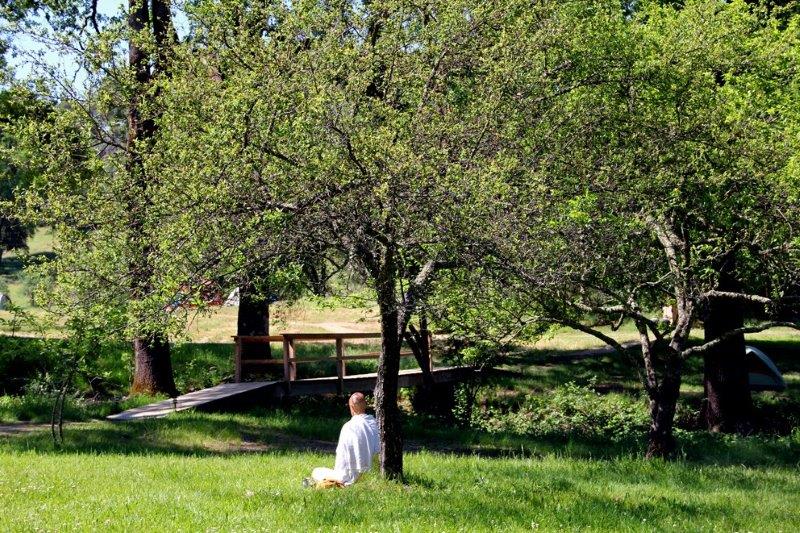
Swami Sitaramananda contemplating on Siva at the Ganges River in Gangotri, Himalayas, North India
Once, while Dattatreya was roaming in a forest happily, he met King Yadu, who on seeing Dattatreya so happy, asked him the secret of his happiness and the name of his Guru. Dattatreya said that the Atman alone was his Guru, and yet, he had learned wisdom from 24 individuals,who were therefore, his Gurus.
I learnt patience and doing good to others from the EARTH, for it endures every injury man commits on its surface, and yet it does him good by producing crops, trees, etc.
From WATER I learnt the quality of purity. Just as the pure water cleanses others, so also the sage, who is pure and free from selfishness, lust, egoism, anger, greed, etc., purifies all who come in contact with him.
AIR though moving everywhere, never gets attached to anything; so I have learnt from the air to be without attachment, though I move with many people in this world.
Just as FIRE burns bright, so also the sage should be glowing with the splendor of hi sknowledge and Tapas.
The air, the stars, the clouds, etc., are all contained in the SKY, but the sky does not come in contact with any of them. I have learnt from the sky that the Atman or the Soul is all-pervading, and yet it has no contact with any object.
The MOON is in itself always complete, but appears to decrease or increase on account of the varying shadow of the earth upon the moon. I have learnt from this that the Atman is always perfect and changeless, and that it is only the Upadhis or limiting adjuncts that cast shadows upon it.
Just as the SUN, reflected in various pots of water, appears as so many different reflections, so also Brahman appears different because of the Upadhis (bodies) caused by the reflection through the mind. This is the lesson I learnt from the sun.
I once saw a fowler spread a net and caught some pigeons. The mother pigeon was very much attached to her children. She did not care to live, so she fellinto the net and was caught. The male pigeon was attached to the female pigeon, so he also fell into the net and was caught. From this I learnt that attachment is the cause of bondage.
The PYTHON does not move about for its food. It remains contented with whatever it gets and lies in one place. From this I learnt to be unmindful of food and to be contented with whatever I get to eat (Ajagara Vritti).
Just as the OCEAN remains unmoved even though hundreds of rivers fall into it, so also the wise man should remain unmoved among all sorts of temptations, difficulties and troubles. This is the lesson I learnt from the ocean.
Just as the MOTH, being enamored of the brilliance of the fire, falls into it and is burnt, so also, a passionate man who falls in love with a beautiful girl comes to grief. To control the sense of sight and to fix the mind on the Self, is the lesson I learnt from the moth.
Just as the BLACK BEE sucks the honey from different flowers and does not suck it only from one flower, so also I take only a little food from one house and a little from another house and thus appease my hunger (Madhukari Bhiksha or Madhukari Vritti). I am not a burden on the householder.
Bees collect honey with great trouble, but a HONEY-GATHERER comes and takes the honey easily. Even so, people hoard up wealth and other things with great difficulty, but they have to leave them all at once and depart when the Lord of Death takes hold of them. From this I have learnt the lesson that it is useless to hoard things.
The male ELEPHANT, blinded by lust, falls into a pit covered over with grass, even at the sight of a paper-made female elephant. It gets caught, enchained and tortured by the goad. Even so, passionate men fall in the traps of women and come to grief. Therefore, one should destroy lust. This is the lesson I have learnt from the elephant.
The DEER is enticed and trapped by the hunter through its love of music. Even so, a man is attracted by the music of women of loose character and brought to destruction. One should never listen to lewd songs. This is the lesson I learnt from the deer.
Just as a FISH that is covetous of food falls an easy victim to the bait, so also, the man who is greedy of food, who allows his sense of taste to overpower him, loses his independence and easily gets ruined. The greed for food must therefore be destroyed. It is the lesson that I have learn from the fish.
There was a DANCING GIRL named Pingala in the town of Videha. She was tired of looking for customers one night. She became hopeless. Then she was contented with what she had, and then had sound sleep. I have learnt from that fallen woman the lesson that the abandonment of hope leads to contentment.
A RAVEN picked up a piece of flesh. It was pursued and beaten by other birds. It dropped the piece of flesh and attained peace and rest. From this I have learnt the lesson that a man in the world undergoes all sorts of troubles and miseries when he runs after sensual pleasures, and that he becomes as happy as the bird when he abandons the sensual pleasures.
The CHILD who sucks milk is free from all cares, worries and anxieties, and is always cheerful. I have learnt the virtue of cheerfulness from the child.
The parents of a MAIDEN had gone in search of a proper bridegroom for her. The girl was alone in the house. During the absence of the parents, a party of people came to the house to see her on a similar object in reference to an offer of marriage. She received the party herself. She went inside to husk the paddy. While she was husking, the glass bangles on both hands made tremendous jingling noise. The wise girl reflected thus: “The party will detect, by the noise of the bangles, that I am husking the paddy myself, and that my family is too poor to engage others to get the work done. Let me break all my bangles except two on each hand”. Accordingly, she broke all the bangles except two on each hand. Even these two bangles created much noise. She broke one more bangle of each hand. There was no further noise though she continued husking. I have learnt from the girl’s experience the following: Living among many would create discord, disturbance, dispute and quarrel. Even among two, there might be unnecessary words or strife. The ascetic or the Sannyasin should remain alone in solitude.
A SERPENT does not build its hole. It dwells in the holes dug out by others. Even so, an ascetic or a Sannyasin should not build a home for himself. He should live in the caves and temples built by others. This is the lesson that I have learnt from the snake.
The mind of an ARROW MAKER was once wholly engrossed in sharpening and straightening an arrow. While he was thus engaged, a king passed before his shop with his whole retinue. After some time, a man came to the artisan and asked him whether the king passed by his shop. The artisan replied that he did not notice anything. The fact is that the artisan’s mind was solely absorbed in his work and he did not know what was passing before his shop. I have learnt from the artisan the quality of intense concentration of mind.
The SPIDER pours out of its mouth long threads and weaves them into cobwebs. It gets itself entangled in the net of its own making. Even so, man makes a net of his own ideas and gets entangled in it. The wise man should therefore abandon all worldly thoughts and think of Brahman only. This is the lesson I have learnt from the spider.
The Bhringi or the BEETLE catches hold of a worm, puts it in its nest, and gives it a sting, the poor worm, always fearing the return of the beetle and sting, and thinking constantly of the beetle, becomes a beetle itself. Whatever form a man constantly thinks of, he attains in course of time that form. As a man thinks, so he becomes. I have learnt from the beetle and the worm to turn myself into Atman by contemplating constantly on It and thus to give up all attachment to the body and attain Moksha or liberation.
This talk is part of the Sivananda Yoga Health
Educator Training (SYHET) course, and was done on a zoom call.
Dr. Fred Luskin
Consultant
Director of the Stanford University Forgiveness Projects
Associate Professor at the Institute of Transpersonal Psychology
Sivananda Yoga Resort and
Training Center, Dalat Vietnam, 15 January, 2020
In this talk Dr. Luskin outlines the procedure for forgiveness. This talk was transcribed (with some editing for clarity and brevity) almost verbatim from a video which was recorded on a zoom call.
Introduction
Dr. Luskin is a psychologist and for over 20 years has run the forgiveness program at Stanford University in Northern California, USA. In this talk he explains the process of forgiveness as he is teaching around the world with many different groups. He is helping the SYHET students develop skills for counseling people with health concerns. Please see his biography at the end of this transcript.
Story of Pain
I had a terribly painful experience of being abandoned and betrayed by a friend who was very close to me. One night he brought his new girlfriend for a dinner party at my home, and then suddenly cut off all connection with me.
I held this negative event in my mind for several years, and later realized that I was ruining my life, missing all of the good things in my life because of it. I was arguing with my wife, not appreciating my child, hating my job, and I was miserable, because I was holding on to the story of this event.
In one extreme moment of anger, I noticed that my whole body was strongly affected by the reply of my ex-friend when I tried to reach out to him with a sincere letter and he sent a very short and casual reply on a post card.
Choosing what is right
Then came a painful (but also very helpful) moment with my wife when she strongly pointed out my problem to me. Some time later, while at the supermarket, after being frustrated beyond my capacity with a relatively small problem, and having another intense physical reaction, I had an amazing flash of revelation.
I recognized that I have a choice of paying attention to what is wrong in my life, or paying attention to what is right in my life, and no one else owns that choice except for me. The moment that I had this realization, I told my wife that I was sorry that I had harmed her so much with my bad mood.
Blaming a friend
Then I got in touch with my friend and agreed to meet him, and basically tell him the same thing, that neither of them were responsible for my bad mood, but rather that I was responsible for my bad mood. When we met, we had a very interesting experience, because I had already forgiven him. I realized that he harmed me, and that harm lasted for a year. And then I harmed myself, and that harm lasted for the next two years!
Those two years were not his responsibility, but I had
blamed him for my misery. I had blamed
him because I could not handle my own life.
When I recoginized that fact and I saw him, we did not actually talk
about his abandoning me. He was open to
me, I had forgiven him, and we had an uncomfortable half hour, but since that
half hour we have again been best friends for the next 25 or more years.
Stanford Forgiveness Project
I had let go of blaming him for harming me, because I saw that when he cut off contact with me, I used the situation badly and harmed myself. We then developed these insights into the Stanford forgiveness project, I have written the best-selling book on forgiveness, and we teach people all over the world how to do it. What I will try to do with you is lead you through some of the processes.
Practice Session
First, please think of something in your life of something that you have not forgiven that continues to haunt you in some way.
Then you can turn to someone near you, and talk about what it is that you have not forgiven, and why you have not let it go.
It does not have to be anything very serious, and not something that is so overpowering that you will become emotionally overcome talking about it.
Just choose something that you have not forgiven, describe it, explain what it was, and why you have not forgiven it and can’t let it go.
practice…..
Understanding Homeostasis
What we came to understand over all of those years is that forgiveness is mainly a story-telling problem, a matter of dealing with the stories we create about our life events. What you have is a “default network and setting” in your brain that tries to keep you in what is called homeostasis, where all of the body’s functions can continue in the normal manner. This homeostasis keeps you “level,” meaning in the proper balance.
Depending on the level of tension that you have, and depending on the level of stress that you have experienced, you have a homeostasis which is anywhere from very calm to very anxious. The important point here is that you consider your current state “normal,” even though it may be quite angry, anxious or disturbed.
The more sensitive, angry, anxious, etc. that your homeostatic point is, the more you have mental verbal stories that are designed to keep that homeostasis in tact. So if you are an angry or anxious person, then many of the stories that you tell about your life are designed to keep you from changing. The stories are keeping the body the as it considers normal.
Not knowing your own tendency
Very often angry people have no idea how angry they are! People in a hurry have no idea how much of a hurry they are in. People who are anxious and skiddish have no idea how they appear to others, because it is so normal for them. When you have suffered or when you have been hurt, you go through a natural period of grieving, where you come up with a story to help explain your experience in a way that will generally fit in with who you are.
If you are a generally kind-hearted person and if someone does something nasty, after a while you will get around to some explanation of “well, you know, they did not mean it, or maybe I took it wrong, or it was just a really tough experience for them.” If you are an obnoxious person, then you will come up with a story that makes the other person wrong or which has them with bad motives, and you can stay comfortable being exactly who you are. Some experiences, however, are outside of our normal range, and therefore we have to adjust to them.
The stories we tell ourselves
The thing that happened to my friend was outside of my normal range. It was outside of homeostasis, and the way I had organized my mental life. So I came up with a story that reflected that being outside of my normal range, and it changed me. The story was that life was not fair, life is terrible, and you cannot trust people.
The story changed my day-to-day vibration and perspective, and that is what my wife complained about. She would not have complained if I created a story that fit in with who I was. But I created a story that changed who I think that I am. It changed my physiology, and not just my perspective. It changed my biology, and that is what all of your stories do.
Your stories cement your biology in place, and they are how you change your biology. So if you are practicing meditation and you have a story that you are not good at this practice, then you will get very minimal results. But if your story is that I am good a learning new things, I am open to new experiences, you will get much more benefits from the meditation practices and it will take much less time for the meditation to change you. So if you think that meditation is not anything important, you would have to have very deep meditation experiences before you would be convinced that there are benefits.
Change the Story
With forgiveness, we see that if we create a negative story,
we tend to ruin our lives through that story.
The story changes our biology, changes our nervous system, and prevents
new information from getting in. So if
our story changes our outlook to “I cannot trust people” then we see
a different world than we saw before the story came. We have now altered the world that we see and
the body of the person in that world.
So this is why unforgiveness is so dangerous to us. These stories tend to either alter who we
are. If we are generally a positive
person, we change to a more negative view, or if we are already a mistrusting
person, the stories tend to cement this negative view more into who we
are. So ultimately what we understood is
that forgiveness is a change in story.
We can change the story, even though we cannot change what actually
happened.
The change in our homeostasis makes it very hard to change the story, so many of us are stuck in these stories of what happened in our childhood, a lover that left us, or we are critical of ourselves, and these stories limit our capacity to grow. If we can see that what happened is not the fault of our past, or the actions of another person, we are will to change our stories, but until then we feel justified in blaming someone else for ruining part of our life, and it is the blame that is so toxic to your well-being.
Blaming is not the answer
Blame is a quality that by itself leads to helplessness. It also leads to hostility, that is we say, “Because they did something my life is not as good as it could be; it is their fault,” instead of admitting that my current situation is actually due to my own inability to cope, which is the truth. Because we are not able to cope with the situation, we create a story that keeps us stuck.
Practice Session 2
Now we do another two exercises, this time in altering stories, to help you to be able to change. Please go back to the first person and tell a short story about what happened to you. But then take a longer time to explain how that story is now keeping you from creating peace in your life. So our problem is not about the past, but rather about our inability to create a story right now that will bring peace for our current life.
In my case, I can say that my friend harmed me. And that was true for some time. It is not true that my friend harmed me for five years. But then I made bad choices about how to handle the situation that kept me suffering, I was ignorant about how to grow past the situation, and it took me years to figure that out. Whole countries and groups of people are getting together and creating stories about how another group of people is responsible for their lives not being peaceful or happy enough. Forgiveness is changing that story.
Practice changing the story
So now you can go to the first person, and give a short
summary of the story you have about how they harmed you. Then begin to tell a different story that
will begin something like, “You know, actually the truth is that it is not
their fault that I have not forgiven them.” The truth is I just did not know how to
forgive, or I did not practice it, or I had no skills as to how to deal with
this. That is not a crime!
But the truth is that I did not know how to make peace with
this part of my life, and it would be good to learn how to make peace with
parts of my life that hurt. With the
other person you can now talk about how to create a narative that will help you
to move past the problem in your current life, rather than talk about what was
done to you in the past. This is just a
first pass, but I ask everyone to try.
You can explain what it was about yourself that kept you from moving
forward, and how you can now learn to do so.
Perhaps you grew up in a house that did not teach you these skills, or this event was too painful, but you want to recognize that now you need to learn, grow and change in order to improve your life. That is the deep shift that occurs in forgiveness, from blame and helplessness to “there is something that I need to develop.” Now please begin the exercise.
practice…..
First step in Forgiveness
OK, thank you for doing the exercise. Usually it takes longer than the time I am asking you to do it, about one hour. However, it can be done more quickly than you think, when you educate people and you have them practice different stories. Because it clicks into people when they realize that, “I have some control of what comes out of my mouth.” If you have been talking for some time about how bad part of your life is, the first step in forgiveness is to stop talking like that. It is simply to shut down that talking.
If people have been wounded, and they have never had the opportunity to talk about it, then talking about it is essential. So if you are a health educator, and someone discloses that they have an issue that they have never told anyone about, never had the opportunity to talk about it, then you need to stop right there and give them the chance to tell you about it. Of course, you must feel comfortable talking with them about the issue, and be theraputically attuned so you are able to deal with the issue. If they want to talk about some serious abuse, probably you should send them to a therapist.
Encourage sharing
If they tell you that they are suicidal, you should send them to a therapist. But if you think their issue is within your scope of practice, which you have to be extraordinaraly careful to maintain, you should give them your attention, because step one is talking about it. You need to encourage them to share it (but only in a safe place), because you want them to talk. Research done on people who have had difficult experiences in life shows that people who heal the least are the ones that do not share. People who hold in their traumas do not heal.
Share with the right people
The second-worst healers are the people who tell everybody
about their difficulties. You may meet
someone and they say, “I had a terrible childhood, my ex-husband was a
bum, I got fired from my job,” and you have never met them before! This type of person does not heal
either. It is not quite as toxic as not
talking about it, but it is definitely unhealthful. What is healthful is to get it out, short
term, to a small number of trusted people.
You could say if there was a significant trauma two months ago, it may be appropriate and helpful to still be talking about it. But if it happened three years ago, the best strategy is to simply stop talking about it. We can apply the technique of “shut up the next time you want to complain about it.” This is the way we can forgive and heal.
Don’t let the story become a habit
This formula is simple and obvious, but most people do not recognize how much they influence their physical and emotional reality to keep telling the same stories over and over and over again. Many people repeat these stories so much for so long that they actually get stuck in the habit, to the extent that they no longer can choose what they are going to say and how they are going to say it! That is the real danger.
If you call you ex-husband a bum for six months, it is very hard in the seventh month to think of them as anything but a bum. If at the age of 15 you started telling the story that you had a terrible mother, then by the age of 30 it will be very hard to change, because by then your whole body has adapted to that story. You have arranged homeostasis around that story, and that is not a healthy place to be.
Allow yourself to feel the emotions in order to heal
If people have not talked at all about the trauma, of course they will not be able to heal at all, because they must process the emotions before they can achieve forgiveness. We call this processing grieving. And people must go through this grieving to help them move past the hurt in their lives. So first they must experience the emotions. If someone hurt you, you may have to experience the anger, if someone left you, you may have to cry, because this is the first step to heal which comes before forgiveness. But if you are around someone who already grieved, got angry, cried, and told the story for some time, then it is time to stop talking about it.
A story can become an addiction almost in the same way a chemical can become an addiction. So it becomes a pattern, you have no control, and no way to stop telling the story or changing it on your own. You do not get any benefit from telling the story again. The first step to change is to admit that you have a problem. You say, “I have a bad habit of talking about this with everyone I meet, and I do not know how to stop. Can you please help me?”
Don’t become the victim
Only you create a “victim.” When you talk about the event in terms of, “there is nothing I can do about this” you become a victim. This is what we do in forgiveness work. We tell them that there is absolutely no value in telling the story again. You are actually laying down more neuro-pathways, making it more difficult to change. This stuff is so simple that it was hard to believe that it came as news when we started using it. And many therapists actually argued with us!
Positive Intention
Here is the way we approached it: we call it “positive
intention.” It is asking yourself
the question, “In that particular situation what was I looking for, what
did I want from it?” For example,
you were trying to get a job or perhaps a romantic relationship, which is
probably the most common situation that causes people to need to forgive. More people have stories about ending of
relationships than any other situation.
The vulnerability we have with intimate partners is the most sensitive
that we experience. These events are
outside of our normal homeostasis.
Let us say that you have had a terrible breakup of an
intimate relationship. The approach here
is to ask yourself what it was that you were looking for in that
relationship. For example, “I
wanted this relationship to have someone to enjoy life with, share with, have
fun with, grow with, etc.” You want
to be honest about that reason. It does
not matter what the reason is, but you want to be positive about what you were
looking for. “I am not giving up on
wanting to get that because this time it did not work out.”
In my example of losing my intimate friend, I have to say, “I loved the situation of having such a wonderful friend, but it did not work out. However, I am not going to give up on having a wonderful friend just because this particular friendship did not last.” And so the story shifts from the past to the future. The story shifts from this was what was wrong, what I did not get, to this is what I am now working to get. So this statement is our positive intention. We say, “Why should I give up trying to get what is important to me?” We can still reach the goal but in a different way.
Practice session 3
So now please go to a different person, and this time, work on telling the positive intention story. You can start with, “OK this difficult thing happened and it was very bad, very painful.” But then you state the positive intention: “This is what I was trying to get, and instead of spending much time obsessing about how I did not get what I wanted, I want to learn how I can get it in a different way.” The unforgiveness story looks backward whereas the forgiveness story looks forward. The unforgiveness story is blaming the other person for not getting what you wanted. The forgiveness story is moving forward to get what you originally wanted. It says, “I will not let this event stand in my way!” It is a complete difference of mental representation. Your body, not just your mind, shifts. You develop an entirely different neuro-architecture.
Meditation to quiet the nervous system
Now I will have you do some very simple meditation practices. The reason for these practices is that if you do not quiet your nervous system, it is hard to cement the result of the other exercises.
So now please get into a position so that you can sit comfortably for five minutes. From my stress management purposes, I suggest that you not have a perfectly straight posture, but rather focus on having soft shoulders and a relaxed body.
The main thing is to be able to breathe properly and easily, with a relaxed abdomen.
Please bring your awareness to your lower abdomen. The key here for stress management is that when you inhale your abdomen expands, and when you exhale, your abdomen contracts.
Now bring an image to your mind of a person that you simply adore. Bring an image to your mind of a human being that you just love. You actually feel the love. You want to cultivate your own heart.
And now let go of that experience and allow your eyes to open.
This is the other thing that we teach about forgiveness, that you just touched where it lives. Forgiveness lives in your open heart. And you never get there by arguing about the past, by blaming people, and being full of self-pity. You get there by opening yourself up to love, beauty, kindness and gratitude. When your heart is open, you pretty much already know how to forgive. That open heart of yours can already do it. It is not complicated, not a big deal.
Go to the love in your heart
But we never go there.
We do not go to the part of us that loves anywhere nearly enough to
solve our life’s problems, and so we stay stuck and unhappy. But when you touch that part of you, and you
open your heart, and you trust, even if it is just for 10 seconds, for those 10
seconds you have forgiven. You are at
peace and your life is OK. You have
touched the place in you that does not need an enemy. It is in you.
You just never looked for it.
Most of the time we look in the wrong place to try to heal, and so we do
not find it.
So what we teach is many different ways to just connect to your own heart. So you practice being in that state, so you want to talk from that state. And when we practice forgiveness we say, “I want to tell a story that does not yank me out of my own heart. By telling the same bitter, life is not fair, life is terrible stories I am making it impossible to feel good.” Forgiveness means that you still have access to your heart. But you cannot find that if you are telling bitter stories all of the time.
Remember the wonderful possibilities
So you need to stop sabotaging your own happiness by
bitterness and complaining, altering your biololgy so that the bitterness
becomes “normal.” Some
grieving is helpful because we can release the negative emotions in a positive
way with people who are close, and learn from the experience. But the problem with most of us is that we
give too much attention to the small negative events and not enough attention
to the rest of our lives, which many times have wonderful possibilities.
When you forgive, you make a big change in your life. When you will not forgive, you are not saying that you will not forgive just one little thing. You are saying that because of that event your whole life is ruined. No matter what happens, if you have enough gratitude like the saints do, then you would not lose your heart. If you were a very strong meditator, with a long practice of compassion, you would not be so upset by these negative events. But most of us are completely yanked out of our hearts when people do something that hurts us.
Conclusion
We cannot find our own heart. We have found that people have to practice finding their own hearts, and stop telling stories that keep finding their own hearts impossible. What you need is much more energy given to appreciating the positive aspects of your life, and less energy given to the negative stories.
We remind people who have a basically good situation, with enough food to eat, water to drink, etc. that they can focus on these positive aspects to help keep up the balance of negative and positive. They can tell the story about how terrible some event was, and they may have had something quite bad. But then we ask them to add to the story something like,
“Yes I had some bad things happen, but my life is actually quite good because I am not going hungry, thirsty, etc. (like some people) and I have much to enjoy and appreciate.”
Dr. Fred Luskin
Biography:
Dr. Fred Luskin has completed extensive research on the
training and measurement of forgiveness therapy. His research demonstrates that
learning forgiveness leads to increased physical vitality, hope, greater
self–efficacy, enhanced optimism and conflict resolution skills. It also shows
that forgiveness lessons the physical and emotional toll of stress, and
decreases hurt, anger depression and blood pressure.
He has worked with men and women from both sides of the
violence in Northern Ireland who have had family members killed and with
different groups of financial advisors after the stock market crash of 2000 to
enhance their conflict resolution and stress management skills.
Dr. Luskin is the author of the best seller Forgive
for Good: A Proven Prescription for Health and Happiness and Stress
Free for Good. He has worked with many organizations and has trained
lawyers, doctors, church leaders and congregations, hospital staffs, teachers
and other professionals to manage stress and enhance forgiveness all over the
United States. Dr. Luskin’s work has been featured in Time
magazine, O magazine, Ladies Home Journal, U.S.
News and World Reports, Parade, Prevention as
well as the New York Times, Los Angeles Times, Chicago
Tribune, U.S.A. Today and the Wall Street
Journal.
Frederic
Luskin, Ph.D. is the Director of the Stanford University Forgiveness Projects
and an Associate Professor at the Institute of Transpersonal Psychology.
He also serves as the Co Chair of the Garden of Forgiveness Project at Ground
Zero in Manhattan.
It is very easy to overcome depression. It is not at all as difficult as one imagines. Mind has the mysterious power of magnifying a problem and making it appear formidable. Do not listen to the promptings of the mind. Reject them ruthlessly and throw them out.
Here are some practical hints that will enable you to triumph over this malady once and for all:
1. First try to analyse yourself thoroughly and find out the cause of the problem. Do not be hasty. Sit calmly and think over the matter. Spend some days over it if necessary. Put your thoughts down on paper and reflect over them. If necessary, get the assistance of someone whom you love and trust and who will be sympathetic to your feelings. Pray to God within to lead you to the right person.
Seeking support from friends, family or someone you trust can be the first step towards overcoming depression.
2. Do not listen to promptings from within that your problems cannot be solved and overcome. The Guru or the Divine within you, and the loved ones around you, can effectively solve or dissolve all your problems.
3. Know that for every problem that confronts you-however difficult and complicated it may seem to be-there is the requisite guidance, strength and wisdom readily available to you from the Divine dwelling in the chambers of your heart. God is nearer to you than your life-breath. Turn to the Lord with a childlike faith and experience the miraculous results.
4. The easiest way to tap the divine power within is to repeat God’s holy Name. Select any Divine Name from the scriptures and repeat it constantly, without a break. In this one method of spiritual practice all the holy scriptures of the world are unanimous. The power latent in the Divine Name is like the power latent in the seed. Just as the seed needs soil and water to enable it to germinate, so also the Divine Name needs to be constantly repeated to make its power manifest.
The Divine Name is the one sovereign, infallible remedy to get rid of depression once and for all. Take any Mantra, like Sri Ram, Om Namasivaya, Om Namo Narayanaya, Om Namo Bhagavade Vasudevaya, Om Sri Ram Jaya Ram Jaya Jaya Ram, the Mahamantra: Hare Rama Hare Rama Rama Rama Hare Hare, Hare Krishna Hare Krishnna Krishna Krishna Hare Hare, and repeat it throughout the day and also just before you go off to sleep and the first thing when you wake up in the morning. It will protect you from all dangers and calamities.
5. Keep the body fit by doing regular physical exercises, and by participating in healthful activities. A hike in the countryside will be refreshing and invigorating both mentally and physically.
6. A pure, nourishing diet is very important for the health of both the body and the mind. Take more of fresh fruit and vegetables. Take health tonics. They are available from the health stores. Vitamin tablets from natural products will be found highly beneficial.
7. The nervous system must be strengthened by means of exercise, relaxation, pure food and regular prayer. A useful nerve and brain tonic may be prepared as follows: Soak 8 dates, a similar quantity of almonds and 4 cardamoms in a bowl overnight. In the morning remove the skin from the almonds. Reduce the ingredients to a paste, add honey and butter and take with warm milk. This delicious tonic rejuvenates the nervous system quickly. A teaspoonful of Amla powder mixed with a glass of warm water and taken twice a day will help tremendously in strengthening the nervous and physical system. Amla is one of the most important ingredients in the well-known Chyvanaprash tonic.
A healthy, balanced diet is important for not only physical health but also mental health.
8. Attend regular prayer services in a temple or Ashram. The holy vibrations will give you added mental and spiritual strength to cope with your problems.
9. Study the scriptures daily. This will give you discrimination, which will give dynamic strength to the mind. It will be your most effective weapon to deal with the promptings of the mind.
10. Check undesirable habits. Overcome them by developing virtuous qualities. Lead a life of purity and righteousness. Such a life will free you from all worry, fear and depression.
Replace negative habits such as overindulging the senses with positive habits such as meditation and spending time in nature.
11. The constant repetition of some beneficial formulae will strengthen the mind considerably. Such repetition is called auto-suggestion. Here are some proven formulae for this purpose. Repeat them as many times as possible during the course of the day, and when you are just about to fall asleep at night:
(a) I am Thine. All is Thine. Thy Will be done, O Lord.
(b) Let go and let God.
(c) What cannot be cured must be endured.
(d) Whatever has happened has happened for the best; whatever is happening now is happening for the best; whatever is to happen in the future will happen for the best.
(e) Through the Grace of God, I am getting better and better every day in every way.
(f) Even this will pass away.
12. Serve the sick and the needy through a service-oriented institution. If you take up some useful activity for the good of others, you will have no time to think about yourself. Losing oneself in selfless service is one of the most dynamic methods of overcoming depression. If you give cheer, joy and happiness to others, you yourself will receive cheer, joy and happiness in return.
13. Do not try to evade or run away from your problems, difficulties and trials. Face them bravely through calm reflection and discrimination, knowing that the Divine within is ever your guide, protector and savior. Know also that everything in this world that you now hold so dear is not lasting and will soon disintegrate and pass away. You are only a passing pilgrim on this earth plane. If you constantly reflect and discriminate thus, then all such emotions and feelings that have such a tenacious hold on your mind will be loosened, and an inexpressible freedom, lightness and joy will fill your heart.
14. Be content. Adopt a lifestyle of “simple living and high thinking”. A great deal of unhappiness today may be traced to unfulfilled desires. There is no end to desire. Each desire breeds a host of new ones. Modern man longs to own TV sets, video recorders, dishwashers, expensive cars, swimming pools and other items of luxury. Reduce your desires and lead a life of contentment and simplicity.
15. A constant attitude of gratitude to God for having provided you with your physical and material needs, will give you an abiding sense of contentment and peace, and free you from depression, cares and worries.
16. Select any suitable method, or a combination of methods, and put them into immediate practice. You will succeed without difficulty, Nil desperandum. Never despair. There is a magazine of enormous power within you. Tap that power diligently and come out victorious. Then share your knowledge with others.
17. Strictly avoid viewing scenes of violence, sex and murder on TV. Avoid places of gambling and liquor, evil company, and literature that deals with violence, sex and crime.
18. Performance of daily Agni-Hotra and recital of the all-powerful Sri Hanuman Chalisa are very effective remedies to overcome depression and suicidal tendencies.
Blessings in Disguise
Adversities, trials, difficulties, calamities, diseases, afflictions, pains and sufferings are all blessings in disguise. They strengthen the will and increase the power of endurance. They turn the mind more and more towards God. They instil in us discrimination and dispassion. They draw out all our latent faculties. They force us to perform even beyond our ability. They develop all talents and capacities lying dormant within us.
It is easy to bask in the sunshine of prosperity. The crucial test is your reaction under adversity and hardship. God wants us to enjoy eternal bliss and peace. For this purpose the body and mind have to be thoroughly purified and strengthened, so that they may be able to bear the pressure of His matchless bliss and peace. This process of purification and strengthening cannot be effected without one confronting adverse conditions and circumstances.
Furthermore, nature’s law of cause and effect operates with relentless precision. The wise and discriminative person will allow the effects of this past actions to bear fruit by meeting all the conditions of life with patience, good cheer, calmness and faith in God.
In this talk Swami Sitaramananda will teach about our negative emotional patterns and we can turn this instead into Selfless love. The main practice to do this is through Bhakti yoga (the yoga of devotion). By doing this we uplift our self and others and we spiritualize our relationships with others.
Normally we are suffering because we all aspire to love 100% but we fail to feel this way most of the time. Instead we feel like we are losing ourself, our mind is swinging and we suffer from the paradox of wanting to lose ourself in love.
Swamiji will teach that Love is the true goal of life and this love is for ever. By learning how to practice Universal Love we can come to a state of True happiness.
Receive weekly emails about the ashram programs and events.
This will close in 33 seconds
Like most websites, we use cookies for various features according to our policy. We hope that’s okay with you – if not, please feel free to disable cookies in your browser.