Understanding the Addictive Mind

Understanding the Addictive Mind

In this podcast Swami Sitaramanandause talks about the use of yoga to heal addictions.  Yoga teaches us to practice self surrender and by doing this we can understand better how the mind works.  When the mind is very active there are many thought waves which causes us to look outwardly for external objects to bring happiness.  We identify with these thoughts and create an attachment to the objects which leads to addiction.

When we repeat these negative thoughts we suffer.  We must learn to practice detach so we are not at the mercy of negative thoughts.  Detachment helps us to connect to our True Self because we no longer identify with the thoughts.  We become content in our Self and no more energy is give to the negative thoughts.

Listen in for Divine Wisdom

Understanding the Addictive Mind

The Yoga of Relationships

http://sivanandayogafarm.libsyn.com/the-yoga-of-relationships

The Yoga of Relationship teaches us to understand that we are in this constant and complex network of relationship and teaches us to learn from the emotional patterns that we usually follow within relationship. It is through our network of relationship that we learn and grow.

People in relationship serve as mirrors to each other emotionally and in various ways, so that we may reach the core issue of what it means to live in relationship, which is the relationship with our own Self.

In Yoga we aim to stop the cycle of recurring negative emotional patterns in our past relationships by looking within and by developing awareness about oneself. It is about being self-sufficient – not in an egoistic manner but in a spiritual manner.

Listen in for Divine Wisdom

Yoga and the Koshas for Spiritual, Mental and Physical Health

Yoga and the Koshas for Spiritual, Mental and Physical Health

Yoga and the Koshas for Spiritual, Mental and Physical Health

by Swami Sitaramananda

Swami Sitaramananda

Swami Sitaramananda

Yoga Farm Director

Swami Sitaramananda is a senior disciple of Swami Vishnudevananda and acharya of the US West Coast centers and Ashram.  Swamiji is also the acharya of the Sivananda mission in Asia, especially in Vietnam, where she hails from.

View Profile >

Yoga Heals on the Spiritual, Mental and Physical Levels.

Here’s how – Yoga works on all three bodies: the physical body, astral body, and causal body. In this article, we will learn about three bodies and how Yoga heals them.

Each person has a physical body made of matter, an astral body containing prana and thoughts, and a causal body which contains the quality of spirit.

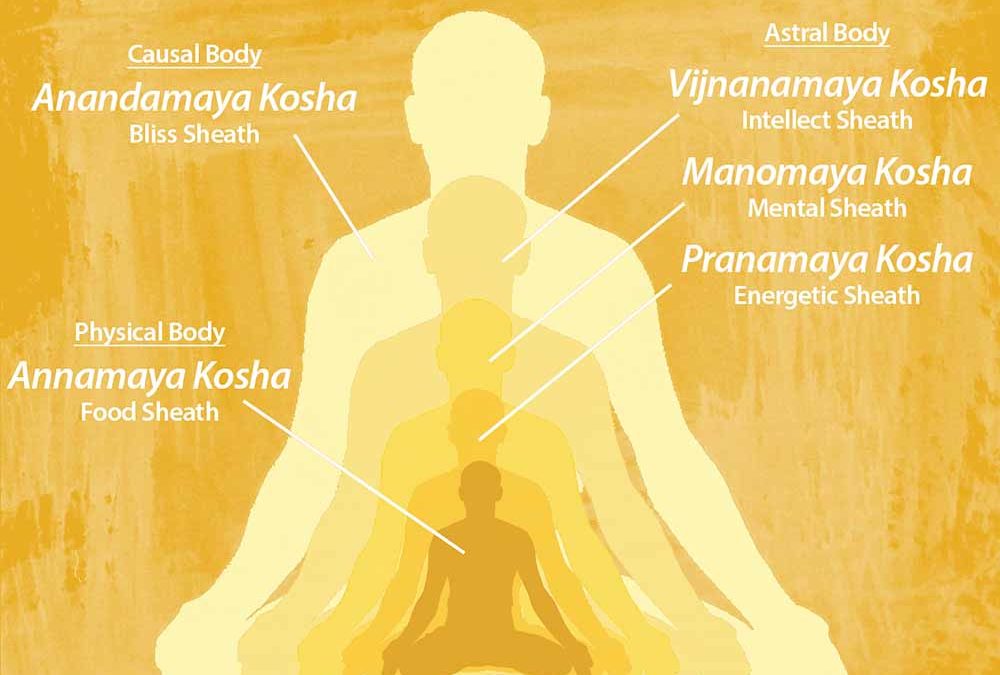
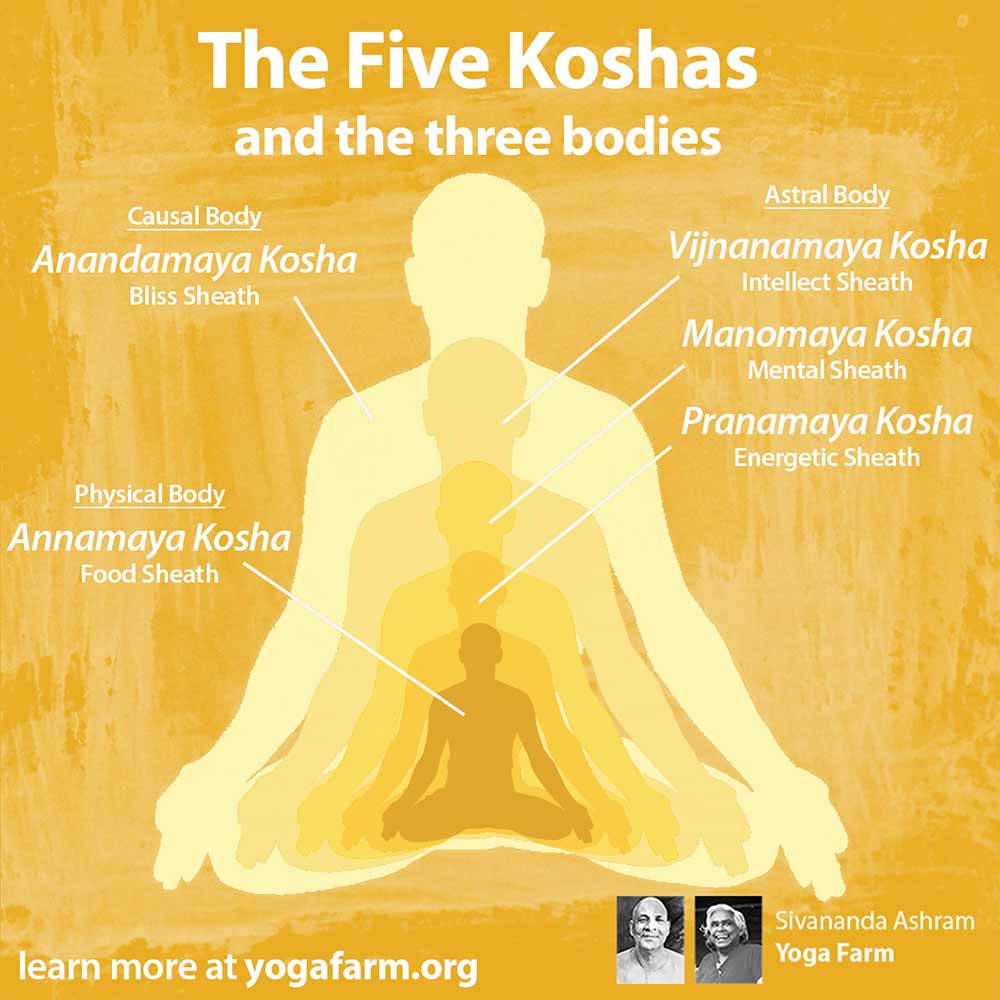
The three bodies are made up of the five “koshas” or sheaths. Below is a breakdown of the three bodies and their corresponding koshas:

Physical Body – The Vehicle for the Soul

Annamaya Kosha – The Food Illusion Sheath

  • Made of food
  • Composed of the five elements: earth, water, fire, air, and ether.
Astral Body – A Subtle Body that the Eyes Cannot See

Pranamaya Kosha – The Energy Body

  • Made of prana or vital life force
  • Physical body is able to live and act because of prana

Manomaya Kosha – The Mind

Vijnanamaya Kosha – The Intellect

Causal Body – The Core from Which Your Karma Originates

Anandamaya Kosha – The Bliss Sheath

  • A thin veil of ignorance
  • Subtle identification with separateness
  • Here you experience your true blissful nature

To help you understand, it’s good to know that the sanksrit word “maya” means illusion and “kosha” means sheath. All of the five koshas are illusory sheaths that are veiling the reality of your true nature as Satchitananda—Existence, Knowledge and Bliss Absolute.

A graphic illustrating the three bodies and the five koshas: Physical Body, Astral Body, Causal Body. Annamaya kosha, Pranamaya kosha, Manomaya kosha, Vijnanamaya kosha, and Anandamaya Kosha.

How to Purify the Three Bodies

Yoga is purification. That is why in Sivananda Yoga we focus primarily on the purification process. The purification process means you have to clean out the gross veils, all these aforementioned maya sheaths (the koshas), in order for you to see through to the Self.

The good news is that there are many different ways to purify. Below are the ways you can purify each kosha. Then you can experience health and peace of mind.

How to Purify the Physical Body

Firstly, you purify the gross physical body and identification with it. This can be accomplished through asanas (yoga postures) and the practice of proper vegetarian diet. If you eat a proper diet then your body will function properly and will not be a hindrance.

Proper Exercise – Asana
  • Removes blockages and toxins in the body
  • Increases strength and flexibility
  • Tones organs, tissues and muscles
  • Reduces stress
  • + many more health benefits
Proper Diet – Vegetarian
  • A proper diet is Sattvic or pure
  • Avoid foods that dull or overstimulate the mind
  • Food prepared with digestive spices
  • Food that is not overcooked or undercooked
  • Avoid drugs and alcohol
  • Organic, whole, unprocessed foods
  • A vegegtarian diet follows the principle of Ahimsa (non-violence)
  • Heals and prevents disease and toxic buildup in the physical body
  • Provides full range of nutrition for optimal function

How to Purify the Astral Body

Secondly, the pranamaya kosha is purified through pranayama, or control of prana. Pranayama involves breathing exercises that help remove blockages and regulate the flow of prana in the pranamaya kosha.

Pranayama – Proper Breathing

Complete Yogic Breath

  • Control of Breath = Control of Prana
  • Use the full lung capacity
  • Inhale and exhale into the diaphragm, ribcage and chest
  • Reduces stress; activates parasympathetic nervous system

Kapalabhati

  • Forceful exhalation, passive inhalation
  • Removes stail air from the lungs
  • Clears blockages in the Nadis or energy system
  • Increases mental clarity, concentration and focus

Anuloma Viloma

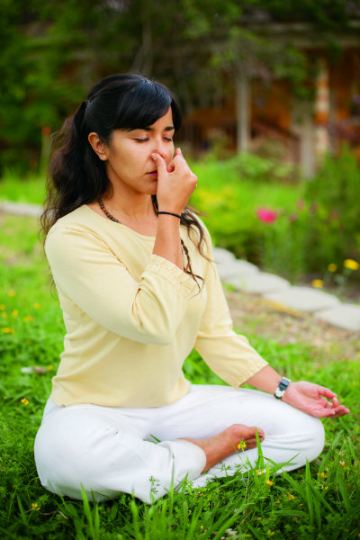
  • Alternate Nostril Breathing
  • Balances prana, mind and emotions
  • Increases pranic energy and overall vitality
  • Leads to mental and emotional health

Thirdly, you can purify the Manomaya kosha through meditation, positive thinking, proper behavior, karma yoga (selfless service), bhakti yoga (devotion), yamas and niyamas (yogic ethics). The Manomaya kosha is the mind, emotions and the senses, and in it you also have the subconscious.

Dhyana – Meditation
  • Connects us with a Reality beyond thoughts and emotions
  • Brings inner strength and peace of mind
  • Provides clarity of purpose in life
  • Increases concentration
Positive Thinking
  • Being aware of negative thoughts
  • Replace negative thoughts with positive ones
  • Practice positive affirmations
  • Over time eradicate negative and wrong thinking
Yamas and Niyamas
  • Ethical foundation of Yoga
  • Yamas include: Non-violence, truthfulness, non-stealing, chastity, and non-greed
  • Niyamas include: purity, contentment, austerity, scripture study, and surrender of the ego
  • Purifies the mind and the heart, removes selfishness

A plate of delicious, organic, vegetarian food at the Sivananda Yoga Farm.
Bhakti Yoga
  • Sublimates the emotions to devotion
  • Opens the heart
  • Surrender to God
Karma Yoga
  • “Do your best, surrender the rest”
  • Let go of attachments to results of action
  • Purifies the heart and the ego
  • Overcome likes and dislikes
  • Gain a flexible mind

    Fourthly, in order to purify the Vijnanamaya kosha, you have to purify the intellect and ego. In order to purify the ego you need get the selfishness out of the way through selfless service or Karma Yoga.  Morever, you can purify the intellect through self inquiry, jnana yoga techniques, and meditation.

    Jnana Yoga
    • The Study of Vedanta (Yoga Philosophy)
    • Highest level of knowledge
    • Knowledge passed down by Rishis or enlightened sages
    • Teaches unity of life
    • Proclaims the common Self in All
    • The limited ego or “little s” self makes you feel separate
    • Your true nature, or “Big S” Self is one with everything
    Self Inquiry
    • Self inquiry is a Jnana Yoga technique
    • Always inquire: “Who am I?”
    • Assert the you are Brahman, the imperishable supreme soul
    • Brahman is one with everything
    • Brahman is Sat (existence) Chit (knowledge) Ananada (bliss) absolute
    • Happiness is your true nature

    In order to practice Jnana Yoga and self inquiry, you must always ask “Who Am I?”. In addition you negate any attachment to the limited, illusory world or false sense of self. Meditation will show you that the intellect is also limited.

    Eventually with practice you will know the intellect is limited because you have the experience of the absolute, infinite, primordial Self. This experience is known as Samadhi. 

    Finally, through Samadhi you transcend the Anandamaya kosha. Meditation already leads you to anandamaya kosha, but your view of the Self is still being obstructed by a thin veil of spiritual ignorance.

    The thin veil of spiritual ignorance is burned when you experience Samadhi, or complete absorption of the mind. Only at that time do you know that the reality is more than the anandamaya kosha, and you go beyond that kosha and merge with the Supreme.

    Conclusively, the four paths of yoga lead to the unveiling of the five koshas and heal on a spiritual, mental and physical level. The four paths of Yoga are karma yoga, bhakti yoga, raja yoga (which includes Hatha Yoga) and jnana yoga.

    In other words, practicing the five points and the four paths of yoga will lead the three bodies to be healed. When you remove spiritual ignorance,  you come closer your True Nature. That is to say you experience spiritual, mental and physical health.

    Self-Realization

    The classical Yoga teaching is always about Self-realization, with nothing else but that realization as the end goal. However, spiritual ignorance makes us believe ourselves to be something other than Self, which is when we are identifying with the vrittis (thought waves).

    Alternately, we identify with our thinking in the mind and then the thinking becomes solidified and it manifests as karma. After that, the soul is born in the physical body in order to work through solidified karmic tendencies that come from the spiritual ignorance in the first place.  

    For the healing aspect of yoga, we have to go into the deep root cause of the wrong thinking in the first place. Because of this, Yoga primarily focuses on spiritual progress. In order for spiritual progress to take place, there must be removal of the impurities in all three bodies. 

    © Swami Sitaramananda 2018 – No part of this article may be reproduced in any form without the written permission of the author.
    Yoga Teacher Training Course

    Check out our 200-hour Yoga Alliance certified Yoga Teacher Training Courses offered twice a year in California, 3x in Vietnam, once in China and once in Japan.

    Foundational Courses

    Choose from upcoming courses for beginners and intermediate level students.

    Yoga Vacation

    Rejuvinate your body and mind. Experience and progress with daily Yoga classes. Learn the 12 basic asanas and pranayama. Enjoy daily meditation, chanting, and organic vegetarian meals.

    Rejuvenate Your Being

    A Yoga vacation is an ideal getaway to change perspective towards one’s life and become healthier, more relaxed and connected.

    Spiritual Guidance

    Spiritual Guidance

    Spiritual Guidance

    by Swami Sitaramananda

    Question:  How would I benefit from living in a spiritual community following a guru lineage?

    Answer:  The guidance of a spiritual community following a guru lineage is essentially the teaching of life lessons. The education is the grace of the guru helping us to destroy our illusions. The daily training in the ashram requires us to go beyond bodily needs, and likes and dislikes. It requires us to reach out to this universal storehouse of energy using our will, our positive mind and our devotion.

    Satsang with swamis by the Yoga Farm Pond

    Learning is Every Day

    Everyday we learn that we are one, no matter what, a realisation achieved only by diving deep within, by taking recourse to those skills learned in satsangs and lectures. We learn to discriminate between the real and the unreal, the Self and the not-Self, the permanent and the impermanent, that which lifts us up and that which brings us down. We learn dispassion, compassion, forgiveness, control of the mind and the emotions. We learn to see the Self in all.

    In the ashram we learn to turn within to discover our inner motives, our emotions, our desires, our contra – dictions and our expectations. 

    We learn dispassion, compassion, forgiveness, control of the mind and the emotions.

    Turning Within

    I have learned that for a young spiritual mind to develop a powerful sense of discrimination, it needs to be protected from outside influences. In this way the mind can strengthen by leading a simple and focused life, away from distractions, overload of useless information, and emotionalism. We learn that to care for the world we need to avoid the world drama, and to concentrate only on raising our own vibrations. By doing so we purify our minds.

    Swami Vishnudevananda giving spiritual guidance to his students
    Swami Dharma teaching to a group of students

    Seeing the Bigger Picture

    Living in the wake of the universal mind of the guru allows for us to feel, in a very direct way, that the world is our family. The guru is concerned about the welfare of the whole world, not only our little corner. As part of an international organization we come into contact with an array of cultures, forcing us to break down any pride we might have in nation, race or gender. We learn to serve all and to find joy in serving all.

    A purified mind functions in a different way, not propelled by impulses and emotions, nor governed by intellect, but moved by intuition. The intuitive mind makes no mistakes, since it is coming from a higher source.

    Conclusion

    Life in the gurukula system is intense and rich. It is not running away from life, but facing it. It is a life of purification. It is not about our separate lives or identity. It is beyond our own ideas. Faith is the final recourse, faith in the teachings of the guru as well as faith in oneself and one’s capacity to attain Self-realisation.

    Upcoming Yoga Teacher Training Course Opportunities>>

    Karma Yoga (Volunteering) Opportunities >>

    © Swami Sitaramananda 2018 – No part of this article may be reproduced in any form without the written permission of the author.
    Follow us

    [et_social_follow icon_style=”slide” icon_shape=”rounded” icons_location=”top” col_number=”2″ counts=”true” counts_num=”0″ outer_color=”dark”]

    Subscribe to the Yoga Farm Newsletter for regular updates, articles, and upcoming events.

    Suffering Can Be Our Greatest Teacher

    Suffering Can Be Our Greatest Teacher

    Suffering Can Be Our Greatest Teacher

    by Swami Sitaramananda

    Yoga is a scientific method to alleviate suffering and help people find the Truth and Essence in the teachings of all religions.

    Understanding Emotions

    Emotions are a major cause of human suffering and are the root causes of many kinds of diseases. Emotions come from deep samskaras (imprints in the mind). The mind carries these emotional grooves and habits.  Some examples are:

    • Deep experiences of attachments and losses, and as a result we experience the consequent emotions of grief, fear and sadness.
    • Habits of desires lead to the consequent emotion of anger when the desires go unfulfilled.
    • Memory of the insecurities of the past and our built-in survival instincts bring about anxieties, competition, greed, and jealousy
    • Repeated mistake between love and lust brings in emotional confusion and fear rather than trust and causes swinging patterns between hatred and love.

    These experiences are written in our subconscious mind and they repeat themselves, becoming imprints. These imprints project themselves out, making the mind restless.

    The emotional scars and traumas cannot be resolved through talking them out or replaying them in the mind.

    We need to go deeper than what they are and change the paradigm, no longer basing ourselves on our ego/self but switching to the Atman/Self — our pure core consciousness that has no scar or imprint and is completely free. 

    Suffering can be a stepping stone to spiritual breakthrough.

    Yoga practice such as the 5 points of yoga comes in handy during times of suffering by offering systematic methods to get out of the box and move into a new paradigm of consciousness. As Einstein once said, “No problem can be solved from the same level of consciousness that has created it.”

    Healing Emotions

    In addition to the numerous medical benefits of Yoga, we can find through Yoga a spiritual approach to healing the psyche and the emotions. Yoga understands and explains the ups and downs and highs and lows of the mind, the samskaras, and the deep karma they come from.

    In Yoga philosophy when we talk about suffering, we talk about karmic lessons, and we are talking about samskaras or karmic imprints.

    Suffering in our lives can point out the areas or tendencies we need to focus on to evolve so we do not repeat the same mistakes. In other words, we “work through the karma“.

    We can be proactive instead of reactive as we take up the opportunity to alleviate our suffering by using the scientific and systematic methods of Bhakti Yoga and Raja Yoga.

    These methods will calm the mind, convert the emotions and allow us to experience the Truth about ourselves. Patanjali, the father of Yoga, said in the Yoga Sutras, “The misery that has not yet manifested should be avoided.”

    Thus devotional practices and meditation practices, initiated by suffering, can blossom into awareness of our own karmic tendencies and samskaras and our willingness to transform our emotions by practicing pure love.

    © Swami Sitaramananda 2018 – No part of this article may be reproduced in any form without the written permission of the author.
    Yoga Teacher Training Course

    Check out our 200-hour Yoga Alliance certified Yoga Teacher Training Courses offered twice a year in California, 3x in Vietnam, once in China and once in Japan.

    Foundational Courses

    Choose from upcoming courses for beginners and intermediate level students.

    Yoga Vacation

    Rejuvinate your body and mind. Experience and progress with daily Yoga classes. Learn the 12 basic asanas and pranayama. Enjoy daily meditation, chanting, and organic vegetarian meals.

    Rejuvenate Your Being

    A Yoga vacation is an ideal getaway to change perspective towards one’s life and become healthier, more relaxed and connected.

    Videos – Yoga of Relationships

    Videos – Yoga of Relationships

    Yoga of Relationships

    by Swami Sitaramananda

    With the mind harmonized by Yoga he sees the Self abiding in all beings, and all beings in the Self, he sees the same everywhere.

    – Bhagavad Gita


    [et_social_follow icon_style=”slide” icon_shape=”rounded” icons_location=”top” col_number=”4″ counts=”true” counts_num=”0″ outer_color=”dark”]

    This will close in 33 seconds