by Swami test | Feb 20, 2016 | Bhakti Yoga, Raja Yoga
This article has been taken from the new Yoga Life book, published late last year. This is a collection of articles that come from the YOGALife magazine published by the Sivananda Yoga Vedanta Centers from 1970 to 2012. Most of these articles are written by Swami Vishnudevananda or are transcipts from his talks.
What is the oldest known method of meditation?
The oldest and most scientific method is Raja Yoga meditation. It is a steady discipline based on five principles: proper exercise, proper breathing, proper relaxation, proper diet and positive thinking and meditation.
Raja Yoga incorporates many techniques such as postural correction, breath control and sound. It is not just a simple exercise in relaxation, but a way to complete, lasting peace and fulfillment.
What is a Mantra?
A mantra is a mystical energy encased in a sound structure, which steadies the mind and leads it into the stillness of meditation, a state which is actually beyond the minds’s comprehension.
Where do mantras come from?
They are handed down by the ancient sages, who had Self-Realization for the first time using a particular mantra.
A mantra cannot be “Concocted” especially for the individual, as claimed, since mantras already existed in Vedic times, just as gravity existed before Newton discovered it.
How many mantras are there?
Although there are innumerable mantras, only a handfulare suitable for meditation. They fall into six categories. The first four, deity mantras, and the fifth, nirguna or abstract mantras, can all be chosen to suit particular personalities.
Finally there are bija mantras, which incorporate a one syllable “seed” sound, or “bija” and should only be used by students of advanced purification who abstain from meat, alcohol, drugs, tobacco, etc. There are also mantras for neutralizing poisons, snake bites, etc. and for exorcising spirits, but these are of a lower nature and are not considers for meditation.
Who can initiate mantra?
Only true spiritual masters of their chief disciples, who have served them throughout many years in intense Yogic practices.
Should a mantra be sold?
No. It is against all spiritual and psychic rules. If a mantra is sold it lacks the psychic benefits of true initiation and there will be negative karmic reaction for the teacher who initiates for profit.
Are there any secret mantras?
Not all mantras are known to all spiritual masters and can be found in ancietnt Vedic and Tantric texts and spiritual books, for instance Japa Yoga by Swami Sivananda.
No spiritual or scientific rule prevents you from discussing you mantra. Tests have conclusively shown that there is no charge in the pulse, heart and breathing rate of meditator after he has divulged his mantra. For your own convenience, however, you woul dbe wise to discuss it only with those who are spiritally inclined. IF you are told to keep your mantra secret, it may perhaps be to disguise its lack of authenticity or through fear of exposure.
What is real meditation?
True Raja Yoga meditation is not simply a relaxation exercise. Ultimately, it will help you to attain liberation from the clutches of the lower senses and mind and to reach absolute, unalloyed bliss.
By definition, meditation must be transcendental, the word being used not as an advertising slogan but in an attempt to convey the real beauty of meditation, in which all fears, desires, longings and negative emotions are transcended and the meditator reaches a transcendental or supra mental state in which he is able to identify with his all-blissful Self. In the transcendental state, there is no awareness of body, mind or duality. The knower becomes one with the knowledge and the known, and the experiencer one with the experience and the experienced.

by Swami test | Jan 10, 2016 | Karma Yoga
Karma Yoga or Selfless service is the foundation for sadhana (spiritual practice)
Question: Should Karma Yoga always take priority over pranayama and asanas?
Swamiji: When I was doing my pranayama, suddenly I heard a cry. I did intense pranayama along with meditation. Suddenly, I am disturbed by a desperate cry of: “Help! Help! Help!” [Swamiji then does loud kapalabhati pumping]. Lord, you help them. [Much laughter]. I didn’t hear, it’s not my problem. [Swamiji laughs].
That’s not pranayama. What’s the purpose of pranayama? What’s the purpose of meditation? It doesn’t matter what sadhana you do: asana, pranayama, meditation, japa, etc. What’s the purpose of all of these?…..
[ANSWERS FROM THE AUDIENCE IN QUOTES]
“To give you energy so that you can serve. To utilize that energy for appropriate and needful purposes.”
“To attain Yoga.” That’s a better answer.
“To get closer to God.” “To become enlightened.” “To purify the mind so you can attain the goal.” I need a better answer.
“To perform any need that is around.” Who cares about other’s needs, I’m just happy to do pranayama.
“To destroy your ego.” A little better.
“Learning to give.” Yoga is uniting with all. There is no individual self. There is only one Self, one God. I and my Father are One. I am in you. You are in me. I am He. Who said that?
“Jesus.” Yes, Jesus taught the same Eastern philosophy. Instead of repeating, “I and my Father are One,” we say “Aham Brahmasmi.”
The man calling for help is me, my own Self. So if I just go on with my pranayama, then I am not identifying with that needy person. If you still didn’t understand….
I have got two hands and ten fingers. Which hand do I use more? Left or right? I’m a right-handed person. So which hand do I use more? Right hand, is it not? You know that I love my right hand more than my left hand. Not only that, but my right hand is always angry with the left hand. He says, “You lazy stupid, I do all the work and you’re lazy. You don’t do anything but just a little work.” All the time the right hand is fighting with the left because the left hand is lazy. Now, suddenly the right hand got injured. The left hand was happy. He thought, “Ah, you stupid fellow. You see, you always scolded me. It’s good what’s happened to you.” Is that what the left hand will say? What will the left hand do now that the right hand is injured? It will help to bandage the right hand and then take over all of the right hand’s work. How did this transformation take place? Before he used to be the lazy hand? Now that the right hand is not working, automatically the left hand will perform all of the duties the right hand used to do to help this body. Even though it cannot do so as efficiently as the right hand, it’ll do it—will it not? Or, will it keep quiet like before saying that this is not his job?
“No, because it has to survive.” That’s correct, the left hand’s survival depends on the survival of the whole body. So, in reality, there is no difference between right hand and left hand. Neither hand gets credit afterwards for doing a great job. The right hand does not send a message: “Thank you left hand, at last you are doing a good thing for me.” They do not send get well cards or thank you cards to each other.
So, the purpose of life is to unite ourselves. Prejudices like: “I am different from you, because you’re English and I’m Indian;” or “You’re Catholic and I’m Protestant;” or “You’re a Muslim and I’m a Jew;” or, “You’re white and I’m black” are distinctions existing only in your mind. Until you remove these distinctions there will be no unity. To cultivate this experience of oneness is called Yoga.
So the question is: Which is important? Should Karma Yoga always take priority? So, I’m doing pranayama with the right hand. [Swamiji demonstrates anuloma viloma.] The left hand is burnt. What is the priority now? Do I continue with my pranayama or do I have to take care of the left hand? The priority is pranayama is it not? [Swamiji chuckles.] Can you imagine the right hand saying, “This is my pranayama,” and letting the left hand get burnt? Who’s going to take care of the body? Do you see? So, think in these terms.
Karma Yoga is not just working. Work is worship. Dedicate it to God. This does not mean that you must work all the time. A bulldozer also works. A bulldozer does more work in less time without expecting anything in return. It’s a good Karma Yogi, is it not? Yes, what does a bulldozer get for its work? Oil and lubrication and some gas—that’s all. It will not get liberation. So with a donkey, a donkey serves. A washerman in India carries the dirty clothes to wash in the river on the donkey’s back in the morning and carries them back home in the evening. The donkey gets what? [Audience] “Food.” He will get just a carrot and possibly a few cashews once in a year. Otherwise, just hay and oats are possible. Or, if we don’t have hay and oats, he must go and eat by himself wherever he can find grass. Even after eating grass from the roadside, he still serves his master. So the donkey will be getting liberation, will he not?
Karma Yoga is not simply action. It is removing the idea of agency, the thought, “I am the doer.” That must go. You are not the doer. We are not the doer. Within all action, there is infinite power, God’s power working. Can you see? That power makes this body move. Karma Yoga removes the egoism, “I am the doer.” Someone just called, “Help, help, help.” So who is calling? God is calling to test you.
YOGALife magazine, Fall 2002
by Swami test | Sep 28, 2015 | Proper Diet
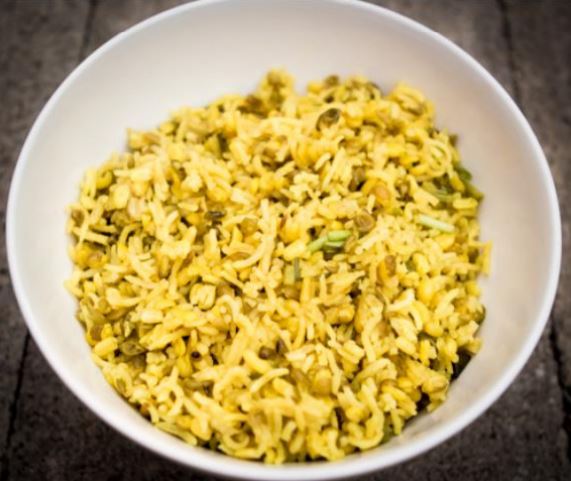
moong dal khicharee recipe
PREP TIME COOK TIME AUTHOR CUISINE SERVES
30 mins 10 mins Bharata Surya Ayurvedic 4
Ingredients:
(measuring cup used, 1 cup = 250 ml)
1 cup Basmati white rice
1 cup yellow or green split mung dal
1/4 tsp. brown mustard seeds
1/4 tsp. cumin seeds
1/4 tsp. coriander seeds
1/4 tsp. each cumin, turmeric, paprika powders
1/8 tsp. hing (Asafoetida)
3-4 curry leaves (optional)
1/2 lime or lemon
1-2 tsp. salt
1 tbsp oil (sunflower, canola or ghee)
Handful chopped cilantro (optional)
4-5 cups of water
Ghee (optional)
Procedure:
1. Wash the rice and dal together until water runs clear.
2. In a pot, heat rice and dal with water on medium-high for 10 minutes.
3. Add cumin, turmeric, paprika powders and salt.
4. Stir and cover. Keep on low flame for 5-7 minutes.
5. In a separate saucepan, add oil, mustard seeds, cumin seeds and coriander seeds.
6. When they pop, add curry leaves and hing. Add the mixture to the main pot.
7. keep on sim or low flame to simmer the khichdi till you get the right consistency.
8. If the khichdi becomes too thick, then add some water and stir well.
9. Once the khichdi is cooked then top it with ghee while serving. (Optional Step)
10. Sprinkle lemon and garnish with cilantro before serving
by Swami test | Oct 20, 2014 | Proper Diet
A delightful alternative to turkey that works well with all the traditional trimmings.
VEGGIE-KEY – serves 8 to 10
Group I – Bean and Grain Mixture
- 3 cups cooked lentils (retain excess cooking water) (1 cup dry)
- 3 cups cooked brown rice (slightly mushy)
- 1 cup wholewheat bread, crumbled
- 1/2 cup rolled oats or cornmeal (uncooked)
- 1/4 lb. butter, melted
- 1 cup walnuts, finely ground
- 1/2 cup sunflower seeds, finely ground
- 1/3 cup tamari
Group II – Garbanzo Beans
2 cups cooked garbanzo beans (optional) (2/3 cup dry, cooks in 2 hours)
(retain excess cooking water)
Group III – Stuffing Mixture
- 1 tablespoon mustard seeds
- 4 tablespoons butter
- 1 bunch celery, coarsely chopped
- 6 cups wholewheat breadcrumbs
- 1 teaspoon thyme
- 1/2 teaspoon savory
- 1 tablespoon sage
- Dash of black pepper
- 2 teaspoons tamari
- 8-ounce can of water chestnuts, thickly sliced (optional)
- 1 cup mung bean sprouts (optional)
Group IV – Tofu Covering
- 8 pieces of tofu, fairly firm
- 1/4 lb. of butter melted
- paprika
* * * * * * * *
Step One: Combine all ingredients in Group I. Make sure all ingredients are well mixed together. Use your hands or a large mixing spoon. You could use a blender or food processor, but it might make the mixture too liquid. Set mixture aside.
Step Two: In a separate bowl, mash garbanzo beans into a thick, mushy consistency. (This can be done in a blender or food processor with a minimum amount of liquid; use water beans were cooked in.)
Step Three: Assemble Group III ingredients as follows: Melt butter, sauté mustard seeds until they pop; add celery and saute until soft. Add breadcrumbs and enough water to moisten (use water leftover from cooking beans). Cook for another 5 minutes, then add seasonings. Remove from heat and add water chestnuts and bean sprouts, if desired. (Note: When adding water to mixture on stove, be careful to add it slowly and check to see if enough has been added a minute or two later, since the bread will take a brief time to absorb the liquid.)
Step Four: Putting it all together: Put a thin layer, about 1/2″ thick of the bean and grain mixture on a greased baking pan. Then mound handfuls of the stuffing mixture on top of this, patting into a rounded mound, or any other desired shape. Then take handfuls of the remainder of the bean and grain mixture and pat between hands until flat, and then place over the stuffing, sealing it in entirely. Then take the garbanzo bean mixture and, in a similar fashion, place over bean and grain mixture.
Step Five: Moving on to Group IV ingredients: Take the tofu pieces and cut thinly widthwise, place tofu on top and all around mounded ingredients, using toothpicks to hold it in place. Pour melted butter onto the tofu (or spread with a pastry brush) and sprinkle with paprika. Cover with aluminum foil and bake at 350 degrees for 45 minutes. Then remove foil and bake another 15 minutes so tofu can slightly crisp, Serve with vegetarian gravy and all the Thanksgiving fixings.

by Swami test | Oct 20, 2014 | Permaculture
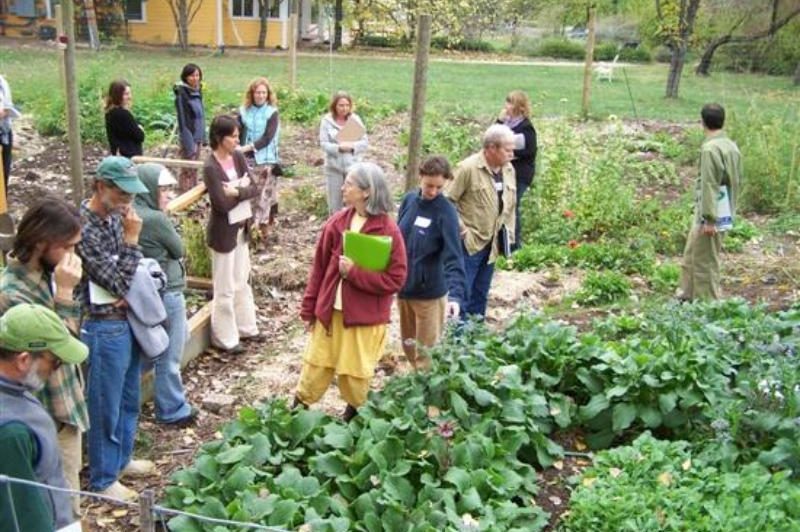
“Permaculturists can grow food just about anywhere, repair environmentally damaged lands, design lovely and long lasting green-buildings, produce power, run successful, people-oriented businesses,and build authentic community -all by using the same fundamental permaculture principles and applying the three Permaculture Ethics:
Care of People – Care of the Earth – Share the Surplus.”
Permaculture is a creative and artful way of designing our lives, where wastes become resources, productivity and yields increase, work is minimized, people and nature are preserved – all by thoughtful planning and a respectful approach to life. Thus embraced, we create an environment where all may thrive for untold generations.
We as humans have the ability to re-design the world we live in. All it takes is desire, know how, will, and time. Even if it takes 50-100 years, the change can begin with each one of us right now and the effects of our work can have beneficial consequences for generations to come. (Permaculture at the Sivananda Ashram Yoga Farm)
Consider this: The ratio of tensile strength-to-density of spider silk is approximately 5 times greater than that of steel, while a single thread, wrapped around the earth, would weigh only 1 pound (16 oz.).
Also, the amount of sunlight that intersects our earth in 40 minutes is equivalent to the total, global-annual-consumption of energy (400 quads).
Permaculturists look at facts such as these and ask the question, ‘If there is that much energy available, and if a spider can make something so strong simply by eating crickets, what kind of world can we create for ourselves and our neighbors if we work hand-in-hand with the natural systems surrounding us?’
The goal of permaculture is to create harmonious relationships with all aspects of our life, to learn how to live abundantly well without hurting or polluting our surroundings and actually leave the planet in better condition than when we arrived on it.
To be clear, permaculture is a lot more than just food production. A thorough study of permaculture invites us to look at our homes, our uses and sources of energy, our methods for providing food and comfortable shelter, our work, our relationships with others, and even our relationship with ourselves.
As in Yoga, permaculture is essentially a spiritual approach to living consciously, harmoniously and healthfully on the planet. We can heal this planet. We can live lightly and we can live well. We can each make a difference… a big difference.
‘For practitioners of Yoga, permaculture can offer a practice in which our external actions express the core yogic teachings of the unity of all creation and the yamas and niyamas. For practitioners of permaculture, Yoga offers an understanding of our basic spiritual nature which underpins all our actions.’
— Swami Omkarananda
‘Sampling the Yoga tradition at this unique yoga ashram will help students better appreciate the connection between spirit and the natural elements that surrounds us at all times.’
— Bill Wilson
Nationally Recognized Permaculture Instructor
Follow us
[et_social_follow icon_style=”slide” icon_shape=”rounded” icons_location=”top” col_number=”2″ counts=”true” counts_num=”0″ outer_color=”dark”]